Writer (Option Writer)
An option writer is the seller of an options contract who collects an upfront cash premium and assumes the contractual obligation to buy or sell the underlying asset at the strike price if exercised.
What Is an Option Writer?
An option writer (also known as an option seller or grantor) is the market participant who creates and sells an options contract to open a new short derivative position (Sell to Open).
In exchange for assuming this contractual obligation, the writer collects an upfront, non-refundable cash premium from the option buyer. In return, the writer forfeits all optionality and becomes legally obligated to perform if the buyer decides to exercise the contract:
- Call Option Writer: Obligated to deliver (sell) the underlying asset at the agreed strike price ($K$) if the call option expires in-the-money.
- Put Option Writer: Obligated to purchase (buy) the underlying asset at the agreed strike price ($K$) if the put option expires in-the-money.
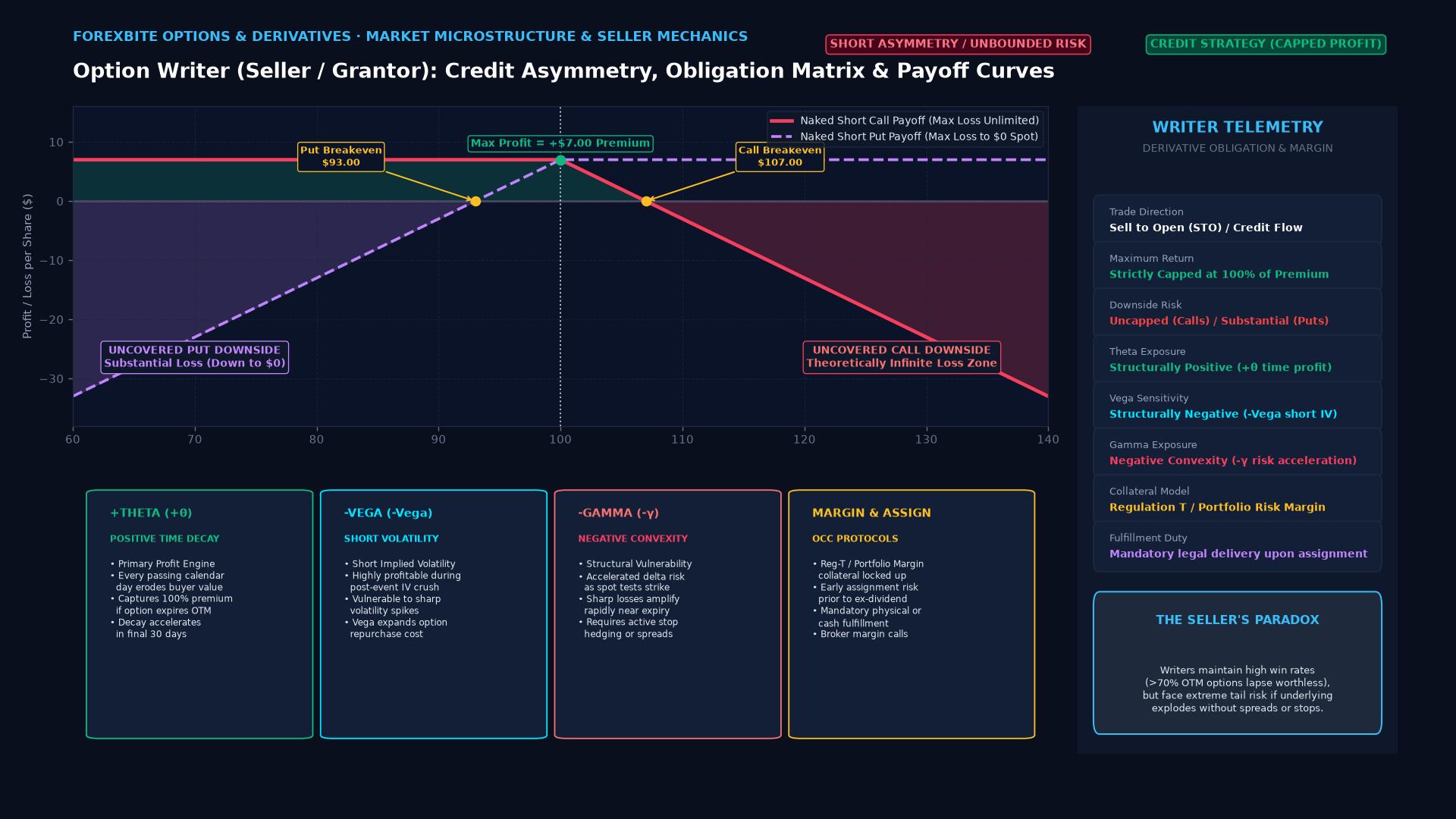
Quantitative Mechanics & Greek Profiles
Option writing is structurally a credit strategy. The writer’s mathematical profile is defined by an asymmetry where maximum profit is strictly capped at the premium collected ($P_{\text{prem}}$), while risk exposure is heavily convex to the downside.
Payoff Equations at Expiration ($T$)
-
Short Call Payoff: $$\Pi_{\text{Short Call}} = P_{\text{prem}} - \max\left(0, S_T - K\right)$$ $$\text{Break-Even} = K + P_{\text{prem}}$$
-
Short Put Payoff: $$\Pi_{\text{Short Put}} = P_{\text{prem}} - \max\left(0, K - S_T\right)$$ $$\text{Break-Even} = K - P_{\text{prem}}$$
The Option Writer’s Greeks Portfolio
- Positive Theta ($\Theta > 0$): Time decay is the primary driver of profitability for the writer. Every passing day erodes the option’s extrinsic time value, which flows directly into the writer’s unrealized profit.
- Negative Gamma ($\Gamma < 0$): As the underlying moves against the writer, delta accelerates unfavorably, compounding losses at an exponential rate.
- Negative Vega ($\nu < 0$): The writer is structurally short volatility. An unexpected spike in implied volatility inflates option prices, resulting in mark-to-market losses.
Execution Strategies: Covered vs. Uncovered Writing
| Strategy | Collateral / Underlying Backing | Maximum Upside | Maximum Downside Risk | Regulatory Margin Burden |
|---|---|---|---|---|
| Covered Call | Writer owns 100 shares of underlying per contract | Capped at Strike + Premium | Substantial (if underlying stock plunges to $0) | Zero additional cash margin required |
| Uncovered (Naked) Call | No underlying shares owned | Capped at initial Premium | Theoretically Unlimited (Underlying can rise indefinitely) | Extreme; requires high-tier margin clearance |
| Cash-Secured Put | 100% cash set aside ($K \times 100$) | Capped at initial Premium | Substantial (Downside to strike zero) | Zero additional cash borrowing |
| Naked Put | Backed by fractional margin equity | Capped at initial Premium | Substantial ($K - P_{\text{prem}}$ per share) | Standard Reg T / Portfolio Margin requirements |
Real-World Case Study: The OptionSellers.com Collapse (November 2018)
The lethal risks of writing uncovered options were demonstrated in November 2018 during the catastrophic liquidation of hedge fund OptionSellers.com, led by veteran commodities trader James Cordier.
Anatomy of a Naked Option Writing Blowup:
1. Strategy: The fund managed over $150 million for high-net-worth clients, generating income by writing deep out-of-the-money naked call options on US Natural Gas and Crude Oil futures.
2. The Shock: On November 14, 2018, unexpected early winter forecasts triggered an acute supply squeeze. Natural gas futures exploded by more than 20% in a single trading session.
3. The Gamma Trap: The deep out-of-the-money short call options rapidly moved in-the-money. Negative gamma exploded the fund's short delta exposure, requiring astronomical margin.
4. Total Wipeout: Clearing brokers forcibly liquidated the short options into an illiquid market at catastrophic prices.
5. The Result: The fund lost 100% of its $150M capital and left clients owing tens of millions of dollars in personal margin debt directly to clearing brokers.
This disaster highlighted why institutional risk managers strictly cap unhedged short gamma and vega exposures through stop-loss protocols and defined-risk spreads.
Frequently Asked Questions (FAQ)
Why do professional traders write options if downside risk is theoretically unlimited?
Professional traders and quantitative funds write options because options are historically overpriced relative to realized volatility—a phenomenon known as the volatility risk premium (VRP). Statistically, a large majority of out-of-the-money options expire worthless. By writing options with positive theta and managing tail risk using disciplined stop-losses or defined-risk spreads (like iron condors or credit spreads), institutional writers capture consistent income from time decay.
What is the difference between a covered call writer and a naked call writer?
A covered call writer owns the underlying stock (100 shares per contract) in their portfolio. If the stock price skyrockets past the strike price, the shares they already own are simply delivered to satisfy the assignment, completely eliminating out-of-pocket cash loss. A naked call writer does not own the stock; if assigned, they are forced to buy the stock in the open market at the prevailing high market price, incurring immediate, unhedged cash losses.
How do clearing brokers handle margin calls for option writers?
Clearing houses (like the OCC) calculate real-time margin requirements using risk-based algorithms like TIMS or SPAN. If market moves cause an option writer’s unrealized losses to exceed their maintenance margin, the broker issues an immediate margin call. If the writer fails to deposit additional collateral within minutes or hours, the broker has the legal right to immediately close out the positions at market prices to protect the clearing house against default.
Ready to trade forex?
Open a free demo account with a regulated broker. Practice with virtual funds before risking real money.