Cambodian Riel (KHR)
The Cambodian Riel (ISO: KHR) is the legal currency of Cambodia, functioning within a heavily dollarized dual-currency economic regime managed by the National Bank of Cambodia (NBC) via a tightly stabilized crawl against the US Dollar.
What Is the Cambodian Riel (KHR)?
The Cambodian Riel (ISO code: KHR) is the official sovereign currency of the Kingdom of Cambodia, issued and regulated by the National Bank of Cambodia (NBC). The riel is historically subdivided into 100 sen, though hyperinflation in the late 20th century rendered fractional subdivisions obsolete.
Cambodia operates under one of the world’s most pronounced dual-currency monetary regimes. Following the total abolition of money during the Khmer Rouge regime (1975–1979) and subsequent United Nations peacekeeping missions in the early 1990s, the United States Dollar (USD) became the de facto primary medium of exchange, unit of account, and store of value. Today, the US Dollar accounts for over 80% of total bank deposits and wholesale commercial transactions, while the Cambodian Riel circulates primarily for small retail purchases, rural agriculture, and domestic tax remittances.
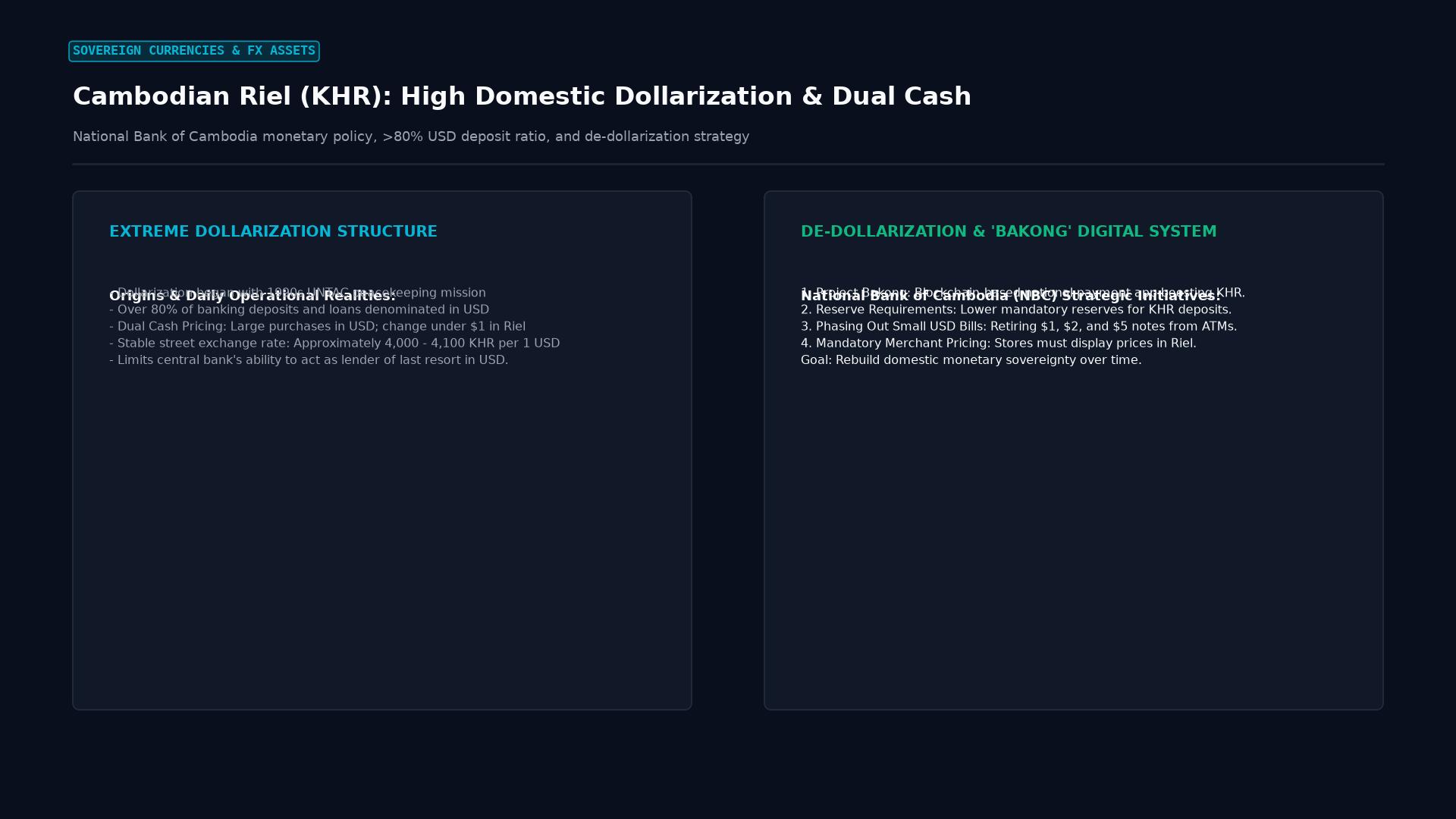 Figure: Dual-currency economy: >80% bank deposit dollarization, cash retail change dynamics, and National Bank of Cambodia Project Bakong de-dollarization reforms.
Technical Mechanics & The Stabilized Exchange Rate Regime
Because Cambodia’s economy is heavily dollarized, the National Bank of Cambodia cannot conduct independent conventional monetary policy (such as setting domestic interbank interest rates). Instead, the NBC’s primary operational focus is maintaining exchange rate stability against the US Dollar through direct open-market foreign exchange auctions.
The Stabilized Crawling Band
The NBC intervenes continuously in the interbank foreign exchange market, buying or selling US dollars against the riel to anchor the nominal exchange rate within a tightly controlled target corridor:
$$\text{USD/KHR} \in [4,050, 4,150]$$
If domestic demand for riels declines (putting depreciation pressure on KHR), the central bank conducts USD selling auctions, absorbing excess domestic riel liquidity to defend the exchange rate floor:
$$\Delta \text{Reserves}{\text{NBC}} = -\Delta \text{USD}{\text{auction}} \implies \Delta M_{\text{KHR}} < 0$$
De-Dollarization Strategies & Project Bakong
To restore national monetary sovereignty, the Cambodian government implemented structural de-dollarization policies:
- Mandatory Riel Tax Collection: All corporate and individual tax assessments must be remitted in KHR.
- Minimum Bank Lending Quotas: Commercial banks must allocate at least 10% of their total loan portfolios in Cambodian Riel.
- Project Bakong: Launched in October 2020, Bakong is the NBC’s pioneering blockchain-based interbank payment and digital wallet system, engineered to make digital KHR transactions faster and cheaper than physical cash US dollar exchanges.
Comparative Matrix: Southeast Asian Frontier Currencies
| Currency | ISO Code | Exchange Rate Regime | Degree of Dollarization | Primary Export Drivers |
|---|---|---|---|---|
| Cambodian Riel | KHR | Stabilized / Crawling Peg to USD | Severe (>80% USD deposits) | Garments, Footwear, Tourism, Agriculture |
| Vietnamese Dong | VND | Managed Crawling Peg to USD | Low (<10% dollarized) | Electronics, Machinery, Textiles |
| Lao Kip | LAK | Managed Float | Moderate (Heavy Baht & USD use) | Hydroelectric Power, Mining, Timber |
| Myanmar Kyat | MMK | Managed Float (Heavy parallel gap) | Moderate | Natural Gas, Jade, Garments |
Real-World Case Study: Defending the Riel During the Post-Pandemic Dollar Surge (2022–2023)
In 2022 and 2023, the US Federal Reserve executed an aggressive monetary tightening cycle, elevating the US Dollar Index (DXY) to 20-year highs. Across Southeast Asia, currencies including the Vietnamese Dong and Lao Kip plunged.
The NBC Foreign Exchange Intervention:
1. The Pressure: Higher US interest rates attracted global capital, putting acute depreciation pressure on the Cambodian Riel toward 4,180 KHR/USD.
2. The Intervention: To preserve purchasing power and prevent imported inflation in domestic food staples, the National Bank of Cambodia launched an aggressive series of foreign exchange auctions.
3. Liquidity Deployment: Between July and October 2023, the NBC injected over $200 million from its $18 billion foreign exchange reserves directly into commercial banks and money changers, absorbing trillions of riels.
4. The Stabilization: The intervention successfully repelled speculative pressure, pulling USD/KHR back within its target comfort band near 4,090.
The operation proved that adequate foreign reserve buffers allow dollarized frontier central banks to isolate their domestic currencies from global macro volatility.
Frequently Asked Questions (FAQ)
Why is the US Dollar used so widely in Cambodia alongside the Riel?
Cambodia’s intense dollarization dates back to the early 1990s. When the Khmer Rouge regime fell, public trust in paper riels was completely shattered. During the 1992–1993 United Nations Transitional Authority in Cambodia (UNTAC) mission, the UN injected approximately $2 billion in physical US currency into the local economy to fund personnel and reconstruction. Because the dollar provided a stable store of value against hyperinflation, Cambodians universally adopted it as their primary transaction currency.
How does cash change work in everyday Cambodian retail transactions?
In everyday Cambodian retail commerce, US dollars and riels function interchangeably at an informal, standardized accounting conversion rate of $1.00 USD = 4,000 KHR. If a consumer purchases an item priced at $2.50 and pays with a $5.00 banknote, the merchant typically returns $2.00 in US dollar banknotes and 2,000 riels in local currency instead of distributing US coins.
Can international investors freely convert and repatriate Cambodian Riel?
Under the 1997 Law on Foreign Exchange, Cambodia maintains an exceptionally open foreign exchange regime with zero restrictions on international capital transfers, foreign direct investment, or profit repatriation. However, because international interbank foreign exchange markets do not actively clear KHR outside the country, multinational investors convert riels into US dollars locally through licensed commercial banks before wiring funds abroad.
Ready to trade forex?
Open a free demo account with a regulated broker. Practice with virtual funds before risking real money.