Cancel Order
A cancel order (or cancellation request) is a formal trading instruction transmitted to an exchange or brokerage matching engine requesting the immediate withdrawal and revocation of an active, unfilled resting order from the limit order book.
What Is a Cancel Order?
In electronic trading and market microstructure, a cancel order (formally designated as an Order Cancel Request) is an electronic instruction dispatched by a market participant to an exchange, alternative trading system (ATS), or electronic communication network (ECN) requesting the immediate revocation and deletion of a previously submitted, unexecuted resting limit order.
In modern electronic markets, resting limit orders provide public liquidity on the Central Limit Order Book (CLOB). As market conditions evolve—such as new macroeconomic data releases, order flow imbalances, or rapid price movements in correlated assets—liquidity providers and algorithmic traders continuously dispatch cancel requests to withdraw stale quotes before adverse order flow sweeps through their price levels.
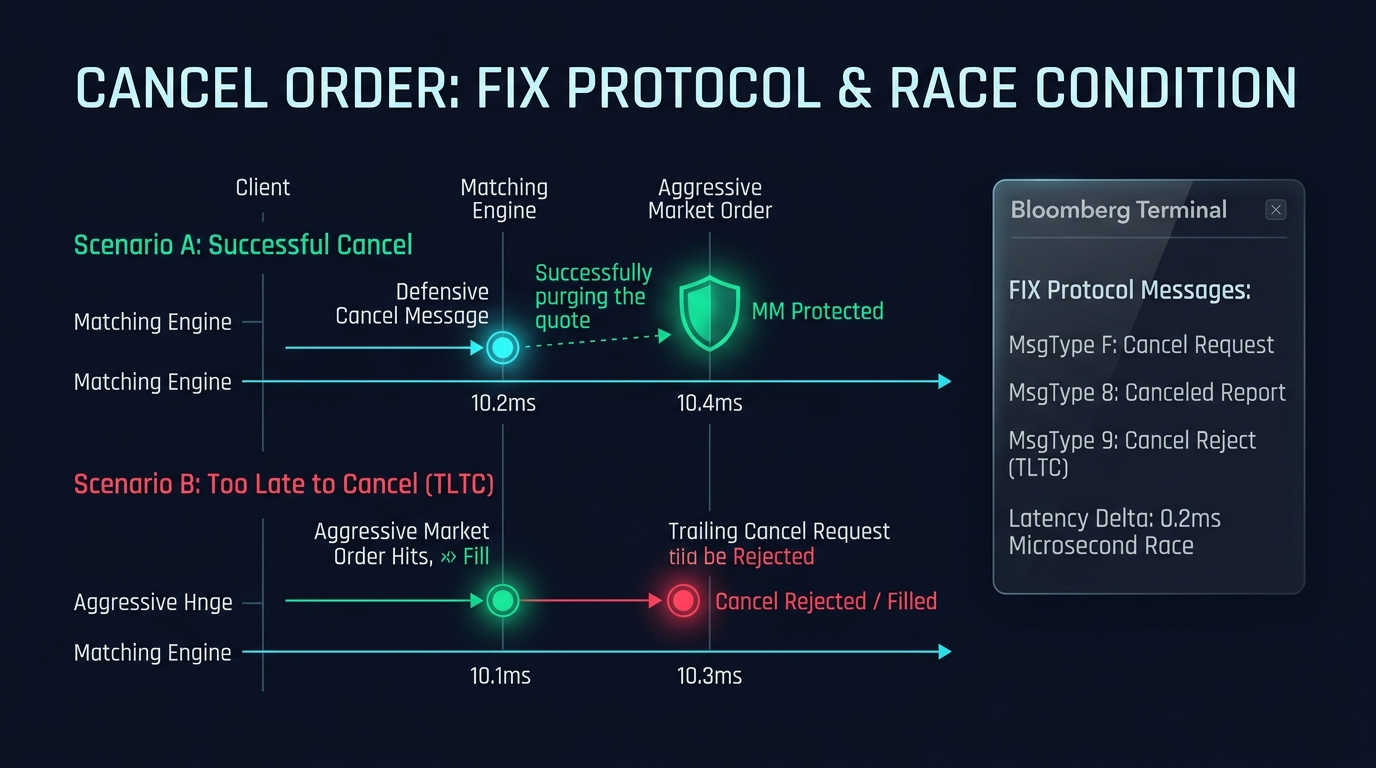
+-----------------------------------------------------------------------+
|                    THE CANCEL ORDER RACE CONDITION                    |
+-----------------------------------------------------------------------+
|                                                                       |
|   SCENARIO A: Successful Cancellation (Cancel Arrives First)          |
|   [Market Maker] ===== CANCEL MSG =====> [ MATCHING ENGINE ]          |
|   (Arrives at t = 10.2 ms)                * Order Removed from Book   |
|   [Aggressive Buyer] == MARKET ORDER ==>  * Buyer Sweeps Higher Price |
|   (Arrives at t = 10.4 ms)                * Market Maker IS PROTECTED |
|                                                                       |
|   SCENARIO B: Race Condition Lost ("Too Late to Cancel" - TLTC)       |
|   [Aggressive Buyer] == MARKET ORDER ==> [ MATCHING ENGINE ]          |
|   (Arrives at t = 10.1 ms)                * Match Executed at Limit!  |
|   [Market Maker] ===== CANCEL MSG =====>  * CANCEL REJECTED (TLTC)    |
|   (Arrives at t = 10.3 ms)                * Market Maker FILLED       |
+-----------------------------------------------------------------------+
Technical Mechanics & FIX Protocol Architecture
Order routing engines interact with institutional exchanges using the Financial Information eXchange (FIX) protocol:
Core FIX Cancellation Messages
MsgType = F(Order Cancel Request): Transmitted by the client or algorithmic engine, specifying the uniqueClOrdID(Client Order ID) andOrigClOrdID(Original Client Order ID) of the resting order to be deleted.MsgType = 8(Execution Report - Canceled): Transmitted back by the exchange confirming that the order was successfully revoked and removed from the order book.MsgType = 9(Order Cancel Reject): Issued by the exchange if the cancellation fails, typically due to order non-existence, prior execution, or invalid formatting.MsgType = G(Order Cancel/Replace Request): A combined message (often termed “Cancel and Replace”) that updates the price or size of a resting order while preserving priority queue position if permissible.
The Race Condition & Latency Arbitrage
A fundamental challenge in high-frequency trading (HFT) is the race condition between an inbound aggressive market order and a defensive cancel request. The probability of successfully cancelling an order before being filled is a direct function of physical network latency ($T_{\text{latency}}$):
$$P(\text{Cancel Success}) = P\left( t_{\text{cancel_engine_ingress}} < t_{\text{market_order_ingress}} \right)$$
If an aggressive buyer’s order packet reaches the matching engine network card even one microsecond before the market maker’s cancel packet, the exchange matching engine executes the trade. The subsequent cancel request is rejected with reason code: “Too Late to Cancel” (TLTC).
Regulatory Constraints: Order-to-Trade Ratios (OTR)
To prevent market makers and quantitative algorithms from overwhelming exchange matching engines with millions of quotes that are cancelled milliseconds later (a predatory tactic known as quote stuffing), global regulators established strict limits on cancellation frequency:
The European MiFID II Order-to-Trade Ratio
Under Directive 2014/65/EU (MiFID II), European trading venues enforce statutory Order-to-Trade Ratios (OTR):
$$\text{OTR}_{\text{Volume}} = \frac{\text{Total Orders Submitted + Total Cancellations}}{\text{Total Executed Trades}}$$
Exchanges impose escalating punitive financial fines on trading firms whose daily order-to-trade ratios exceed specified operational thresholds (e.g., exceeding 50,000 cancellations per executed trade), forcing quantitative funds to deploy intelligent, throttled quoting algorithms.
Comparative Matrix: Order Revocation Types
| Instruction Type | FIX Tag | Matching Engine Behavior | Primary Objective |
|---|---|---|---|
| Straight Cancel | MsgType=F |
Removes remaining unfilled shares from book | Full withdrawal of market exposure |
| Cancel / Replace | MsgType=G |
Modifies price/size; updates queue position | Repositioning quotes to new equilibrium |
| Immediate-or-Cancel (IOC) | TimeInForce=3 |
Fills available liquidity immediately; cancels unexecuted remainder | Eliminating post-execution resting risk |
| Fill-or-Kill (FOK) | TimeInForce=4 |
Fills 100% of order immediately or cancels entire order instantly | Avoiding partial execution fills |
Real-World Case Study: The 2010 Flash Crash & Algorithmic Cancellation Cascades
The systemic risks associated with high-frequency cancellation waves were demonstrated on May 6, 2010, during the US Equity Flash Crash.
Anatomy of an Algorithmic Cancellation Cascade:
1. The Initial Trigger: At 14:32 EST, a mutual fund initiated an automated algorithmic sell program of 75,000 E-mini S&P 500 futures contracts ($4.1 billion value).
2. The HFT Reaction: High-frequency market-making algorithms detected the massive selling pressure and attempted to withdraw their resting bid quotes.
3. The Cancellation Avalanche: Over a 10-minute window, electronic market makers submitted millions of cancel requests per second, driving order-to-trade ratios past 100,000:1.
4. Liquidity Vacuum: With resting buy orders instantaneously cancelled across all exchanges, top-of-book depth evaporated. The Dow Jones Industrial Average collapsed nearly 1,000 points in minutes before automated circuit breakers halted trading.
The incident forced exchanges worldwide to introduce standardized Limit Up-Limit Down (LULD) price bands and implement structural circuit breakers to manage algorithmic cancellation freezes.
Frequently Asked Questions (FAQ)
What happens if an order is partially executed before the cancel request arrives at the exchange?
If a limit order to buy 10,000 shares receives a partial fill of 3,000 shares before the cancel request is processed by the matching engine, the 3,000 executed shares represent a binding, completed transaction. The exchange matching engine will cancel the remaining unfilled 7,000 shares and transmit a FIX Execution Report confirming that the order has been cancelled with an updated remaining quantity of zero.
What is the difference between an order cancellation and an order expiration?
An order cancellation is an active, deliberate intervention initiated by the trader or algorithm requesting the immediate withdrawal of a resting order. An order expiration is a passive, automated event triggered by the order’s pre-programmed time parameter (such as a Day Order expiring at the close of trading, or a Good-Till-Date order reaching its expiration timestamp) without requiring any manual instruction from the trader.
Can an exchange cancel a trader’s order without their permission?
Yes. Exchanges possess statutory authority to cancel resting orders under specific systemic conditions. Common examples include:
- Self-Trade Prevention: Cancelling an order if it would execute against another order submitted by the same trading firm.
- Regulatory Trading Halts: Clearing all resting unexecuted orders from the book when a stock or futures contract is halted due to breaking news or circuit breaker limits.
- Credit / Risk Thresholds: Automated clearing house risk engines automatically purging a broker’s open orders if the firm breaches its pre-set intraday capital margins.
Ready to trade forex?
Open a free demo account with a regulated broker. Practice with virtual funds before risking real money.