Day Order
A day order is a standard order duration specification instructing an exchange or broker that the order remains active and executable strictly until the conclusion of the current trading session, expiring automatically if unfulfilled.
What Is a Day Order?
In securities trading and foreign exchange execution, a day order is an order duration parameter—technically known as a Time-in-Force (TIF) instruction—directing the broker, electronic communication network (ECN), or exchange matching engine that the order is valid and executable solely during the active trading session in which it was submitted.
If a day order is not filled (or only partially executed) by the official close of the trading day (such as 16:00 EST for US cash equities or 17:00 EST for foreign exchange daily bank roll), the remaining unexecuted shares or lots are automatically cancelled by the matching engine. On virtually all retail and institutional trading platforms, the Day Order serves as the default order duration unless an investor explicitly selects an alternative time parameter.
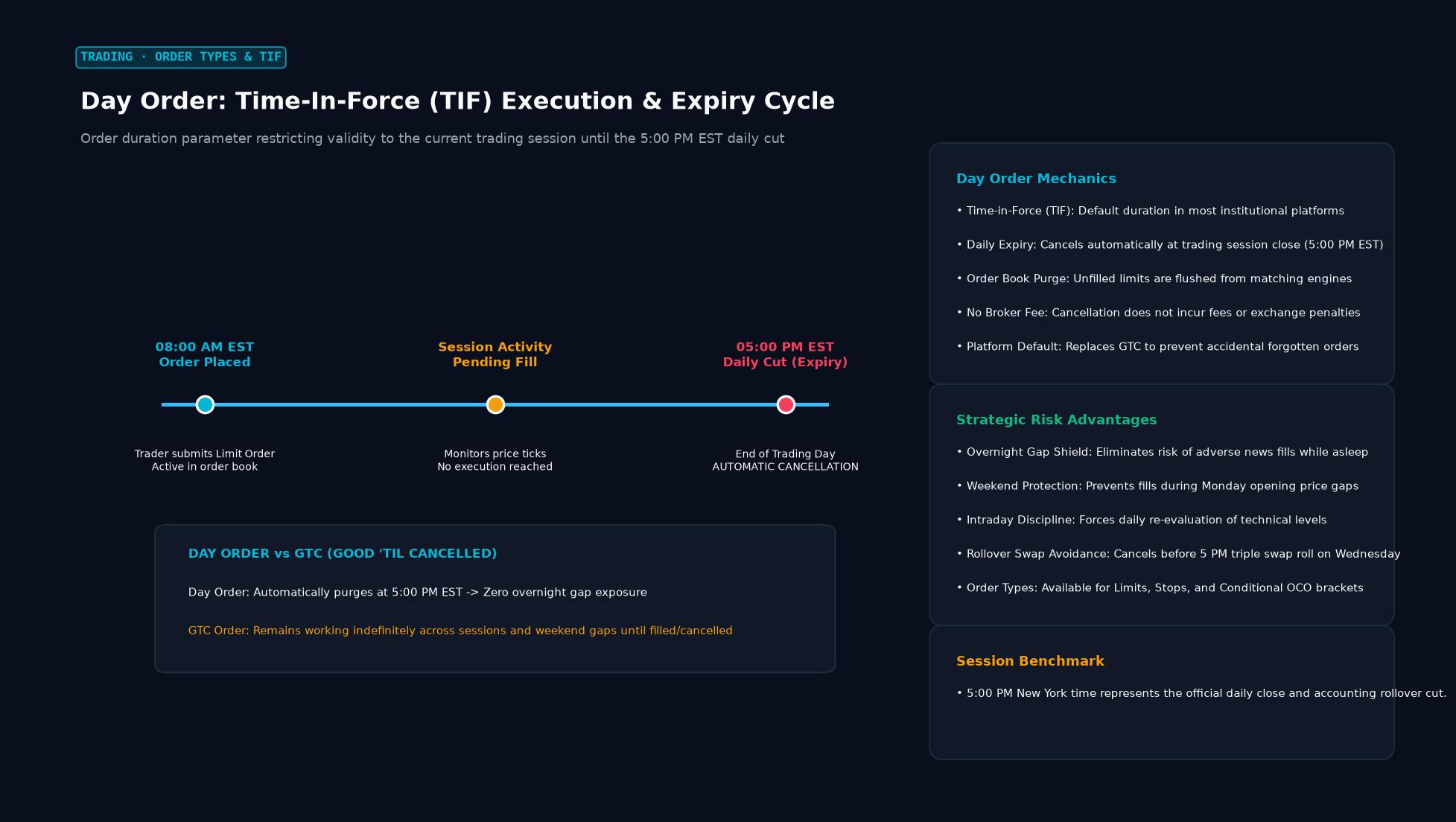 Figure: Order duration parameter restricting validity to the current trading session until the 5:00 PM EST daily cut
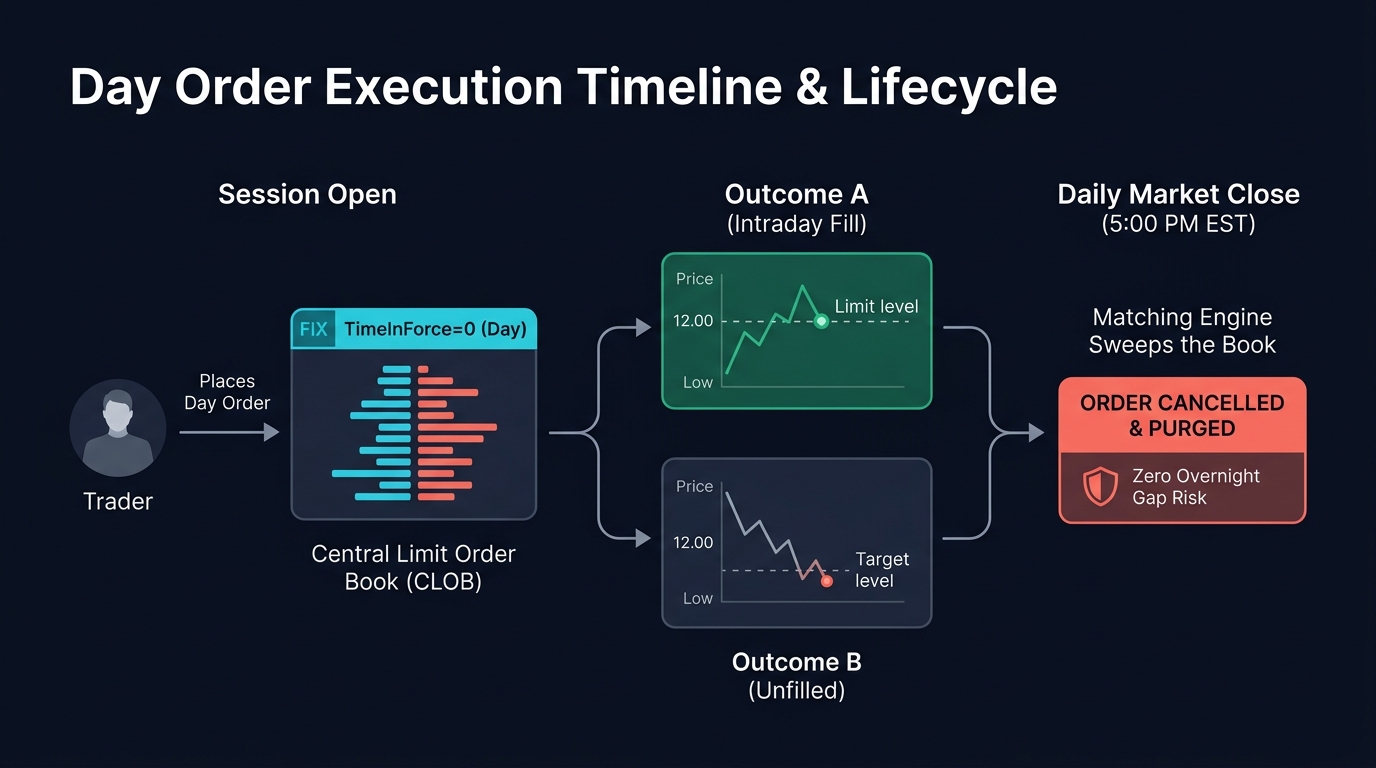
Technical Mechanics & FIX Protocol Architecture
Across institutional execution management systems (EMS) and algorithmic routing engines, day orders are governed by standardized Financial Information eXchange (FIX) protocol parameters:
FIX Tag Configuration
When an algorithmic trading desk dispatches an order packet, the time-in-force condition is dictated by Tag 59:
Tag 59 (TimeInForce) = 0   ===> DAY ORDER
Tag 59 (TimeInForce) = 1   ===> Good-Till-Cancelled (GTC)
Tag 59 (TimeInForce) = 3   ===> Immediate-or-Cancel (IOC)
Tag 59 (TimeInForce) = 4   ===> Fill-or-Kill (FOK)
Tag 59 (TimeInForce) = 6   ===> Good-Till-Date (GTD)
Upon receiving an order with TimeInForce=0, the exchange matching engine attaches a session-end timestamp ($t_{\text{close}}$):
$$\text{Active Window} = [t_{\text{submission}}, t_{\text{session_close}}]$$
$$\text{If } t \ge t_{\text{session_close}} \text{ and } Q_{\text{unfilled}} > 0 \implies \text{Purge Order from Book}$$
Overnight Gap Risk Mitigation
The primary risk-management benefit of a Day Order is the total elimination of overnight gap risk:
$$\text{Overnight Gap Risk} = |P_{\text{next_open}} - P_{\text{prior_close}}|$$
If a trader leaves an active Good-Till-Cancelled (GTC) limit order to buy a stock at $100, and disastrous corporate earnings or geopolitical news breaks overnight, the stock may open the following morning at $75. The resting GTC order would be filled at the opening print near $75, instantly triggering a massive, unmanaged loss. By defaulting to a Day Order, the order expires at 16:00, forcing the trader to re-evaluate market conditions before committing capital the next morning.
Comparative Matrix: Time-in-Force (TIF) Specifications
| TIF Specification | Active Life | Expiration Mechanism | Overnight Risk | Primary User Group |
|---|---|---|---|---|
| Day Order (TIF=0) | Single Trading Session | Automatic purge at market close | Zero | Day traders, scalpers, quants |
| Good-Till-Cancelled (GTC) | Multi-Day (typically 60-90 days) | Remains until filled or manually cancelled | High (Overnight news gaps) | Long-term swing traders, investors |
| Good-Till-Date (GTD) | Specific calendar date | Purged at close of specified date | Moderate | Swing traders with catalyst targets |
| Immediate-or-Cancel (IOC) | Sub-second / Instantaneous | Unfilled portion cancelled immediately | Zero | High-frequency liquidity takers |
| Fill-or-Kill (FOK) | Sub-second / Instantaneous | Cancelled if entire size cannot fill | Zero | Institutional block traders |
Real-World Case Study: Algorithmic Order Management in High-Beta Tech
The necessity of strict Day Order execution was demonstrated during the tech earnings season of 2022.
Anatomy of an Overnight Order Hazard:
- The Asset: Meta Platforms (META) trading at $320.00 prior to Q4 earnings.
- Trader A (GTC Order): Placed a limit order to "Buy at $280.00 GTC," believing a $40 dip represented strong historical valuation support.
- Trader B (Day Order): Placed an identical limit order to "Buy at $280.00 Day."
- The Earnings Release (After-Market Close): Meta missed user growth projections, causing the stock to collapse 26% in after-hours trading, opening the next morning at $245.00.
- The Execution Outcome:
  * Trader B's Day Order had safely expired at 16:00 EST. Trader B woke up holding 100% cash and was able to assess the fundamental breakdown.
  * Trader A's GTC order remained active on the specialist book. At the 09:30 open, the order executed at $245.00, immediately locking the trader into a severe losing position as the stock continued to slide toward $200.
Frequently Asked Questions (FAQ)
What happens to a Day Order if it is submitted after the stock exchange closes?
If a Day Order is submitted after regular market hours (e.g., at 07:00 PM EST), most brokerage systems will queue the order and activate it at the market open on the next business day, where it will remain valid until the closing bell of that new session. However, if the trader desires to trade during the after-hours or pre-market extended sessions, they must explicitly select a “Day + Extended Hours” order parameter.
What is the difference between a Day Order in stocks vs. foreign exchange?
In the US stock market, the regular trading session has a rigid start and end: 09:30 AM to 04:00 PM EST. In the spot foreign exchange market—which trades 24 hours a day—there is no physical opening or closing bell. In forex, a Day Order is universally standardized to expire at 17:00 New York time (5:00 PM EST), which represents the official end of the global trading day and the timing of central bank interest rate rollover (swap) calculations.
Can an investor cancel a Day Order before the market closes?
Yes. A Day Order specifies the maximum duration the order can remain active in the matching engine. The trader retains the full legal right to cancel or modify the order at any time during the trading session prior to execution by transmitting an Order Cancel Request (MsgType=F). Once cancelled by the exchange, the order is immediately purged from the book.
Ready to trade forex?
Open a free demo account with a regulated broker. Practice with virtual funds before risking real money.