Electronic Communication Network (ECN)
An Electronic Communication Network (ECN) is an automated financial system that directly matches buy and sell orders from institutional market participants, prime brokers, and retail traders without intermediary dealer intervention or dealing desk manipulation.
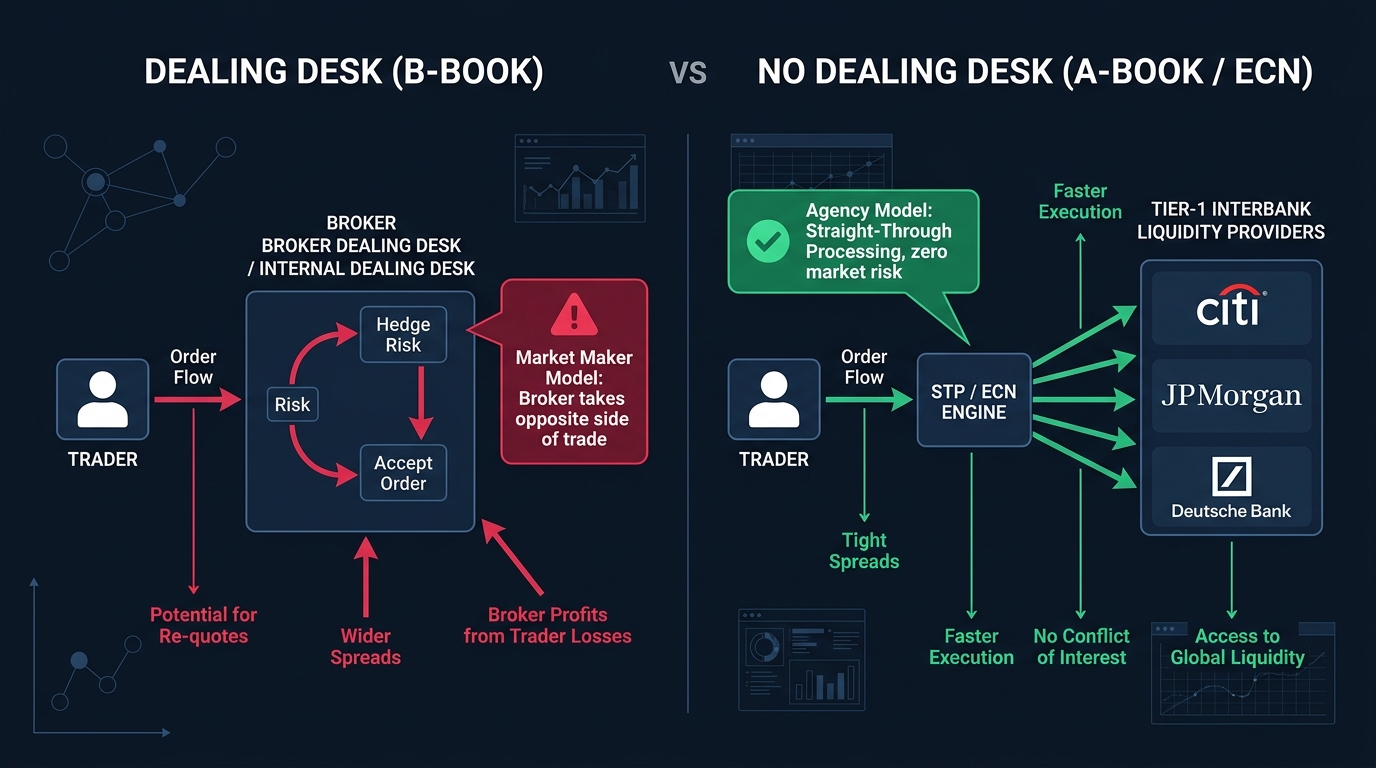
What Is an Electronic Communication Network (ECN)?
An Electronic Communication Network (ECN) is an automated, computerized trade execution system that matches buy and sell orders directly between market participants in financial markets—primarily foreign exchange, equities, and sovereign money markets.
Unlike traditional market makers or retail “dealing desks” that take the counterparty side of their clients’ trades (often internalizing order flow inside a B-book), an ECN acts as an impartial electronic hub. It consolidates streaming price quotes from tier-1 liquidity providers (global investment banks, non-bank electronic market makers, and hedge funds) into a consolidated Central Limit Order Book (CLOB). Traders interact directly with the deepest available market liquidity with complete price transparency, no dealer intervention, and no conflict of interest.
+-----------------------------------------------------------------------+
|                    ECN VS. DEALING DESK EXECUTION                     |
+-----------------------------------------------------------------------+
|  TRUE ECN ARCHITECTURE:                                               |
|  [Liquidity Providers]                                                |
|  (Citi, JPM, Barclays) ---\                                           |
|                            v                                          |
|  [Hedge Funds / Desks] ----> [ ECN MATCHING ENGINE ] <--- [Retail     |
|                            ^ (Central Order Book)         Trader]     |
|  [Prime Brokers] ---------/                                           |
|  * Best bid/ask matched automatically by Price-Time Priority.         |
|  * Broker earns a transparent fixed commission; zero conflict.        |
|                                                                       |
|  DEALING DESK (MARKET MAKER / B-BOOK):                                |
|  [Retail Trader] <==== Trades Against ====> [ Broker Dealing Desk ]   |
|  * Broker takes the opposite side; profits when the client loses.     |
+-----------------------------------------------------------------------+
Technical Mechanics & Order Matching Algorithms
ECNs operate on high-speed matching engines deployed in co-located institutional data centers (such as Equinix LD4 in London or NY4 in New Jersey).
The Price-Time Priority Algorithm
Incoming limit and market orders are sorted in the order book according to strict Price-Time Priority (FIFO):
$$\text{Execution Priority} = \arg \max_{i} \left( \text{Bid Price}i \right) \longrightarrow \arg \min{i} \left( t_{\text{arrival}, i} \right)$$
$$\text{Execution Priority} = \arg \min_{j} \left( \text{Ask Price}j \right) \longrightarrow \arg \min{j} \left( t_{\text{arrival}, j} \right)$$
Orders with the best price are executed first. If multiple participants offer identical prices, the order that entered the engine first receives execution priority.
Spread & Commission Cost Structure
Because an ECN passes through the raw, unmanipulated interbank market spread (which frequently compresses to 0.0 to 0.2 pips in liquid pairs like EUR/USD), the broker generates revenue by charging a transparent commission per round-turn lot:
$$\text{Total Transaction Cost} = (\text{Raw Spread} \times \text{Pip Value}) + \text{Round-Turn Commission}$$
For example, a trade with a 0.1-pip raw spread ($1.00 on a standard lot) and a $6.00 round-turn commission delivers a total cost of $7.00 per lot—substantially cheaper than a dealing desk broker offering a fixed 1.5-pip spread ($15.00 per lot).
Comparative Matrix: Execution Brokerage Models
| Dimension | True ECN | Straight Through Processing (STP) | Market Maker / Dealing Desk |
|---|---|---|---|
| Order Book | Central Limit Order Book (CLOB) | Liquidity Provider Bridge | Internal Dealer Book (B-Book) |
| Price Spreads | Raw Interbank (from 0.0 pips) | Variable (often with markup) | Fixed or wide variable spreads |
| Broker Revenue | Fixed commission per volume | Spread markup or commission | Client trading losses + spreads |
| Conflict of Interest | Zero (Broker wants client to trade) | Low | High (Client loss = Broker profit) |
| Execution Speed | Ultra-low latency (co-located) | Fast (bridge-dependent) | Can suffer manual dealer requotes |
| Market Depth (DoM) | Full Level II Depth of Market | Limited Level II | Synthetic or No Depth displayed |
Real-World Case Study: The Swiss National Bank (SNB) ECN Liquidity Freeze (January 2015)
The structural resilience—and extreme-tail limitations—of ECN networks were demonstrated on January 15, 2015, when the Swiss National Bank (SNB) unexpectedly abandoned its 1.2000 floor on EUR/CHF.
Anatomy of an ECN Flash Freeze:
1. The Shock: At 09:30 GMT, the SNB terminated its currency peg without warning.
2. Order Book Collapse: Institutional liquidity providers immediately pulled all resting bid orders from primary interbank ECNs (such as EBS and Currenex).
3. Liquidity Void: For several minutes, the EUR/CHF order book was completely empty—there were literally zero bids available at any price.
4. Cascading Slippage: Sell stop orders routed to ECN matching engines could not execute at 1.1990; the first executed trades cleared hundreds of pips lower near 1.0000, 0.9000, and 0.8500.
5. Broker Solvency: Retail traders suffered massive negative account balances. Retail brokers operating pure ECN/STP agency models (such as Alpari UK) were unable to recover client shortfalls and collapsed into insolvency within 24 hours.
The crisis proved that while ECNs provide superior pricing during normal market conditions, market orders on an ECN carry severe gap and slippage risk when institutional liquidity providers withdraw from the book.
Frequently Asked Questions (FAQ)
What is the difference between a true ECN broker and an STP broker?
A true ECN broker operates a Central Limit Order Book where all participants (retail traders, hedge funds, banks) can interact directly as both price makers (providing limit orders) and price takers. A Straight Through Processing (STP) broker passes client orders directly to external liquidity providers (banks or prime brokers) via an automated bridge without maintaining its own internal multilateral order book. In practice, many retail brokers blend these technologies into hybrid ECN/STP accounts.
Why do ECN brokers charge a commission instead of embedding costs in the spread?
True ECN brokers do not manipulate, widen, or mark up the bid-ask quotes streamed by their liquidity providers. Because they deliver the raw institutional interbank spread (which can be zero pips during peak market hours), they must charge a transparent, separate commission per lot (e.g., $3.00 per side) to cover operational technology costs and maintain exchange connectivity.
Can a trader experience slippage on an ECN account?
Yes. Slippage is an inherent, natural feature of real-market order execution. On an ECN, limit orders guarantee price (or better) but do not guarantee execution, while market orders guarantee execution but do not guarantee price. During high-impact macroeconomic releases (such as US Non-Farm Payrolls or central bank rate decisions), market prices move rapidly through the order book. When a market order reaches the matching engine, it will fill at the best available prevailing price, which may be several pips above or below the price displayed when the trader clicked the button.
Ready to trade forex?
Open a free demo account with a regulated broker. Practice with virtual funds before risking real money.