Capitalization Rate (Cap Rate)
The capitalization rate (cap rate) is a foundational real estate and commercial asset valuation metric that measures the unleveraged, annual rate of return generated on a property based on its net operating income relative to its current market asset value.
What Is the Capitalization Rate (Cap Rate)?
The capitalization rate (universally abbreviated as the cap rate) is the primary rate of return metric utilized in commercial real estate (CRE) and income-producing asset valuation. It indicates the expected annual percentage yield a property will produce, assuming the asset is purchased entirely with unleveraged cash (free and clear of debt financing).
In real estate private equity and institutional appraisal, the cap rate serves as the universal denominator that links an asset’s operating income to its capital value. It provides an objective baseline to compare diverse real estate opportunities across geographic markets and property sectors (such as multifamily apartment complexes, industrial logistics warehouses, and prime office towers) independent of specific mortgage loan structures.
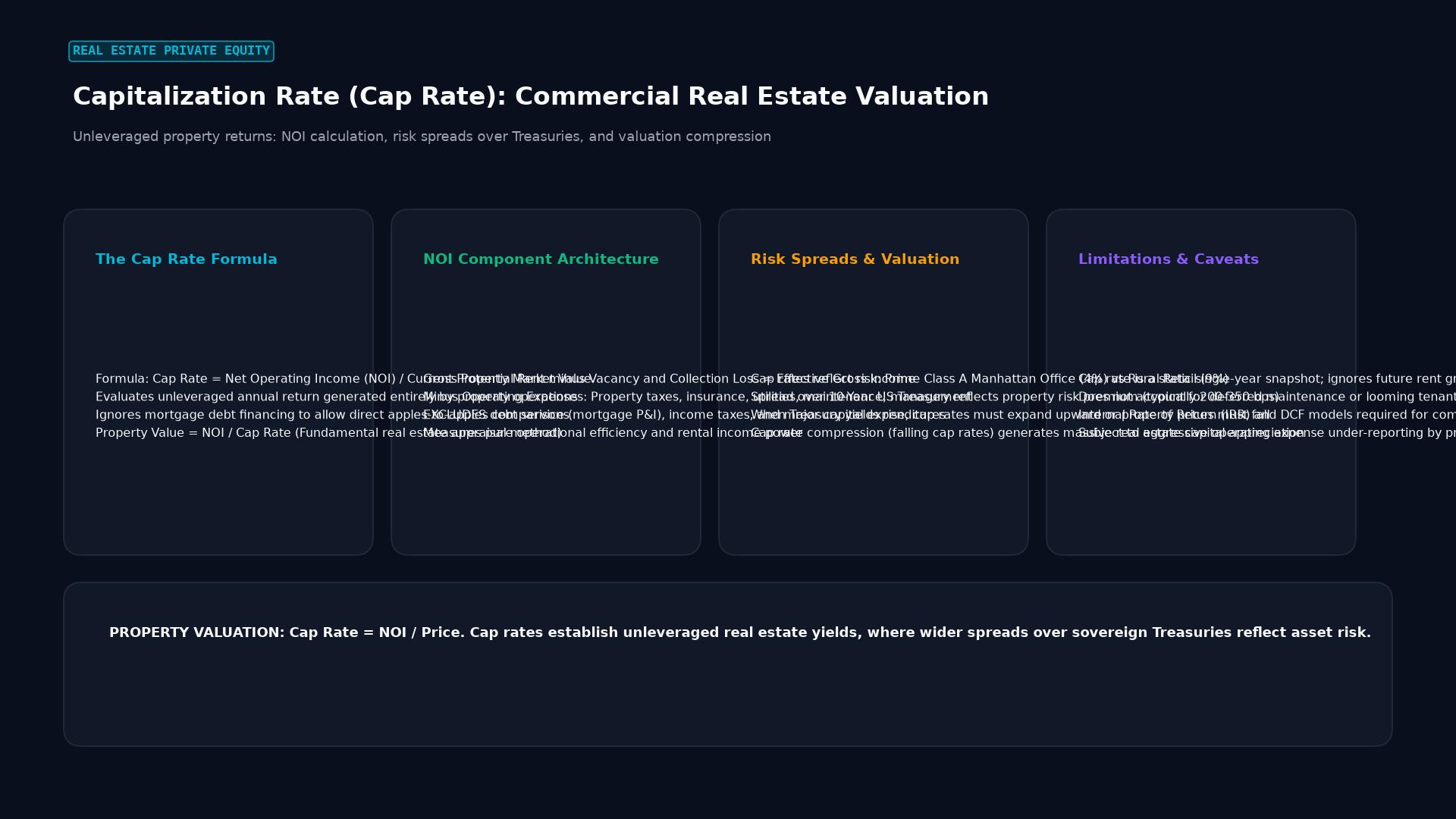 Figure: Unleveraged property returns: NOI calculation, risk spreads over Treasuries, and valuation compression
Technical Mechanics & Mathematical Derivation
The capitalization rate is derived directly from the fundamental cash flow of the property:
The Core Cap Rate Equation
$$\text{Cap Rate} = \frac{\text{Net Operating Income (NOI)}}{\text{Current Market Value (or Purchase Price)}} \times 100$$
Where Net Operating Income (NOI) equals gross potential rental revenue minus vacancy losses and ordinary operating expenses (property taxes, insurance, property management, and maintenance), excluding debt service (mortgage principal and interest) and income taxes:
$$\text{NOI} = (\text{Gross Potential Rent} - \text{Vacancy & Credit Losses}) - \text{Operating Expenses}$$
Property Valuation via Capitalization
Rearranging the formula allows appraisers and institutional acquisitions teams to calculate the theoretical fair market value ($V$) of an asset:
$$V = \frac{\text{NOI}}{\text{Cap Rate}}$$
If an industrial distribution center generates a stable NOI of $1,200,000 annually, and prevailing institutional market cap rates for logistics assets in that metropolitan area are 5.0% ($0.05$):
$$V = \frac{$1,200,000}{0.05} = $24,000,000$$
The Gordon Growth Model Relationship
In quantitative financial economics, the cap rate is equivalent to the discount rate ($r$) minus the perpetual growth rate of cash flows ($g$):
$$\text{Cap Rate} = r - g$$
Where $r$ represents the investor’s required cost of capital (Risk-Free Sovereign Yield + Real Estate Risk Premium). If benchmark Treasury yields increase, $r$ rises, mechanically forcing cap rates to expand and asset valuations to decline.
Comparative Matrix: Real Estate Performance Metrics
| Metric | Incorporates Debt Financing? | Accounts for Future Growth? | Evaluates Exit Value? | Primary Utility |
|---|---|---|---|---|
| Cap Rate | No (Unleveraged baseline) | No (1-year snapshot) | No | Market-wide valuation comparison |
| Cash-on-Cash Return | Yes (Leveraged cash flow) | No (Year-one cash return) | No | Measuring return on actual equity invested |
| Internal Rate of Return (IRR) | Yes | Yes (Multi-year cash projections) | Yes (Sale disposition) | Full lifecycle fund performance benchmark |
| Gross Rent Multiplier (GRM) | No | No (Ignores operating costs) | No | Quick top-of-funnel screening |
Real-World Case Study: The Commercial Real Estate Office Crisis (2022–2024)
The sensitivity of property valuations to cap rate expansion was demonstrated during the global monetary tightening cycle of 2022–2024.
Anatomy of Cap Rate Expansion in Prime Office Space:
- The Asset: A Class-A office tower in central San Francisco generating a steady Net Operating Income of $10,000,000.
- The 2021 Low-Rate Regime:
  * 10-Year US Treasury Yield: 1.50%.
  * Prevailing Metro Office Cap Rate: 4.00%.
  * Implied Property Valuation: $10,000,000 / 0.04 = $250,000,000.
- The 2023 Inflationary Shock:
  * The Federal Reserve hiked rates; 10-Year Treasuries surged to 4.80%.
  * Remote-work trends pushed tenant vacancy to 30%, while risk premiums jumped.
  * Office Market Cap Rate Expanded to: 8.00%.
- The 2023 Property Valuation:
  * Implied Property Valuation: $10,000,000 / 0.08 = $125,000,000.
Even without any initial drop in net operating income, a doubling of the cap rate from 4.0% to 8.0% triggered an instantaneous 50% wipeout in the property’s capital asset value ($125 million lost).
Frequently Asked Questions (FAQ)
What is considered a “good” cap rate for an investment property?
There is no universal “ideal” cap rate; the figure is strictly relative to asset risk, property sector, and prevailing interest rates. A premier apartment complex in Manhattan might trade at a low cap rate of 3.5% to 4.5% (reflecting prime location stability and low default risk), while a suburban retail strip mall in a secondary market might demand an 8.0% to 10.0% cap rate to compensate investors for tenant turnover and illiquidity risk.
Does the cap rate factor in mortgage interest or loan payments?
No. The cap rate is strictly an unleveraged metric. It intentionally ignores whether the buyer pays with 100% cash or borrows 80% through a commercial mortgage. By excluding debt financing costs, the cap rate enables investors to evaluate the intrinsic earning efficiency of the physical real estate itself, isolated from the specific financing structure of the buyer.
What is the relationship between the 10-Year US Treasury yield and commercial cap rates?
The 10-Year US Treasury yield represents the risk-free rate of return in dollar-denominated assets. Real estate investors demand a spread (typically 200 to 400 basis points) above the 10-year Treasury yield to compensate for real estate illiquidity, leasing risk, and asset management overhead: $$\text{Cap Rate} \approx \text{10-Year Treasury Yield} + \text{Real Estate Risk Premium}$$ When Treasury yields rise, commercial cap rates must expand to maintain this required risk premium, putting downward pressure on commercial property values.
Ready to trade forex?
Open a free demo account with a regulated broker. Practice with virtual funds before risking real money.