Consumer Confidence
Consumer confidence is an economic indicator that quantifies the degree of optimism or pessimism consumers exhibit regarding their personal financial health and the broader economy, heavily influencing personal consumption expenditures and GDP growth.
What Is Consumer Confidence?
Consumer confidence is a crucial macroeconomic sentiment indicator that measures how optimistic or pessimistic consumers feel about their current financial well-being, the state of the labor market, and short-term economic prospects. Because personal consumption expenditures account for nearly 70% of Gross Domestic Product (GDP) in major consumer-driven economies like the United States, consumer confidence serves as a primary forward-looking barometer for aggregate demand.
When consumer sentiment is high, households are more inclined to make major discretionary purchases (such as vehicles, electronics, and homes), expand credit card balances, and pursue entrepreneurial investments. Conversely, when confidence deteriorates, consumers curtail non-essential spending, pay down debt, and increase precautionary savings, which can trigger an economic slowdown or full-scale recession.
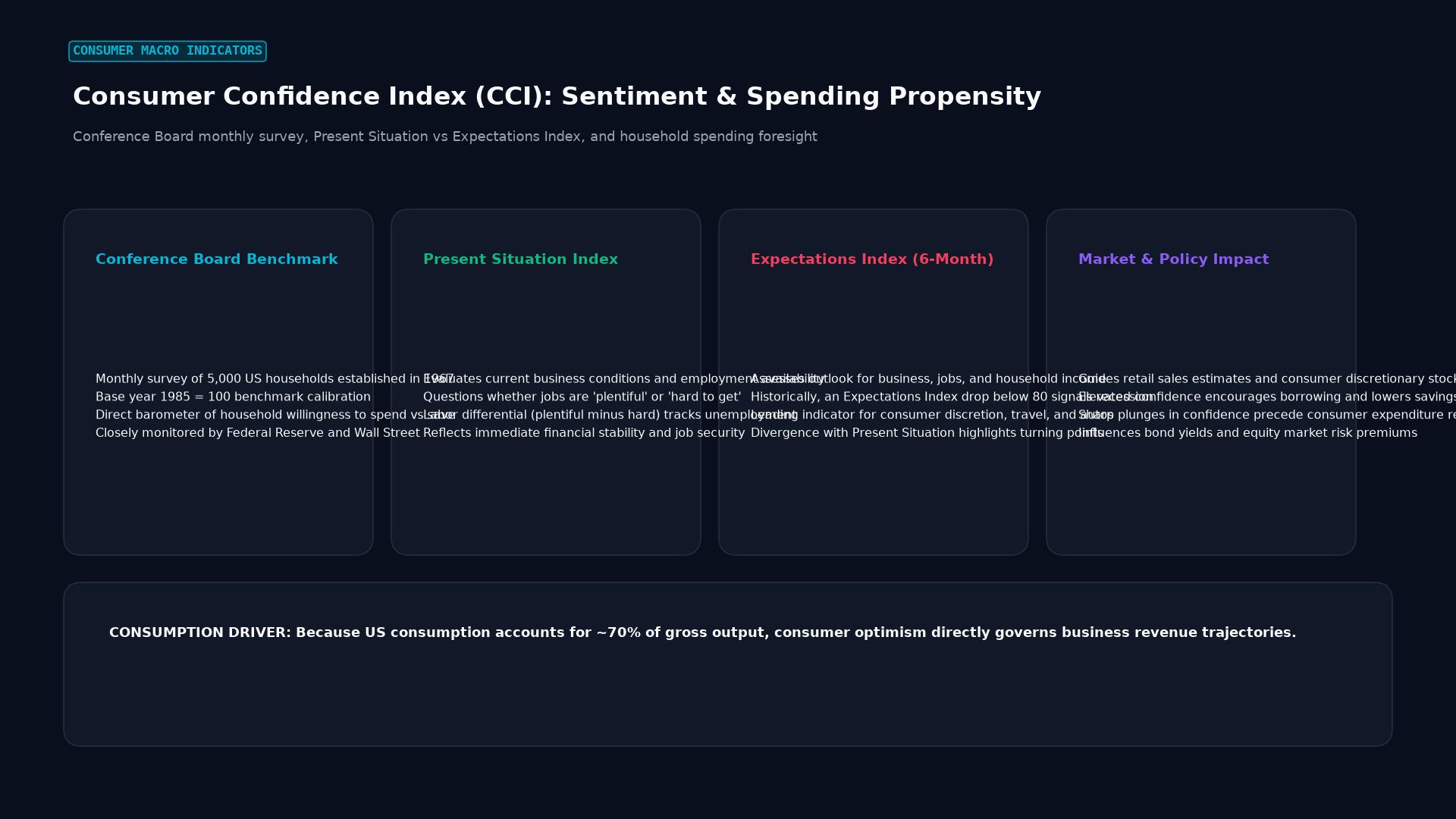 Figure: Conference Board monthly survey, Present Situation vs Expectations Index, and household spending foresight
Key Takeaways
- Twin Benchmark Surveys: In the United States, consumer sentiment is tracked primarily through two major monthly releases: the Conference Board Consumer Confidence Index (CCI) and the University of Michigan Consumer Sentiment Index (MCSI).
- Leading Indicator Function: Shifts in consumer expectations typically precede changes in actual consumer spending by three to six months.
- Inflation Expectations Component: The University of Michigan survey tracks 1-year and 5-year forward consumer inflation expectations, which central banks (including the Federal Reserve) scrutinize to ensure long-term inflation expectations remain anchored.
- Forex Market Reaction: Above-consensus confidence prints support domestic currency valuations by lifting retail sales expectations and elevating sovereign bond yields.
Comparison: The Conference Board CCI vs. University of Michigan MCSI
While both metrics evaluate consumer sentiment, their methodologies, timing, and economic focus differ substantially:
| Analytical Dimension | The Conference Board (CCI) | University of Michigan (MCSI) |
|---|---|---|
| Release Timing | Last Tuesday of the reference month (10:00 AM ET) | Preliminary mid-month; Final on last Friday of month (10:00 AM ET) |
| Survey Focus | Heavily weighted toward labor market conditions and job availability | Heavily weighted toward personal finances, household budgets, and prices |
| Index Composition | Present Situation Index (40%) + Expectations Index (60%) | Current Economic Conditions (ICC) + Consumer Expectations (ICE) |
| Base Year Period | $1985 = 100$ | $1966 = 100$ |
| Key Critical Metric | “Jobs Hard to Get” vs. “Jobs Plentiful” labor differential | 1-Year and 5-to-10-Year Inflation Expectations |
The Labor Differential and the “Recession Trigger”
One of the most powerful sub-components of the Conference Board survey is the Labor Market Differential, calculated as:
$$\text{Labor Market Differential} = % \text{ Consumers Claiming Jobs are Plentiful} - % \text{ Consumers Claiming Jobs are Hard to Get}$$
When this differential narrows sharply and falls below historical threshold bands, it strongly correlates with a turning point in the U.S. unemployment rate, signaling an imminent business cycle contraction.
Similarly, an Expectations Index reading below 80 has historically signaled a looming recession within the subsequent 12 to 18 months, alerting institutional currency desks to prepare for defensive safe-haven asset rotations.
Why Consumer Inflation Expectations Drive FX Markets
In modern central banking, inflation expectations are as influential as realized Consumer Price Index (CPI) prints. The University of Michigan surveys households on expected price changes:
- 1-Year Inflation Expectations: Reflects immediate consumer perception of grocery, gasoline, and housing prices.
- 5-Year Inflation Expectations: Measures the credibility of the central bank’s long-term inflation target (2.0%).
   ┌──────────────────────────────────────────────┐
   │ 5-Year Inflation Expectations Spike (e.g. 3.4%)│
   └──────────────────────┬───────────────────────┘
                          │
                          ▼
   ┌──────────────────────────────────────────────┐
   │ Risk of De-Anchoring Inflation Psychology    │
   └──────────────────────┬───────────────────────┘
                          │
                          ▼
   ┌──────────────────────────────────────────────┐
   │ Federal Reserve Forced to Maintain Higher    │
   │ Benchmark Rates for Longer                   │
   └──────────────────────┬───────────────────────┘
                          │
                          ▼
   ┌──────────────────────────────────────────────┐
   │ U.S. Dollar Appreciates via Yield Advantage  │
   └──────────────────────────────────────────────┘
If long-term expectations begin unanchoring to the upside, central bankers are compelled to adopt an aggressively restrictive posture to prevent a wage-price spiral, driving substantial capital inflows into the domestic currency.
Real-World Case Study: Trading the University of Michigan Release
At 10:00 AM Eastern Time on a Friday, the University of Michigan publishes its preliminary consumer sentiment survey.
Market Setup:
- Pair: EUR/USD trading at 1.0880.
- Consensus Forecast: Headline Index: 68.5; 5-Year Inflation Expectations: 2.9%.
- Actual Print:
- Headline Consumer Sentiment: 63.2 (Severe miss reflecting high borrowing costs).
- 5-Year Inflation Expectations: 2.7% (Falling well below expectations).
Trading Reaction:
- Bond Market Repricing: U.S. Treasury yields fall across the 2-Year and 5-Year maturities as traders recognize that consumer demand is fading while disinflation is accelerating.
- Rate Cut Expectations: Fed Funds futures shift from pricing a 40% chance of a rate cut at the next FOMC meeting to an 85% probability.
- Forex Currency Movement: The U.S. Dollar weakens across all G10 peers. EUR/USD rallies from 1.0880 to 1.0945 within 45 minutes (a 65-pip gain).
- Follow-Through: Equity markets rally on the prospect of lower discount rates, while the greenback remains under sustained selling pressure for the rest of the New York session.
Frequently Asked Questions
Can consumer confidence diverge from actual retail sales data?
Yes. Economists frequently observe a “say-do” divergence. Consumers may express pessimism in surveys due to negative political headlines or inflation fatigue, yet their actual purchasing behavior (reflected in hard retail sales and credit card transaction data) remains resilient. Savvy forex traders always confirm soft sentiment trends with hard coincident retail data.
How does consumer confidence differ across international economies?
Every major currency zone publishes a domestic equivalent:
- Eurozone: European Commission Consumer Confidence Index and German GfK Consumer Climate.
- United Kingdom: GfK UK Consumer Confidence Barometer.
- Japan: Cabinet Office Consumer Confidence Index.
- Australia: Westpac-Melbourne Institute Consumer Sentiment Index.
Why does the preliminary University of Michigan survey cause more volatility than the final release?
The preliminary survey is released midway through the current month, capturing the very latest shifts in sentiment. By the time the final revision is published two weeks later, the market has already absorbed the broader economic picture, making the final release significantly less market-moving unless there is a dramatic surprise revision.
Ready to trade forex?
Open a free demo account with a regulated broker. Practice with virtual funds before risking real money.