Copey
Copey is traditional foreign exchange dealing desk slang for the Danish Krone (DKK), derived from Denmark's capital city, Copenhagen, commonly traded against the Euro under the European Exchange Rate Mechanism II (ERM II).
What Is Copey in Forex Trading?
In international foreign exchange trading rooms, Copey (alternatively spelled Copi or Cophie) is the longstanding market slang used by interbank spot traders and liquidity brokers to refer to the Danish Krone (ISO code: DKK). The nickname is derived directly from Denmark’s capital and financial center, Copenhagen, where the Danish foreign exchange and money markets are anchored.
Just as dealers ubiquitously refer to the British Pound as “Cable,” the Canadian Dollar as the “Loonie,” the New Zealand Dollar as the “Kiwi,” and the Swedish Krona as “Stocky” (after Stockholm), interbank dealers use “Copey” as verbal and chat shorthand when quoting bid-ask spreads or executing Scandinavian cross-currency transactions.
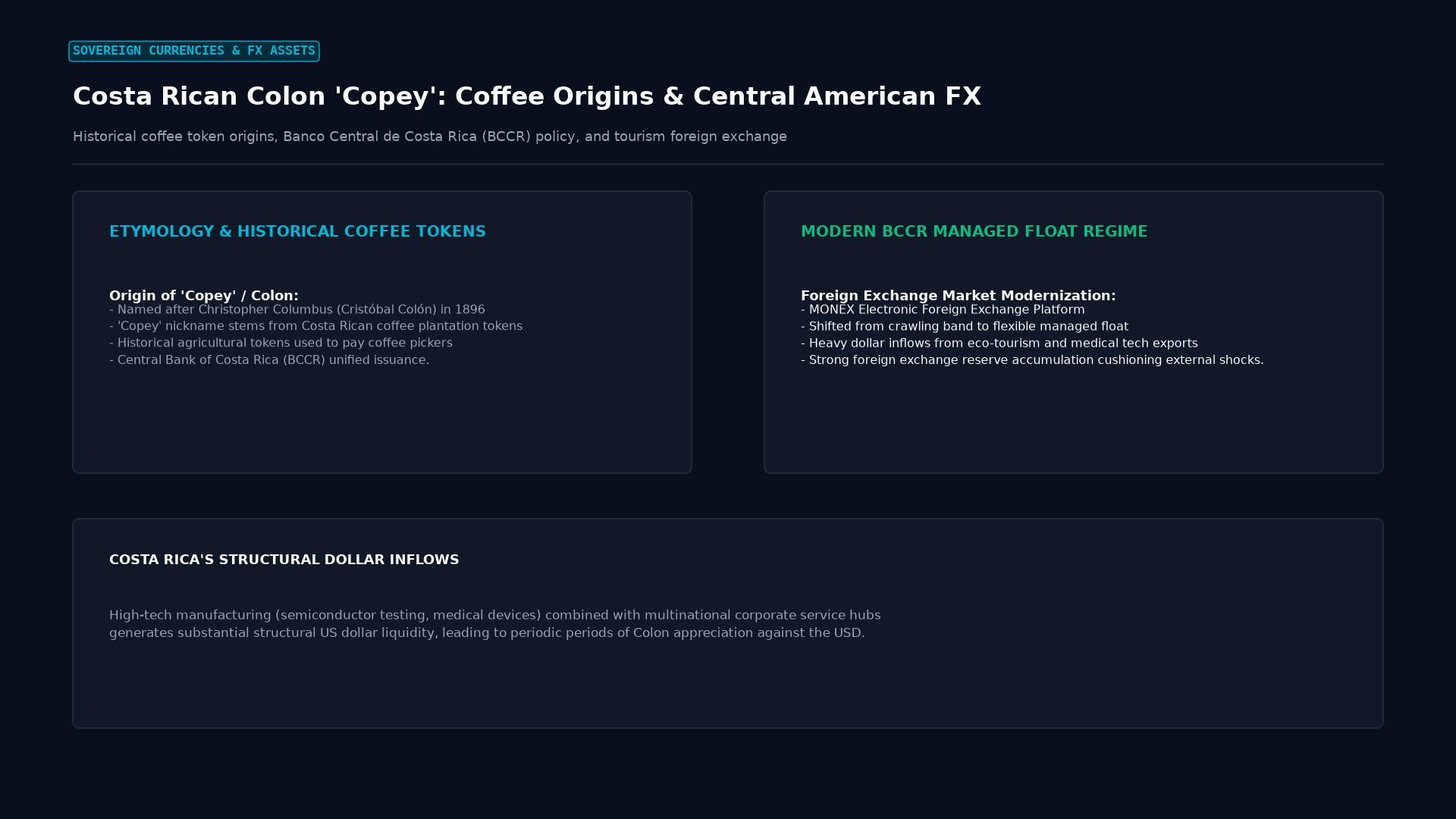 Figure: Historical coffee token origins: agricultural token roots evolving into Banco Central de Costa Rica’s modern electronic MONEX managed float platform.
Key Takeaways
- Desk Slang Origin: “Copey” denotes the Danish Krone (DKK), referencing Copenhagen, home to Danmarks Nationalbank and the Danish banking sector.
- The ERM II Fixed-Exchange Peg: Unlike the free-floating Swedish Krona or Norwegian Krone, Denmark maintains a formal, legally binding currency peg to the Euro through the European Exchange Rate Mechanism II (ERM II).
- Ultra-Narrow Fluctuation Band: While official ERM II treaty guidelines allow a fluctuation band of $\pm 15%$, Denmark negotiated an ultra-tight mutual agreement restricting EUR/DKK fluctuation to within $\pm 2.25%$ around a central rate of 7.46038 DKK per EUR (in operational reality, held within $\pm 0.5%$).
- Monetary Policy Pass-Through: Danmarks Nationalbank does not set interest rates to control domestic consumer inflation; its sole operational mandate is to defend the EUR/DKK exchange rate peg by shadowing the European Central Bank (ECB).
Denmark and the Euro: The ERM II Architecture
Following the rejection of the Maastricht Treaty in 1992 and the subsequent Edinburgh Agreement, Denmark negotiated an official opt-out from adopting the Euro as its sovereign currency. However, to foster economic stability and deep trade integration with the European single market, Denmark entered ERM II on January 1, 1999.
| Peg Characteristic | Official ERM II Rule | Denmark’s Actual Implementation |
|---|---|---|
| Anchor Currency | Euro (EUR) | Euro (EUR) |
| Central Parity Rate | Fixed central rate | 1 EUR = 7.46038 DKK |
| Statutory Fluctuation Band | $\pm 15.0%$ band | Agreed narrow band of $\pm 2.25%$ (7.29228 – 7.62824) |
| Operational Trading Range | Typically wide | In practice, maintained within $< 0.5%$ (7.4350 – 7.4700) |
| Intervention Obligation | Mutual obligation between ECB and national central bank | Unlimited mutual intervention support at the outer band edges |
How Danmarks Nationalbank Defends the “Copey” Peg
Because the Danish Krone is fixed to the Euro, Danish monetary authorities have surrendered autonomous monetary policy. To keep EUR/DKK pinned to 7.46038, Danmarks Nationalbank deploys two primary tools:
1. Direct Foreign Exchange Intervention
When global financial shocks trigger safe-haven capital flight into Denmark, upward pressure mounts on Copey, driving EUR/DKK lower toward 7.4350. The central bank intervenes in the spot interbank market by selling DKK and buying foreign currency (EUR), accumulating vast foreign exchange reserves. Conversely, when capital exits, the bank buys DKK and drains reserves.
2. Independent Interest Rate Adjustments
If foreign exchange interventions alone are insufficient to stem capital flows, the central bank adjusts its benchmark certificates of deposit rate independently of the ECB:
- To deter capital inflows: Danmarks Nationalbank lowers rates below the ECB deposit facility (Denmark was the first nation in modern history to introduce negative interest rates in 2012, pushing rates to -0.75%).
- To halt capital outflows: It raises rates above the ECB rate to enhance Danish yield appeal.
Defending the ERM II Peg:
Safe-Haven Capital Inflows ──► Copey Appreciates (EUR/DKK falls) ──► Nationalbank Sells DKK & Lowers Rates
Speculative Outflows       ──► Copey Depreciates (EUR/DKK rises) ──► Nationalbank Buys DKK & Hikes Rates
Trading Characteristics: Why Institutions Trade EUR/DKK and USD/DKK
While retail traders favor volatile floating currencies, institutional hedge funds, corporate treasurers, and fixed-income desks trade Copey for specific structural reasons:
1. Ultra-Low Volatility & High Liquidity
EUR/DKK trades with an annualized implied volatility of less than 1.5%, making it the most stable currency pair in Europe. Institutional funds utilize EUR/DKK for low-risk liquidity parking and short-term corporate balance-sheet management.
2. Cross-Currency Triangulation via USD/DKK
Retail traders frequently encounter Copey through USD/DKK. Because DKK is effectively a fixed proxy for the Euro, USD/DKK price action mirrors EUR/USD with near-perfect inverse correlation:
$$\text{USD/DKK} = \frac{\text{EUR/DKK (Fixed at ~7.46)}}{\text{EUR/USD}}$$
When EUR/USD rallies by 100 pips, USD/DKK falls proportionally by approximately 680 pips (accounting for the 7.46 conversion factor).
Real-World Case Study: The 2015 “Swiss Shock” Contagion on Copey
On January 15, 2015, the Swiss National Bank (SNB) stunned the financial world by abruptly abandoning its 1.20 floor on EUR/CHF.
The Speculative Attack on Denmark:
- The Logic: Speculative currency hedge funds reasoned that if Switzerland could not defend its currency cap against quantitative easing by the European Central Bank, Denmark would be forced to abandon its ERM II peg next.
- The Inflow Avalanche: Billions of Euros rushed into Denmark seeking refuge in “undervalued” Danish Kroner, pushing EUR/DKK to the lower boundary of its operational band.
- The Defense: Danmarks Nationalbank unleashed unprecedented countermeasures:
- It intervened massively, buying a record $40 billion USD in foreign currency within six weeks (expanding its foreign exchange reserves to over 35% of Danish GDP).
- It slashed its benchmark interest rate four times in three weeks, plunging deep into negative territory to -0.75%.
- The Danish government suspended all domestic sovereign bond auctions to restrict debt supply.
- The Outcome: The peg held completely unbroken. Speculators shorting EUR/DKK were forced to surrender after paying punitive negative interest rates, cementing Copey’s reputation as the most rigorously defended currency peg on earth.
Frequently Asked Questions
Is “Copey” an official currency code?
No. “Copey” is informal trader jargon. The official three-letter ISO 4217 currency code is DKK, and its domestic symbol is kr..
Why didn’t Denmark join the Eurozone like other EU member states?
In a national referendum held in September 2000, 53.2% of Danish citizens voted against adopting the Euro. The Danish electorate preferred to retain sovereign control over physical banknotes and domestic institutions, while the ERM II peg simultaneously secured the trade and price-stability benefits of the Euro.
Can retail forex traders trade Copey?
Yes. Most international brokers offer EUR/DKK and USD/DKK under their minor or exotic currency tabs. However, due to its low volatility, EUR/DKK requires larger position sizes or is traded primarily during monetary policy shifts.
Ready to trade forex?
Open a free demo account with a regulated broker. Practice with virtual funds before risking real money.