Countervalue
Countervalue is the equivalent cash monetary value of a foreign exchange transaction expressed in the counter (quote) currency, calculated by multiplying or dividing the base currency amount by the agreed exchange rate.
What Is Countervalue?
In international banking and foreign exchange dealing, countervalue (often termed contra value or equivalent value) is the exact monetary amount of the counter (quote) currency that corresponds to a specified quantity of the base currency in a financial transaction. When counterparties agree to execute a currency trade, the transaction consists of two interconnected legs: the base amount and its contractual countervalue.
Because every FX trade is an exchange rather than a one-sided purchase, countervalue establishes the precise cash settlement obligation owed by the buyer of the base currency. In back-office settlement operations, treasury management systems, and SWIFT confirmation messages (such as MT300), countervalue represents the definitive amount of funds that must be wired over national clearing rails (like Fedwire, TARGET2, or CHAPS) on the value date.
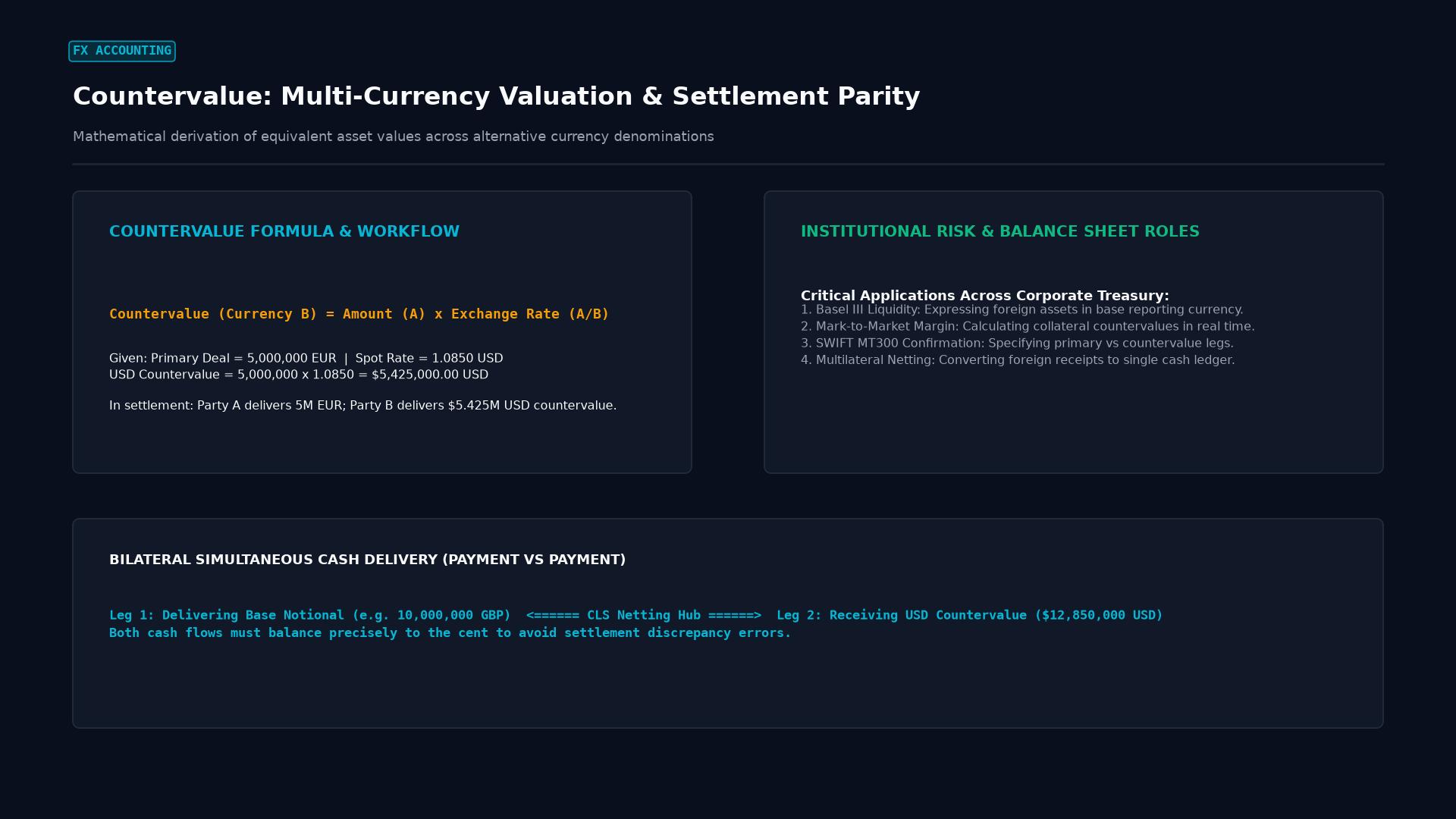 Figure: Multi-currency settlement mechanics: deriving opposing leg countervalue in CLS payment-versus-payment foreign exchange transactions.
Key Takeaways
- Settlement Delivery Obligation: Countervalue determines the exact dollar-and-cent (or pound-and-pence) quantity that must be paid out to receive the contracted foreign currency.
- The Core Mathematical Relationship: For standard direct quotations, countervalue is calculated as the base currency volume multiplied by the agreed exchange rate.
- SWIFT Messaging Standardization: In institutional SWIFT MT300 and ISO 20022
pacs.008payment messages, the countervalue is encoded under dedicated settlement sequence fields to ensure zero discrepancy between clearing banks. - Corporate Invoicing Precision: Corporate treasurers utilize countervalue calculations to execute precise currency hedges for cross-border accounts payable and receivable, preventing residual balance sheet drag.
Mathematical Formulation: Calculating Countervalue
The mathematical computation of countervalue depends on how the currency pair is quoted in relation to the account or home currency:
1. Direct Quotation Calculation
When calculating the countervalue in the quote currency:
$$\text{Countervalue} = \text{Base Currency Notional} \times \text{Agreed Exchange Rate}$$
2. Reverse Calculation (Deriving Base Notional from Target Countervalue)
If a corporate treasurer needs to settle a foreign invoice of a fixed amount in the counter currency, they divide the target countervalue by the exchange rate to determine the base amount to trade:
$$\text{Base Currency Notional} = \frac{\text{Required Countervalue}}{\text{Agreed Exchange Rate}}$$
Practical Institutional Examples
The table below illustrates how countervalue scales across major currency pairs for standard institutional transaction sizes:
| Currency Pair | Base Currency Amount | Agreed Execution Rate | Calculated Countervalue | Settlement Obligation |
|---|---|---|---|---|
| EUR/USD | €5,000,000 EUR | 1.08500 |
$5,425,000.00 USD | Buyer of EUR must deliver $5.425M USD |
| GBP/USD | £2,500,000 GBP | 1.28000 |
$3,200,000.00 USD | Buyer of GBP must deliver $3.2M USD |
| USD/JPY | $10,000,000 USD | 155.500 |
¥1,555,000,000 JPY | Buyer of USD must deliver ¥1.555B JPY |
| USD/CAD | $4,000,000 USD | 1.36250 |
C$5,450,000.00 CAD | Buyer of USD must deliver C$5.45M CAD |
| EUR/GBP | €1,000,000 EUR | 0.85200 |
£852,000.00 GBP | Buyer of EUR must deliver £852,000 GBP |
Countervalue in Post-Trade Operations & Clearing
In institutional dealing rooms, trade execution is only the initial step. Once an order is executed on an electronic platform (e.g., EBS or Refinitiv):
Trade Execution ──► MT300 Confirmation Matching ──► Countervalue Wire Generation (RTGS/CLS)- Trade Capture: The automated execution engine captures the traded base volume and instantly computes the exact countervalue down to two decimal places.
- Confirmation Matching: Counterparties generate reciprocal SWIFT MT300 messages:
- Sequence B (Party A): Bought €10,000,000 EUR / Sold $10,850,000 USD.
- Sequence B (Party B): Sold €10,000,000 EUR / Bought $10,850,000 USD.
- Discrepancy Exception (Breaks): If Party B’s risk engine rounds the countervalue differently by even one single cent (e.g., $10,850,000.01), automated matching engines reject the ticket, triggering a back-office investigation.
- CLS PvP Settlement: Continuous Linked Settlement (CLS) reconciles both the base leg and countervalue simultaneously across national central bank accounts, ensuring delivery cannot occur without reciprocal countervalue receipt.
Real-World Case Study: Corporate Treasury Commercial Hedging
Consider an American multinational technology firm importing specialized microchips from a supplier in Tokyo.
The Operational Challenge:
- The supplier issues an invoice for ¥775,000,000 JPY, payable in 60 days.
- The U.S. corporate treasurer must determine the exact U.S. Dollar countervalue required to fund the invoice.
- Current Spot Rate:
USD/JPY = 155.00. - 60-Day Forward Rate:
USD/JPY = 153.50(reflecting JPY forward premium).
Calculating Countervalue Exposure:
- Unhedged Spot Risk: If the firm waits 60 days and USD/JPY strengthens to 160.00, the dollar cost drops. But if USD/JPY collapses to 140.00, the required dollar countervalue surges from $5.0M to $5.535M ($535,000 unexpected cost).
- Locking Countervalue via Forward Contract: The treasurer enters a 60-day outright forward contract to buy JPY against USD at 153.50: $$\text{USD Countervalue} = \frac{¥775,000,000}{153.50} = $5,048,859.93 \text{ USD}$$
- Result: The corporate balance sheet is completely insulated. Regardless of what happens in the foreign exchange market over the next 60 days, the company’s accounting software records an exact, unchanging countervalue liability of $5,048,859.93 USD.
Frequently Asked Questions
What is the difference between countervalue and quote currency?
The quote currency is the specific monetary denomination itself (e.g., U.S. Dollars or Japanese Yen). The countervalue is the actual numerical cash sum of that quote currency required to settle the trade (e.g., $1,085,000 USD).
Can countervalue be affected by rounding errors?
Yes. When converting between currencies with large numerical values (such as Japanese Yen, Indonesian Rupiah, or Vietnamese Dong) and decimal currencies (USD or EUR), slight differences in fractional pip rounding algorithms can create minor cash mismatches. Institutional systems adhere to strict ISDA market standard rounding conventions to ensure countervalues match to the nearest cent.
How does countervalue apply to retail forex margin accounts?
Retail traders do not wire physical countervalues. Instead, their broker provides leverage, requiring only a fraction of the notional value as margin (e.g., 2% or 3.33%). However, the broker’s liquidity providers must clear the full underlying countervalue across interbank accounts on the backend.
Ready to trade forex?
Open a free demo account with a regulated broker. Practice with virtual funds before risking real money.