Financial Contagion
Financial contagion (historically referenced as economic infection) is the rapid cross-border or cross-market transmission of financial distress, currency devaluations, or systemic banking shocks from one sovereign economy or asset class to others.
What Is Financial Contagion?
Financial contagion (historically referred to in early economic glossaries as economic or financial “infection”) describes the rapid, cross-border diffusion of economic distress, liquidity freezes, currency crashes, or banking crises from one initial epicentral market to other ostensibly healthy economies and asset classes.
Much like a biological pathogen, financial distress spreads through interconnected structural vectors—including interbank lending relationships, shared global asset managers, bilateral trade dependencies, and behavioral panic. When an asset class or sovereign market collapses, it sets off a cascading chain reaction where institutional market participants face sudden margin calls and fire-sell uncorrelated assets to raise cash, transmitting shockwaves worldwide.
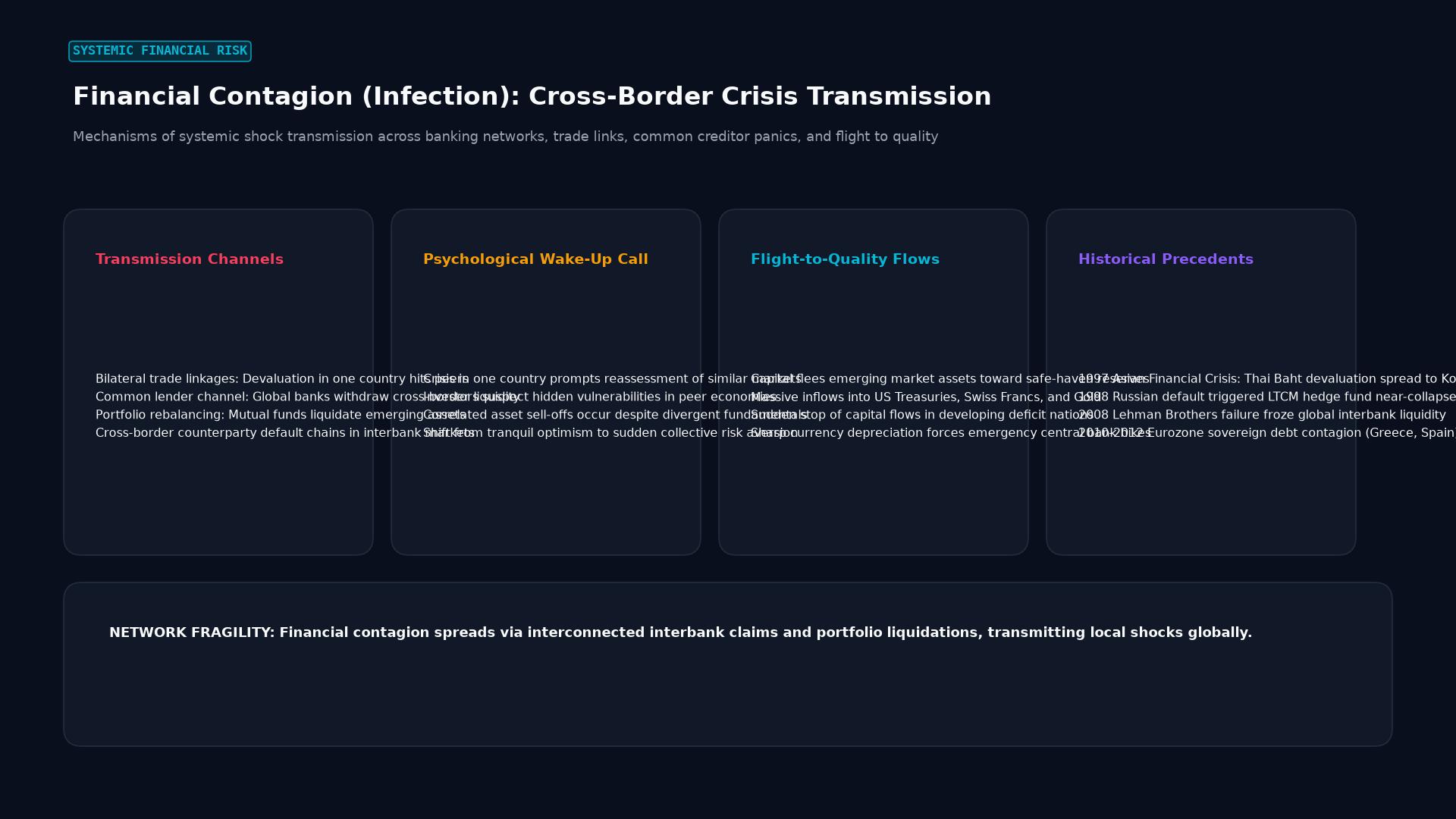 Figure: Mechanisms of systemic shock transmission across banking networks, trade links, common creditor panics, and flight to quality
Key Takeaways
- Systemic Spillover: Contagion occurs when distress in one country’s domestic banking system or sovereign bond market spills over into unrelated international markets with little direct fundamental exposure.
- Liquidity Spiral Mechanism: Global funds facing catastrophic losses in one emerging market are forced by risk-management mandates (e.g., Value at Risk limits) to liquidate positions in other emerging markets, triggering a multi-market liquidity squeeze.
- Flight-to-Quality Inflows: During peak contagion episodes, speculative capital flees developing markets, driving violent institutional inflows into sovereign safe-haven currencies (such as the US Dollar, Swiss Franc, and Japanese Yen) and gold.
- Policy Intervention: Central banks counter contagion through bilateral currency swap lines, international lender-of-last-resort bailouts (IMF packages), and coordinated monetary easing.
The Three Primary Channels of Financial Contagion
Economists classify the propagation of contagion across global markets into three distinct operational channels:
| Transmission Channel | Operational Mechanism | Historical Precedent |
|---|---|---|
| Financial / Interbank Channel | Cross-border institutional cross-holdings, repo hair-cuts, syndicated loans, and margin calls force immediate deleveraging | 2008 Lehman Brothers Collapse: Subprime mortgage defaults froze international interbank lending rates (LIBOR-OIS spread blew out) |
| Trade & Competitiveness Channel | A massive currency devaluation in one exporting nation makes neighboring competitors’ exports uncompetitive, forcing retaliatory devaluations | 1997 Asian Financial Crisis: Devaluation of the Thai Baht triggered speculative attacks on the Indonesian Rupiah, Malaysian Ringgit, and Korean Won |
| Behavioral / Informational Channel | Investors realize their risk models were flawed, prompting indiscriminate “wake-up call” liquidations across all peer economies | 1998 Russian Rouble Default: Caused the near-collapse of Long-Term Capital Management (LTCM) and global emerging debt contagion |
The Anatomy of an FX Liquidity Spiral
In the foreign exchange market, contagion manifests through a self-reinforcing liquidity spiral modeled by economists Markus Brunnermeier and Lasse Heje Pedersen:
               ┌────────────────────────────────────────┐
               │ Shock: Asset Price Drops in Country A  │
               └───────────────────┬────────────────────┘
                                   │
                                   ▼
               ┌────────────────────────────────────────┐
               │  Traders Face Margin Calls & VaR Caps  │
               └───────────────────┬────────────────────┘
                                   │
                                   ▼
               ┌────────────────────────────────────────┐
               │ Fire Sale: Unwind Positions in B, C, D │
               └───────────────────┬────────────────────┘
                                   │
                                   ▼
               ┌────────────────────────────────────────┐
               │ Liquidity Collapses across All Pairs   │
               └───────────────────┬────────────────────┘
                                   │
                                   ▼
               ┌────────────────────────────────────────┐
               │ Spreads Widen & Volatility Multiplies  │
               └───────────────────┬────────────────────┘
                                   │
└──────────────► Loop Repeats- Leverage Overhang: Hedge funds hold highly leveraged long positions in emerging currencies yielding 8% funded by borrowing Japanese Yen or Swiss Francs at 0%.
- First-Order Loss: A sovereign shock hits one emerging nation, driving its currency down 25% in three sessions.
- Margin Call Enforcement: Prime brokers increase margin requirements (haircuts) and enforce strict stop-outs.
- Indiscriminate Selling: To preserve capital and pay dollar margin, hedge funds are forced to sell their most liquid holdings—not just the affected currency, but other stable currencies worldwide.
- Safe Haven Spike: The funding currencies (JPY, CHF, USD) surge as short-carry positions are bought back simultaneously, accelerating cross-market devastation.
Real-World Case Study: The 1997 Asian Financial Crisis
In July 1997, the Bank of Thailand exhausted its foreign exchange reserves attempting to defend the Thai Baht’s peg to the U.S. Dollar.
Sequence of Events:
- July 2, 1997: Thailand unpegged the Baht, which plunged 15% immediately and more than 50% over the subsequent months.
- The Contagion Vector: Foreign investors who held regional Southeast Asian debt quickly recognized that neighboring nations (Malaysia, Indonesia, the Philippines, and South Korea) maintained similar macroeconomic vulnerabilities: high unhedged private-sector dollar debt, real estate bubbles, and low official FX reserves.
- The Spillover: Speculators launched coordinated attacks against the Indonesian Rupiah (which plummeted over 80%), the Malaysian Ringgit, and the Philippine Peso.
- Systemic Culmination: The contagion breached developed Asian tigers, forcing the Hong Kong Monetary Authority to push overnight interest rates to 280% to defend its currency board, while the South Korean Won buckled, necessitating a record $58 billion IMF emergency bailout.
Defensive Strategies for Forex Traders and Fund Managers
Navigating financial contagion requires distinct risk management protocols:
1. Recognizing Non-Linear Correlation Breakdown
During normal market conditions, diversification across varied emerging market pairs lowers portfolio variance. During a contagion event, correlations converge toward +1.0 (all risk assets drop together) and -1.0 against the US Dollar and safe-haven instruments. Relying on historical correlation tables during crises creates catastrophic drawdowns.
2. Monitoring the Sovereign CDS & Interbank Funding Spreads
Traders track sovereign Credit Default Swap (CDS) spreads and interbank funding indicators (such as the FRA-OIS spread and SOFR-Euribor cross-currency basis swaps). When cross-currency basis spreads widen dramatically, it signals an acute global dollar shortage—the hallmark of imminent contagion.
Frequently Asked Questions
Why was financial contagion referred to as “economic infection”?
In early 20th-century economic literature and translated international trading glossaries, the biological metaphor of “infection” was frequently used to describe how fiscal insolvency in one country could transmit into neighboring trading partners. Modern academic and institutional literature universally uses the term financial contagion or systemic spillover.
What currencies typically benefit during global contagion?
The U.S. Dollar (USD), Swiss Franc (CHF), and Japanese Yen (JPY) are the historic beneficiaries of global contagion. Global institutions repatriate funds to the United States and unwind short-funding carry trades, while domestic retail investors in safe-haven nations pull capital back home.
How do central bank swap lines prevent contagion?
During acute stress, foreign commercial banks cannot obtain U.S. dollars to service maturing debts. The U.S. Federal Reserve establishes reciprocal standing currency swap arrangements with peer central banks (ECB, BoE, BoJ, SNB, BoC). This allows foreign central banks to provide liquidity in U.S. dollars directly to local commercial banks at official rates, dampening offshore funding panics before they cause systemic bank runs.
Ready to trade forex?
Open a free demo account with a regulated broker. Practice with virtual funds before risking real money.