Cover on Approach
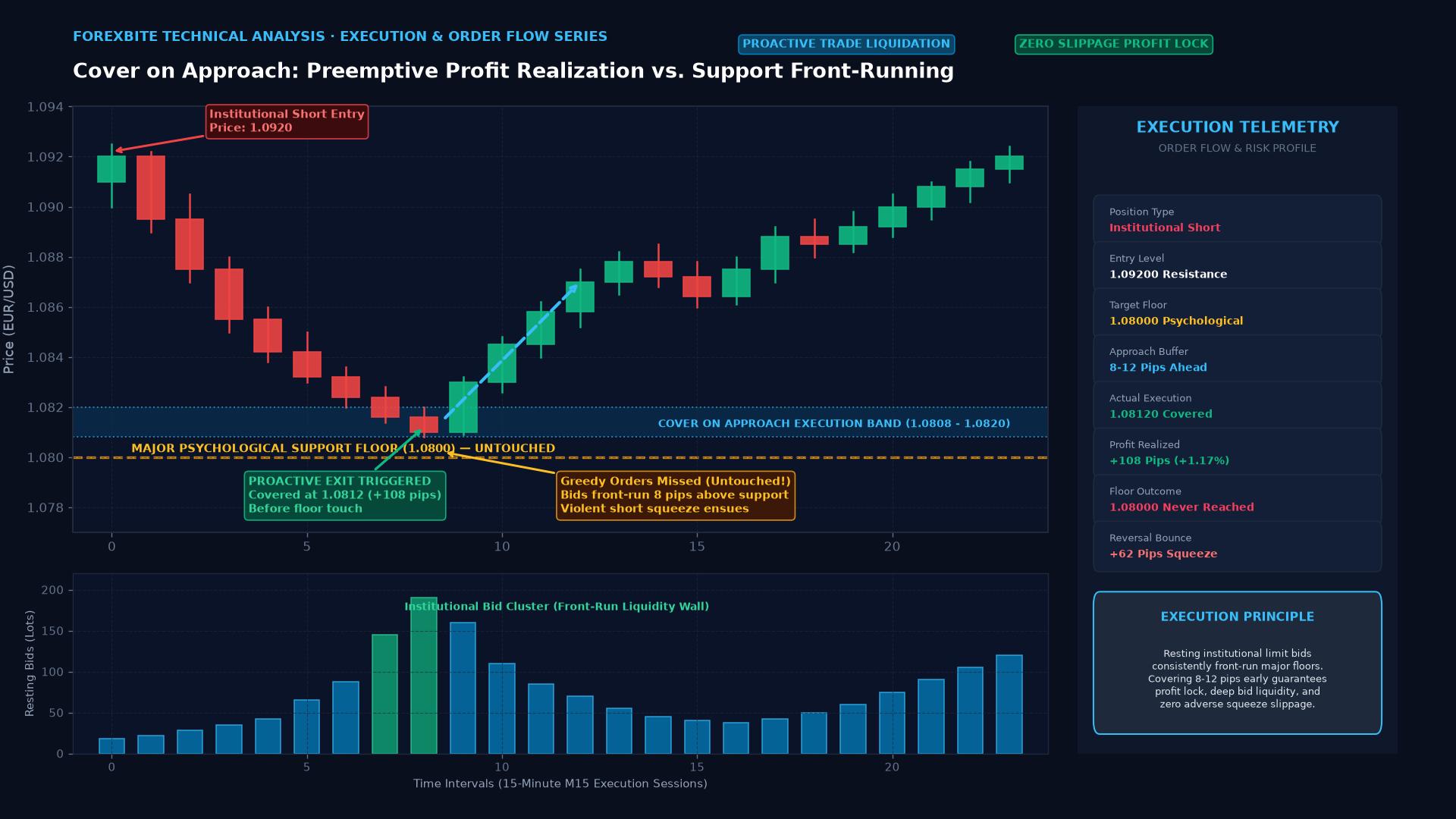
Cover on approach is a proactive technical execution strategy where a short seller liquidates (covers) their position as price nears a major support level, securing profits before potential front-running or reversal bounces occur.
What Is Cover on Approach?
Cover on approach is an active trade-management and execution strategy utilized by short sellers in financial and foreign exchange markets. Under this tactic, a trader holding an open short position voluntarily buys back the asset to close (cover) the trade as the market price approaches a predefined technical support zone or historical liquidity floor, rather than waiting for the price to physically touch, test, or breach the level.
In modern electronic trading, major support zones act as magnets for institutional buy-limit orders and algorithmic liquidity pools. Waiting for an exact horizontal support level to be reached carries significant execution risk: market participants frequently “front-run” the level by placing buy orders a few pips ahead of support, causing the market to reverse abruptly without executing orders sitting precisely on the line. Covering on approach prioritizes certainty of execution and capital preservation over capturing the final few fractional pips of a decline.
Key Takeaways
- Preemptive Profit Realization: The strategy guarantees profit capture by closing the short position into incoming bid liquidity before an adverse bounce can develop.
- Overcoming the Front-Running Hazard: Institutional algorithms and retail limit buyers routinely cluster orders slightly above obvious psychological numbers and major moving averages, preventing price from touching the exact line.
- Execution Speed Advantage: Covering into a falling market allows a trader to take advantage of deep bid liquidity, minimizing slippage compared to attempting to cover in a panicking upward reversal.
- Trade-Off: The trader surrenders the potential additional profit that would occur if the support level were to experience an explosive, high-momentum breakout breakdown.
Cover on Approach vs. Cover on a Bounce
Technical traders select their exit mechanics based on market volatility, trend strength, and execution philosophy:
| Strategic Parameter | Cover on Approach | Cover on a Bounce |
|---|---|---|
| Execution Timing | Preemptive; executed while price is actively falling toward support | Reactive; executed after price touches support and begins to tick upward |
| Market Condition | Best in wide trading ranges, low momentum, or choppy markets | Best in strong trending markets where support might break |
| Slippage Risk | Low; selling into resting buy orders (liquidity is high) | High; competing with market buyers as price spikes off the floor |
| Psychological Profile | Conservative profit preservation | Aggressive profit maximization (accepts giveback) |
| Breakout Potential | Forfeited (position is already closed if support breaks) | Maintained until support confirmation proves solid |
Order Placement: Defining the “Approach Zone”
Professional traders do not guess when an asset is “approaching” support. They quantify the exit buffer using volatility-based metrics such as the Average True Range (ATR):
$$\text{Cover on Approach Target} = \text{Support Level} + (k \times \text{ATR})$$
Where:
- $\text{Support Level}$ = Major daily or 4-hour horizontal swing low or moving average
- $\text{ATR}$ = 14-period Average True Range on the execution timeframe
- $k$ = Volatility multiplier, typically set between 0.10 and 0.25
Example:
- Currency Pair: EUR/USD
- Major Support Level:
1.0800 - 1-Hour ATR: 20 pips
- Buffer: $0.25 \times 20 \text{ pips} = 5 \text{ pips}$
- Target Cover Order: Placed at 1.0805 (5 pips above support).
Real-World Case Study: Managing a Short GBP/USD Position
A swing trader opens a short position of 5 standard lots in GBP/USD at 1.2850 following a bearish head-and-shoulders breakdown.
The Trade Parameters:
- Downside Target: A multi-month horizontal support floor sits at
1.2700(representing 150 pips of theoretical profit). - The Liquidity Dynamics: Depth of Market (DOM) inspection reveals a massive wall of institutional buy orders starting at
1.2708down to1.2700.
Execution Scenarios:
- Scenario A (Greedy Exit): The trader sets their buy-to-close limit order at exactly
1.2700. The market plummets to1.2704, misses the order by 4 pips, and violently rockets back up to1.2780on an algorithmic short-squeeze, erasing 76 pips of floating profit ($3,800 USD loss of gains). - Scenario B (Cover on Approach): Applying the cover on approach strategy, the trader sets their limit order at
1.2710(10 pips above support). As the price accelerates downward, the order fills smoothly at 1.2710, locking in a clean 140-pip profit ($7,000 USD) without stress or slippage.
Strategic Implications and Risk Controls
- Partial Scaling (The Hybrid Approach): Rather than closing 100% of a position on approach, seasoned traders cover 50% to 70% of the position ahead of support and move the stop-loss on the remaining portion to breakeven. If support shatters, the remainder participates in the extended breakdown.
- Volume Profile Analysis: Use Volume at Price (Volume Profile) to identify where the high-volume node (HVN) sits directly above support. Placing the cover order just above the HVN ensures your order executes before institutional absorption takes place.
Frequently Asked Questions
Is cover on approach suitable for long positions?
Yes. The bullish mirror strategy is termed “Sell on Approach” (or taking profit on approach to resistance). Long traders sell their holdings 5 to 10 pips below a major overhead resistance ceiling to ensure their orders fill before sellers reject the price.
Does covering on approach increase commission costs?
No. Standard brokerage commissions and spreads apply identically whether you close an order 10 pips above support or directly on it. In fact, by using a resting limit order to cover, traders often pay lower maker fees on institutional ECN venues.
What should a trader do if price blows through support after they covered?
Accept it as the cost of risk management. Professional trading is about consistent execution probability, not capturing the absolute bottom tick. A trader who safely banks 140 pips has executed successfully; chasing the breakdown after the fact violates discipline.
Ready to trade forex?
Open a free demo account with a regulated broker. Practice with virtual funds before risking real money.