Credit Spread
A credit spread is the difference in yield between a risk-bearing bond and a benchmark risk-free government bond of identical maturity, or an options strategy that generates a net cash credit upon entry.
What Is a Credit Spread?
In global finance and investment analysis, the term credit spread carries two distinct, foundational definitions depending on whether it is referenced in fixed-income debt markets or options derivatives trading:
- In Fixed-Income and Macroeconomics: A credit spread is the yield difference (measured in basis points) between a risk-bearing debt security (such as a corporate bond or emerging market sovereign bond) and a default-free benchmark government security (such as a U.S. Treasury bond or German Bund) of equivalent maturity. It quantifies the additional compensation investors demand for assuming credit, liquidity, and default risk.
- In Options Derivatives Trading: A credit spread is a multi-leg options strategy where an investor simultaneously sells a higher-premium option and buys a lower-premium option of the same underlying asset, expiration date, and option class, resulting in an immediate net cash credit deposited into their account.
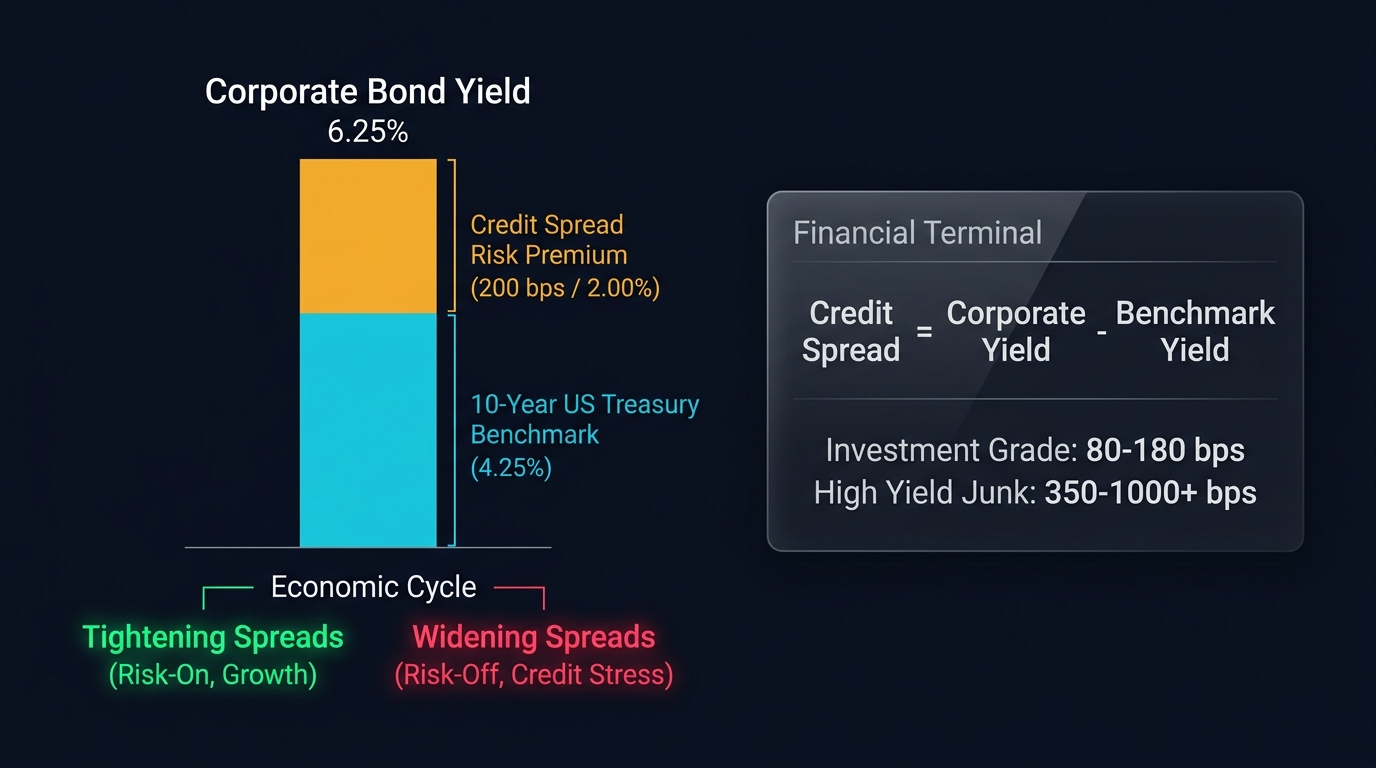
Fixed-Income Credit Spread Decomposition:
┌────────────────────────────────────────────────────────┐
│             CORPORATE BOND YIELD (e.g. 6.25%)          │
└──────────────────────────┬─────────────────────────────┘
                           │
      ┌────────────────────┴────────────────────┐
      ▼                                         ▼
┌──────────────────────────┐      ┌──────────────────────────┐
│  RISK-FREE BENCHMARK     │  +   │      CREDIT SPREAD       │
│  10-Year U.S. Treasury   │      │   Compensation for       │
│     Yield = 4.25%        │      │   Default Risk = 200 bps │
│  (Base Cost of Capital)  │      │   (2.00% Risk Premium)   │
└──────────────────────────┘      └──────────────────────────┘
Key Takeaways
- The Barometer of Financial Health: In macroeconomic analysis, aggregate credit spreads (such as the High Yield Option-Adjusted Spread - OAS) serve as one of the most reliable leading indicators of recessions and credit crunches.
- Widening vs. Tightening: Widening credit spreads signal deteriorating corporate balance sheets, tightening bank lending standards, and rising default risk. Tightening spreads signal economic expansion, corporate earnings growth, and risk-on market conditions.
- Forex Transmission Channel: Surging credit spreads trigger rapid deleveraging across global financial markets, depressing high-beta currencies (AUD, NZD, CAD) while driving safe-haven capital into the U.S. Dollar, Swiss Franc, and Japanese Yen.
- The Options Dimension: In options trading, credit spreads—specifically Bull Put Spreads and Bear Call Spreads—allow traders to generate high-probability recurring income with mathematically defined risk.
Fixed-Income Credit Spreads: Mechanics and Classification
Bond markets price credit risk through yield differentials that adjust continuously across business cycles:
$$\text{Credit Spread (in bps)} = (Y_{\text{Corporate}} - Y_{\text{Risk-Free Benchmark}}) \times 10,000$$
Credit Spread Tiers Across Debt Categories:
- Investment Grade (IG) Spreads: Typically range between 80 and 180 basis points over Treasuries during normal economic expansions.
- High-Yield (“Junk”) Spreads: Typically trade between 300 and 500 basis points during stable periods, but can blowout beyond 1,000 basis points (10.0%) during systemic recessions.
| Market Environment | High Yield OAS Spread | Macro Interpretation | Forex Market Impact |
|---|---|---|---|
| Benign Expansion | < 350 bps | Abundant liquidity, low corporate defaults, strong earnings | High-beta risk currencies rally; carry trades thrive |
| Late-Cycle Stress | 350 – 550 bps | Corporate earnings slow; credit underwriting tightens | Volatility expands; range-bound currency price action |
| Recessionary Crisis | > 700 bps | Credit freeze, liquidity crunch, debt defaults spike | Massive flight to quality; USD and safe havens surge |
Credit Spreads as an FX Sentiment Indicator
Foreign exchange traders monitor the ICE BofA U.S. High Yield Option-Adjusted Spread (OAS) as a primary risk barometer:
Credit Spreads Widen Sharply (e.g. Blowout to 850 bps)
                       │
                       ▼
Corporate Borrowing Costs Surge & Commercial Paper Freezes
                       │
                       ▼
Institutional Hedge Funds De-Risk & Fire-Sale Liquid Assets
                       │
                       ▼
Capital Flees Risk Currencies (AUD, NZD, EM) into Safe Havens (USD, JPY)
When credit spreads widen, carry trades (borrowing low-yielding currencies to invest in high-yielding currencies) become instantly toxic because the capital loss from currency devaluation far exceeds the small interest yield earned.
The Derivatives Dimension: Options Credit Spreads
In options trading, a credit spread allows an investor to profit from the erosion of extrinsic time value ($\Theta$ decay):
1. Bull Put Credit Spread (Moderately Bullish / Neutral)
- Execution: Sell an Out-of-the-Money Put (higher strike $K_2$) and buy a further Out-of-the-Money Put (lower strike $K_1$).
- Cash Flow: Receive a net credit upon trade entry.
- Objective: The underlying asset remains above strike $K_2$, allowing both options to expire worthless so the trader keeps 100% of the net credit.
2. Bear Call Credit Spread (Moderately Bearish / Neutral)
- Execution: Sell an Out-of-the-Money Call (lower strike $K_1$) and buy a further Out-of-the-Money Call (higher strike $K_2$).
- Cash Flow: Receive a net credit upon entry.
- Objective: The underlying asset remains below strike $K_1$, expiring worthless.
$$\text{Maximum Profit} = \text{Net Premium Credit Received}$$
$$\text{Maximum Loss} = (\text{Spread Width between Strikes}) - \text{Net Credit Received}$$
Real-World Case Study: The March 2020 Credit Spread Explosion
During the onset of the COVID-19 pandemic in March 2020, credit spreads provided an unmistakable early warning of global market dislocations:
The Sequence of Events:
- The Blowout: Between February 20 and March 23, 2020, the U.S. High Yield Credit Spread exploded from 338 bps up to 1,087 basis points—a near-instantaneous 750-basis-point widening as corporate bond markets froze.
- Forex Liquidity Scramble: As credit spreads surged past 800 bps, global multinational corporations drew down bank credit lines, creating an unprecedented global shortage of U.S. Dollars.
- Currency Repricing:
- AUD/USD collapsed from
0.6700down to0.5510(-17.7%) within four weeks. - GBP/USD crashed to
1.1410, its lowest level in over three decades. - The U.S. Dollar Index (DXY) surged parabolic above
103.00.
- AUD/USD collapsed from
- The Resolution: Only after the Federal Reserve announced unprecedented corporate credit facilities (PMCCF and SMCCF) to purchase corporate debt did credit spreads contract back below 600 bps, immediately halting the dollar’s ascent and igniting a massive multi-year rally in commodity currencies.
Frequently Asked Questions
Why do bond yields rise when bond prices fall?
Bond prices and yields share an exact mathematical inverse relationship. Because a bond’s annual coupon payout is fixed in dollar terms at issuance, when investors sell bonds due to credit fear and push the market purchase price down, that fixed coupon represents a higher percentage yield relative to the discounted purchase price.
What is the difference between a credit spread and a debit spread in options?
In a credit spread, the option sold is more expensive than the option bought, resulting in a net cash inflow to the trader’s balance at inception (profiting from time decay). In a debit spread, the option bought is more expensive than the option sold, requiring an upfront net cash payment (profiting from strong directional moves).
How can a retail forex trader track credit spreads?
Retail traders can track corporate credit spreads via publicly available benchmark tickers on charting platforms:
- HYG (iShares iBoxx $ High Yield Corporate Bond ETF)
- LQD (iShares iBoxx $ Investment Grade Corporate Bond ETF)
- BAMLC0A0CM (FRED St. Louis Federal Reserve High Yield OAS Index) When HYG and LQD drop precipitously, corporate credit spreads are widening, signaling immediate caution for long currency risk positions.
Ready to trade forex?
Open a free demo account with a regulated broker. Practice with virtual funds before risking real money.