Currency Symbol
A currency symbol is a graphic typographic glyph (such as $, €, £, or ¥) or standardized three-letter alphanumeric code (ISO 4217) used to denote a specific monetary unit in commerce, banking, and financial markets.
What Is a Currency Symbol?
A currency symbol is a standardized typographic glyph or alphanumeric representation used to signify a specific sovereign currency unit in global commerce, banking ledgers, and financial market quotations. In financial analysis, the term encompasses two distinct identification systems:
- Graphic Currency Symbols (Glyphs): Visual graphic marks—such as $ (Dollar), € (Euro), £ (Pound Sterling), ¥ (Yen/Yuan), and ₹ (Indian Rupee)—used primarily in retail pricing, marketing, and general business documentation to denote money quickly without spelling out the currency name.
- ISO 4217 Three-Letter Currency Codes: The universal, unambiguous international standard maintained by the International Organization for Standardization (ISO). In institutional foreign exchange, banking wire transfers (SWIFT), and electronic trading protocols (FIX), ISO 4217 codes (such as USD, EUR, GBP, JPY, and CHF) are mandatory to eliminate the severe ambiguity inherent in generic typographic symbols.
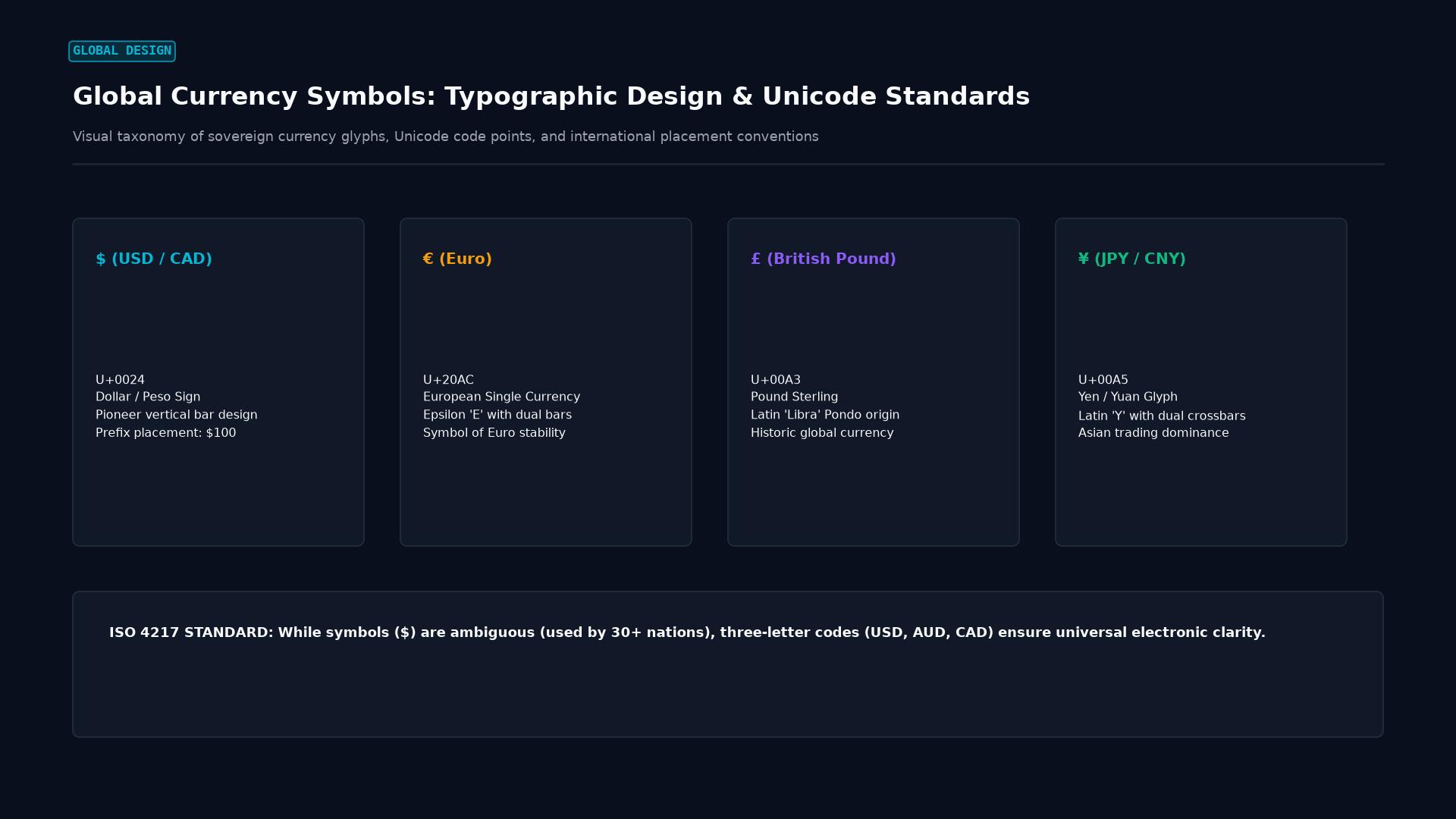 Figure: Taxonomy of monetary typography: Unicode standardization of major currency symbols ($, €, £, ¥) and three-letter ISO 4217 disambiguation.
Key Takeaways
- The ISO 4217 Architecture: The three-letter standard follows a strict rule: the first two characters designate the two-letter ISO country code, while the third character denotes the initial letter of the national currency unit (e.g.,
US+D= USD). - Resolving Symbol Ambiguity: More than thirty sovereign nations utilize the dollar sign ($). Relying on the generic
$in international contracts creates legal disputes; institutional contracts legally mandate ISO 4217 codes (e.g., specifying USD vs. CAD vs. AUD). - The Supranational “X” Prefix: Currencies, precious metals, and supranational monetary units not tied to an individual sovereign nation begin with the letter X under ISO standards (e.g., XAU for Gold, XAG for Silver, and XDR for the IMF Special Drawing Right).
- Number Code Integration: Every ISO 4217 currency is also assigned a unique three-digit numeric code (e.g., USD = 840, EUR = 978) utilized in legacy mainframe banking systems and non-Latin character computing environments.
The ISO 4217 Structural Matrix
The table below outlines the global benchmark currencies, their official ISO 4217 codes, numeric identifiers, and graphic symbols:
| Sovereign Entity | Currency Name | ISO Code | Numeric Code | Graphic Glyph | Minor Unit (Sub-division) |
|---|---|---|---|---|---|
| United States | US Dollar | USD | 840 | $ | 100 Cents (2 decimals) |
| Eurozone | Euro | EUR | 978 | € | 100 Cents (2 decimals) |
| United Kingdom | British Pound Sterling | GBP | 826 | £ | 100 Pence (2 decimals) |
| Japan | Japanese Yen | JPY | 392 | ¥ | 0 (Zero decimals in cash) |
| Switzerland | Swiss Franc | CHF | 756 | Fr. / CHF | 100 Rappen/Centimes (2 decimals) |
| Australia | Australian Dollar | AUD | 036 | $ / A$ | 100 Cents (2 decimals) |
| Canada | Canadian Dollar | CAD | 124 | $ / C$ | 100 Cents (2 decimals) |
| India | Indian Rupee | INR | 356 | ₹ | 100 Paise (2 decimals) |
| China | Chinese Yuan (Renminbi) | CNY | 156 | ¥ / 元 | 10 Jiao / 100 Fen (2 decimals) |
| Global Bullion | Troy Ounce of Gold | XAU | 959 | Au | N/A (Commodity weight) |
Deconstructing the ISO 4217 Formula
The International Organization for Standardization establishes currency nomenclature through a deterministic three-character formula:
$$\text{ISO 4217 Code} = [\text{ISO 3166-1 Alpha-2 Country Code}] + [\text{First Letter of Currency Name}]$$
Breakdown Examples:
- Japan: Country Code =
JP, Currency = Yen (Y) $\implies$ JPY - Great Britain: Country Code =
GB, Currency = Pound (P) $\implies$ GBP - Canada: Country Code =
CA, Currency = Dollar (D) $\implies$ CAD - Australia: Country Code =
AU, Currency = Dollar (D) $\implies$ AUD - Switzerland: Country Code =
CH(Confoederatio Helvetica in Latin), Currency = Franc (F) $\implies$ CHF
Exceptions to the Rule:
- The Euro (EUR): Because the Euro is the currency of the multi-nation European Union rather than an individual sovereign state, the ISO created a dedicated regional exemption code (
EUR). - The “X” Series (Commodities & Supranationals): ISO allocates codes beginning with “X” to assets that transcend national borders:
- XAU: Gold (from Latin Aurum)
- XAG: Silver (from Latin Argentum)
- XPT: Platinum
- XDR: Special Drawing Rights (IMF)
- XOF / XAF: West African and Central African CFA Francs
Typographic Conventions and Global Placement Rules
The visual placement of a currency symbol varies across international borders, dictated by regional linguistic customs:
Prefix Placement (Anglo-American Standard):
Placed before the number without space: $1,500.50 | £250.00 | ¥10,000

Suffix Placement (Continental European Standard):
Placed after the number with a non-breaking space: 1 500,50 € | 250,00 Fr.- Punctuation Inversion: In English-speaking jurisdictions (US, UK, Australia), a comma is used as the thousands separator and a period as the decimal mark (
$1,250.75). In Continental Europe and Latin America, the roles are reversed: a period separates thousands and a comma marks decimals (1.250,75 €). - In international financial contracts, best practices require explicitly prefixing ambiguous symbols (e.g., using
US$ 1,000orC$ 1,000) or replacing them entirely with the ISO code (1,000 USD).
Frequently Asked Questions
Why does Bitcoin have multiple currency codes (BTC vs. XBT)?
In popular retail usage and cryptocurrency exchanges, Bitcoin is widely identified by the informal ticker BTC. However, because “BT” was already assigned to the sovereign nation of Bhutan under ISO country standards, major institutional derivative exchanges and the ISO framework designated XBT as the compliant supranational code (matching the “X” convention of gold and silver).
What is the currency code for offshore Chinese Yuan?
Onshore Chinese Yuan traded inside mainland China is designated CNY. Offshore Chinese Yuan traded primarily through Hong Kong, London, and Singapore is designated CNH. While both represent the identical underlying currency (Renminbi), they trade at slightly different market prices due to mainland capital controls.
Where did the Dollar sign ($) originate?
The dollar symbol $ evolved in the late 18th century from the abbreviation of the Spanish-American Peso (real de a ocho or “Pieces of Eight”), which was the dominant trade currency in North America before the U.S. Mint was established. Merchants abbreviated “pesos” as “ps”, which scribes gradually overlapped into a single glyph featuring an “S” superimposed over a “P”.
Ready to trade forex?
Open a free demo account with a regulated broker. Practice with virtual funds before risking real money.