Custodian
A custodian (custodian bank) is a specialized financial institution responsible for the safekeeping, administration, and legal segregation of client securities, cash, and financial assets, safeguarding them against theft or intermediary insolvency.
What Is a Custodian?
A custodian (commonly referred to as a custodian bank) is a specialized financial institution that holds and safeguards a firm’s or individual’s financial assets—including stocks, sovereign bonds, commodities, foreign exchange cash reserves, and mutual fund shares. Unlike commercial banks, which take customer deposits and lend them out to borrowers (fractional reserve banking), a custodian’s primary fiduciary obligation is the absolute safekeeping, custody, and legal segregation of client property.
In institutional wealth management, hedge funds, sovereign pension schemes, and retail brokerage, custodians act as the independent third-party pillar of the financial system. By legally separating the entity that manages or trades the assets (the asset manager or broker) from the entity that physically or electronically holds the assets (the custodian), the system prevents fraudulent embezzlement, unauthorized liquidation, and counterparty loss in the event of intermediary insolvency.
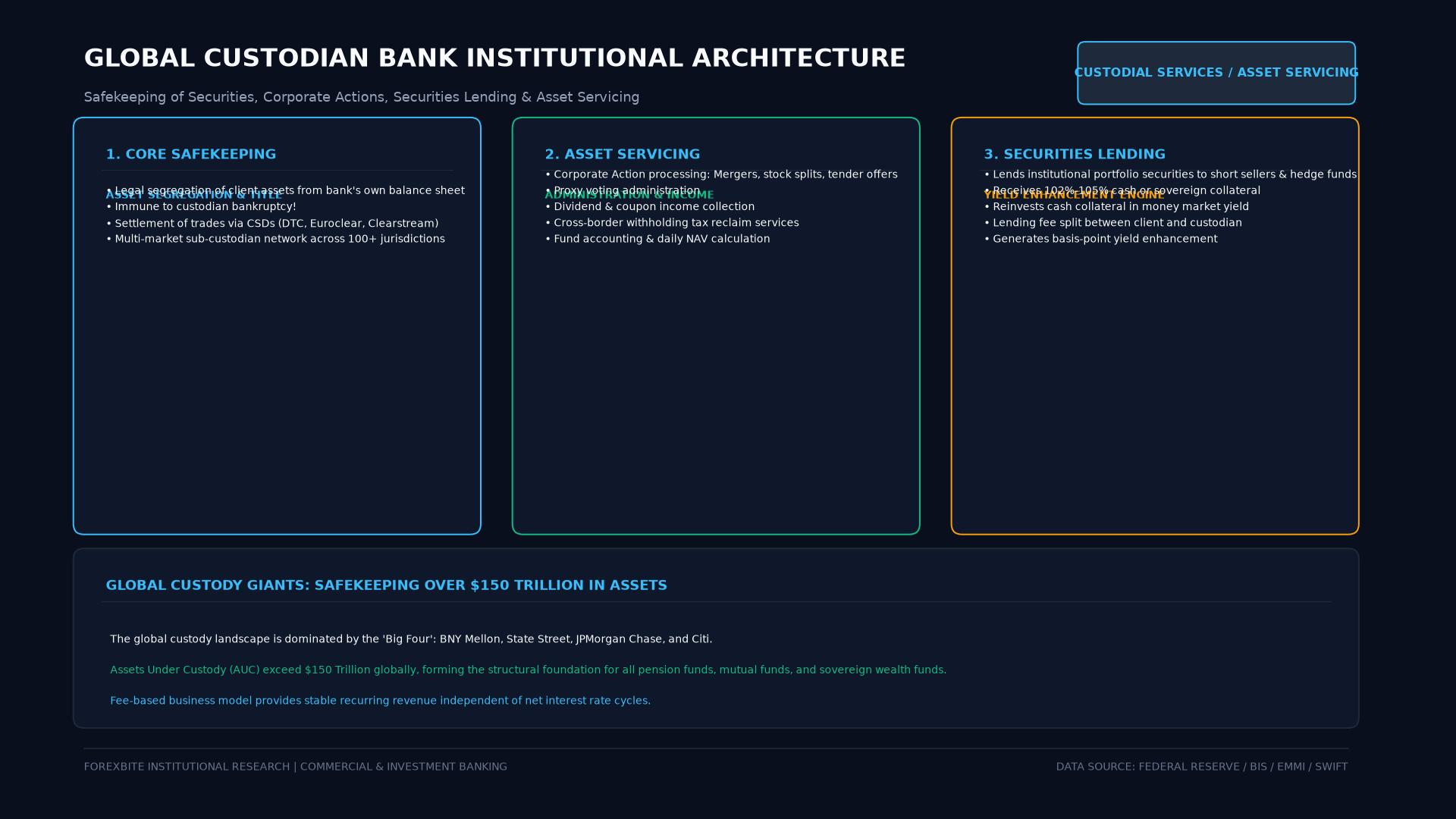 Figure: Institutional custody infrastructure: bankruptcy-remote asset safekeeping, sub-custodian network, corporate actions processing, and settlement.
Key Takeaways
- Segregation of Assets: Assets held in custody are legally protected off-balance-sheet; if the custodian bank or trading broker goes bankrupt, the client’s assets cannot be claimed by general creditors.
- Global Custody Giants: The global institutional custody market is anchored by major tier-one custodian banks, notably BNY Mellon, State Street, JPMorgan Chase, and Citi, which collectively safe-keep tens of trillions of dollars in assets.
- Administrative Agency Services: Beyond mere safekeeping, custodians handle dividend and interest coupon collection, corporate actions (stock splits, mergers, proxy voting), tax reclamation, and trade settlement.
- Sub-Custodians in Emerging Markets: For international assets, global custodians partner with licensed local sub-custodian banks to clear transactions within foreign domestic regulatory frameworks.
The Core Functions of a Custodian Bank
A custodian performs a broad array of operational, clearing, and fiduciary activities on behalf of institutional clients:
| Core Custodial Function | Operational Process | Benefit to Investor |
|---|---|---|
| Safekeeping & Book-Entry | Electronic ledger registration of securities with central depositories (e.g., DTCC, Euroclear, Clearstream) | Complete protection against physical loss, theft, or unauthorized transfer |
| Trade Settlement & Clearing | Transferring cash and securities on value date via Delivery-versus-Payment (DvP) | Eliminates settlement risk; ensures delivery occurs if and only if payment is made |
| Corporate Actions Administration | Processing mandatory/voluntary tender offers, rights issues, and proxy votes | Ensures clients never miss corporate dividend deadlines or voting rights |
| Income Collection & Tax Relief | Automatically collecting interest coupons and dividends, filing cross-border withholding tax treaties | Optimizes net portfolio yield; reduces foreign dividend tax drag |
| Fund Accounting & Valuation | Calculating daily Net Asset Value (NAV) for mutual funds and exchange-traded funds (ETFs) | Provides verified, auditable pricing transparency for fund investors |
Legal Asset Protection: Why Custodial Segregation Matters
The most critical legal distinction in banking is between an unsecured commercial deposit and an off-balance-sheet custodial account:
$$\text{Commercial Bank Deposit} \implies \text{Debtor-Creditor Relationship (Unsecured Loan to Bank)}$$
$$\text{Custodial Holding} \implies \text{Bailment / Trust Relationship (Client Retains Absolute Property Title)}$$
- When you deposit money into a commercial checking account, the bank legally owns your money and lists it as an asset on its balance sheet, issuing you an IOU. If the bank fails, you are an unsecured creditor (insured only up to national caps like FDIC $250,000).
- When assets are placed with a custodian, the bank holds the assets in a trust capacity. The assets never appear on the custodian’s corporate balance sheet. If a custodian bank enters bankruptcy, 100% of client custody assets are transferred intact to a new custodian, completely immune to the claims of the bank’s bankruptcy liquidators.
Real-World Case Study: The Madoff Fraud and the Custody Failure
The devastating Bernie Madoff Ponzi scheme (which collapsed in December 2008 with $65 billion in paper losses) occurred precisely because of the absence of an independent custodian:
The Fatal Flaw:
- Bernie Madoff operated his investment advisory firm (Bernard L. Madoff Investment Securities LLC) as a self-clearing broker-dealer that acted simultaneously as asset manager, executing broker, and asset custodian.
- Clients sent funds directly to Madoff’s firm. Madoff generated fake trade confirmations and monthly account statements from an unmonitored back-office computer, claiming double-digit annual returns.
- Because there was no independent custodian bank holding the actual shares or verifying that trades were cleared at the DTCC, Madoff simply deposited client funds into a personal JPMorgan Chase business checking account and paid off redemptions using new investors’ money.
The Regulatory Overhaul:
Following the disaster, global regulators (including the U.S. SEC under Rule 206(4)-2, known as the Custody Rule) mandated that registered investment advisers managing client funds must maintain those assets with a Qualified Independent Custodian, permanently ending self-custody loopholes.
Custody in Modern Forex and Digital Assets
As financial markets evolve into decentralized protocols and digital assets, custody models have transformed:
- Retail Forex Segregation: Regulated forex brokers (under FCA, ASIC, CFTC) are legally mandated to hold client margin deposits in segregated accounts at Tier-1 commercial custodian banks (such as Barclays or National Australia Bank), ensuring broker operational expenditures cannot touch client trading capital.
- Cryptocurrency Custody: Digital asset custodians (e.g., Coinbase Custody, BitGo, Fidelity Digital Assets) utilize cold-storage multi-signature hardware modules (HSMs) and institutional insurance policies to protect cryptographic private keys against cyber-theft.
Frequently Asked Questions
What is the difference between a broker and a custodian?
A broker is an execution venue that matches buy and sell orders, executes trades, and provides market access. A custodian is the vault entity that holds legal possession of the cash and securities after execution is completed, ensuring the broker cannot misappropriate the client’s property.
Can a custodian bank lend out my securities?
Only if you explicitly sign a Securities Lending Agreement. In institutional finance, pension funds often authorize custodians to lend their shares to short sellers in exchange for an annualized interest fee (which is split between the fund and the custodian). If you do not authorize lending, the custodian must keep your assets fully segregated.
What are the “Big Four” global custodian banks?
The institutional custody industry is dominated by four American institutions known as the global custodian leaders: BNY Mellon (over $45 trillion in assets under custody), State Street (~$40 trillion), JPMorgan Chase, and Citigroup.
Ready to trade forex?
Open a free demo account with a regulated broker. Practice with virtual funds before risking real money.