Daily Trading Limit (Price Limit)
A daily trading limit is a regulatory price threshold established by an exchange that restricts the maximum upward or downward price movement permitted for a futures contract or security during a single trading session.
What Is a Daily Trading Limit?
A daily trading limit (also known as a daily price limit) is an exchange-mandated regulatory restriction that establishes the maximum allowable price fluctuation—both upward and downward—that a futures contract, commodity, or equity security is permitted to trade within a single session, calculated relative to the previous day’s official closing settlement price.
When an asset’s market price reaches its upper threshold, it is said to be “Limit Up”; when it hits its lower boundary, it is “Limit Down.”
Daily trading limits are engineered by derivatives exchanges (such as the Chicago Mercantile Exchange - CME, Intercontinental Exchange - ICE, and Shanghai Futures Exchange) to prevent market panics, curb cascading margin liquidations, provide cooling-off periods during extreme volatility events, and safeguard the solvency of clearing house members.
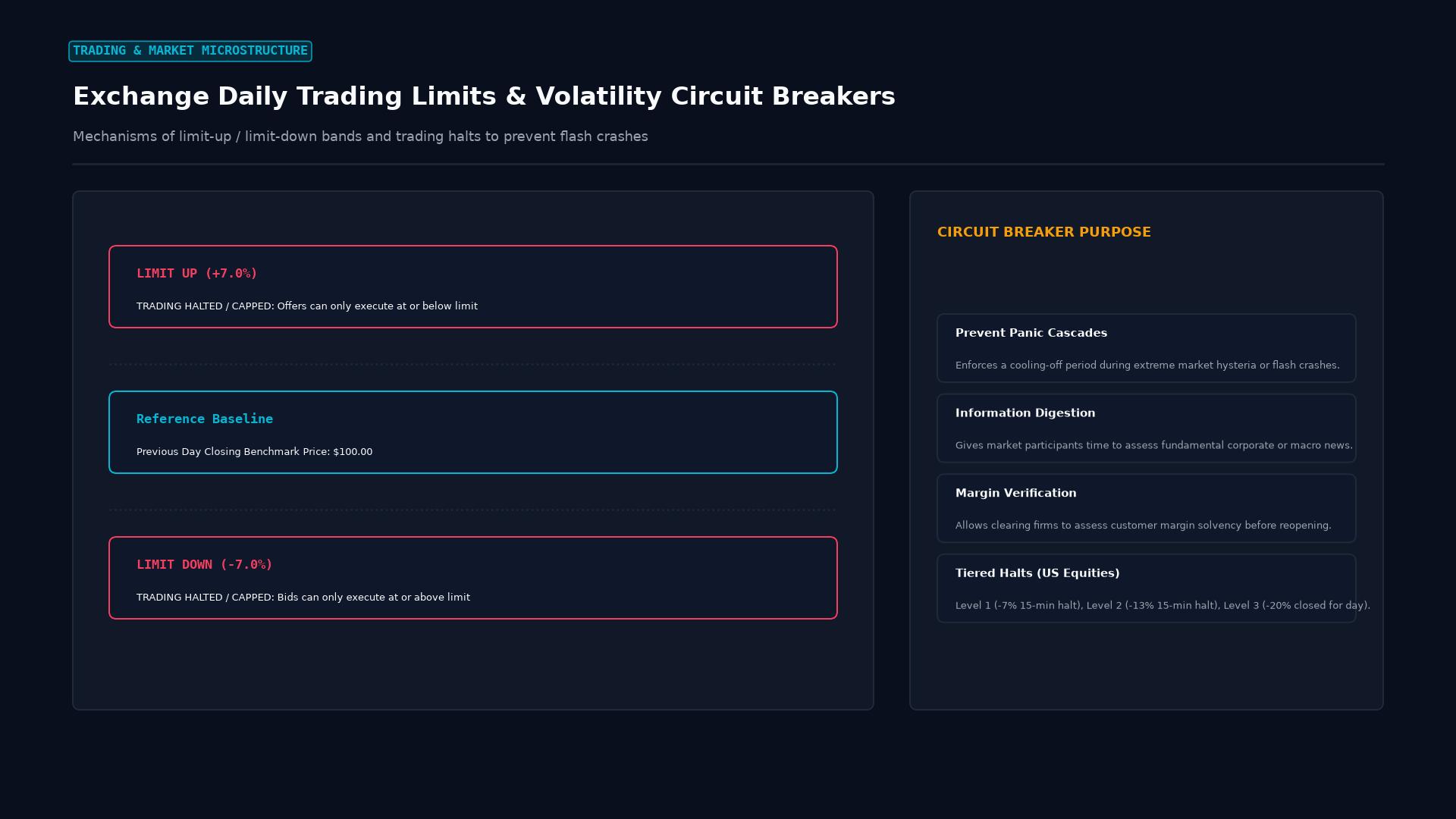 Figure: Market stabilization safeguards: limit-up and limit-down bands triggering automated trading pauses and halts to curb panic flash crashes and allow information digestion.
Technical Mechanics & The “Locked Market” Condition
The price limit bands are calculated prior to the market open based on the prior day’s official settlement price ($P_{\text{settle}}$):
Limit Formulas
$$P_{\text{Limit Up}} = P_{\text{settle}} \times (1 + \text{Limit %})$$
$$P_{\text{Limit Down}} = P_{\text{settle}} \times (1 - \text{Limit %})$$
For example, in CME agricultural futures (such as Corn or Soybeans), limits are quoted in fixed cent increments (e.g., $0.35 per bushel). If December Corn settles at $5.00, the daily limits for the following session are bounded between $4.65 (Limit Down) and $5.35 (Limit Up).
The Locked Market
When violent news strikes, the market can become “locked limit”:
- Locked Limit Down: The market hits the lower limit price, and sellers willing to liquidate far exceed buyers. Because exchange rules prohibit any trades below the limit price, trading essentially freezes; sellers are trapped, and no orders can clear until new buyers enter at the limit price or the exchange widens the bands the following day.
- Expanded Limits: If a contract closes locked limit on consecutive days, exchanges automatically invoke expanded limit rules, temporarily widening the allowable percentage band (e.g., from 5% to 7.5% or 10%) to allow price discovery to clear the backlog of orders.
Circuit Breakers: US Equity Market Rules (Rule 80B)
In the United States equity markets, market-wide circuit breakers operate based on percentage drops in the S&P 500 Index relative to the prior day’s close:
| Circuit Breaker Tier | Trigger Threshold | Market Action (Before 3:25 PM EST) | Market Action (After 3:25 PM EST) |
|---|---|---|---|
| Level 1 | 7.0% decline in S&P 500 | 15-minute trading halt across all US exchanges | Trading continues normally |
| Level 2 | 13.0% decline in S&P 500 | 15-minute trading halt across all US exchanges | Trading continues normally |
| Level 3 | 20.0% decline in S&P 500 | Trading halted for remainder of the day | Trading halted for remainder of the day |
In individual stocks, the Limit Up-Limit Down (LULD) mechanism halts trading for 5 minutes if an individual stock’s price deviates outside a rolling 5-minute price band (typically 5% to 10%).
Real-World Case Study: The Four Circuit Breakers of March 2020
The unprecedented real-world deployment of daily trading limits and circuit breakers occurred during the onset of the COVID-19 pandemic in March 2020.
Anatomy of a Historic Limit Cascade:
1. March 9, 2020 (Black Monday I): Overnight E-mini S&P futures hit the 5% overnight Limit Down band. At the 09:30 EST cash open, the S&P 500 plunged 7% within seconds, triggering a Level 1 circuit breaker (first market-wide halt since 1997).
2. March 12, 2020 (Black Thursday): European travel bans triggered another immediate 7% collapse at the open, halting the market for 15 minutes.
3. March 16, 2020 (Black Monday II): Despite the Fed cutting rates to zero over the weekend, the market opened down 8.14%, immediately triggering a third Level 1 halt.
4. March 18, 2020: The S&P 500 triggered its fourth Level 1 circuit breaker in eight trading sessions.
The circuit breakers successfully paused automated algorithmic panic selling, allowing brokers to issue margin calls and institutional risk managers to calculate counterparty exposures without clearing house defaults.
Frequently Asked Questions (FAQ)
What happens to a trader’s open orders when a futures market becomes “locked limit”?
When a futures contract becomes locked limit down, all resting bids below the limit price are cancelled or rejected by the matching engine. Market sell orders and stop-loss sell orders cannot be executed because there are no buyers permitted to transact below the limit price. Traders attempting to exit long positions become trapped until the market either re-opens above the limit price or the exchange broadens the limits in the next trading session.
Why does the spot foreign exchange (forex) market not have daily trading limits?
The spot foreign exchange market is an over-the-counter (OTC), decentralized global interbank market that has no central exchange or single governing regulatory authority. Because trading takes place across thousands of commercial banks and ECN networks operating 24 hours a day across London, New York, Tokyo, and Singapore, there is no single entity that could enforce a market-wide trading halt. However, regulated currency futures traded on the CME (such as Euro FX or Japanese Yen futures) do maintain formal daily price limit collars.
What is the difference between a trading halt and a daily price limit?
A daily price limit restricts the price range within which trades can occur; trading can continue to take place at or inside the limit boundary. A trading halt is a total cessation of all trading activity for a security or entire exchange. During a trading halt, the matching engine stops executing transactions entirely, order entry may be paused, and no trades can occur at any price until the exchange formally reopens the market.
Ready to trade forex?
Open a free demo account with a regulated broker. Practice with virtual funds before risking real money.