Daisy Chaining
Daisy chaining is an illicit market manipulation scheme where an interconnected group of colluding brokers, traders, or entities trade a security among themselves in rapid succession to manufacture artificial volume and inflate prices before dumping shares onto unsuspecting investors.
What Is Daisy Chaining?
In securities regulation and forensic financial analysis, daisy chaining refers to an illegal price and volume manipulation scheme in which an organized ring of colluding broker-dealers, offshore shell entities, or market participants trade blocks of an illiquid security back and forth among themselves in rapid succession.
The objective of a daisy chain is to manufacture the fraudulent illusion of intense market liquidity and upward commercial momentum. Because the shares are simply rotating within a closed circle of coconspirators, there is zero genuine change in beneficial ownership.
Unsuspecting retail investors and momentum algorithms, scanning the market for unusual volume spikes and rising prices, are tricked into buying the inflated shares. Once sufficient retail liquidity enters the market, the daisy chain participants terminate the scheme and dump their remaining holdings onto the public—a specialized form of the classic pump-and-dump operation.
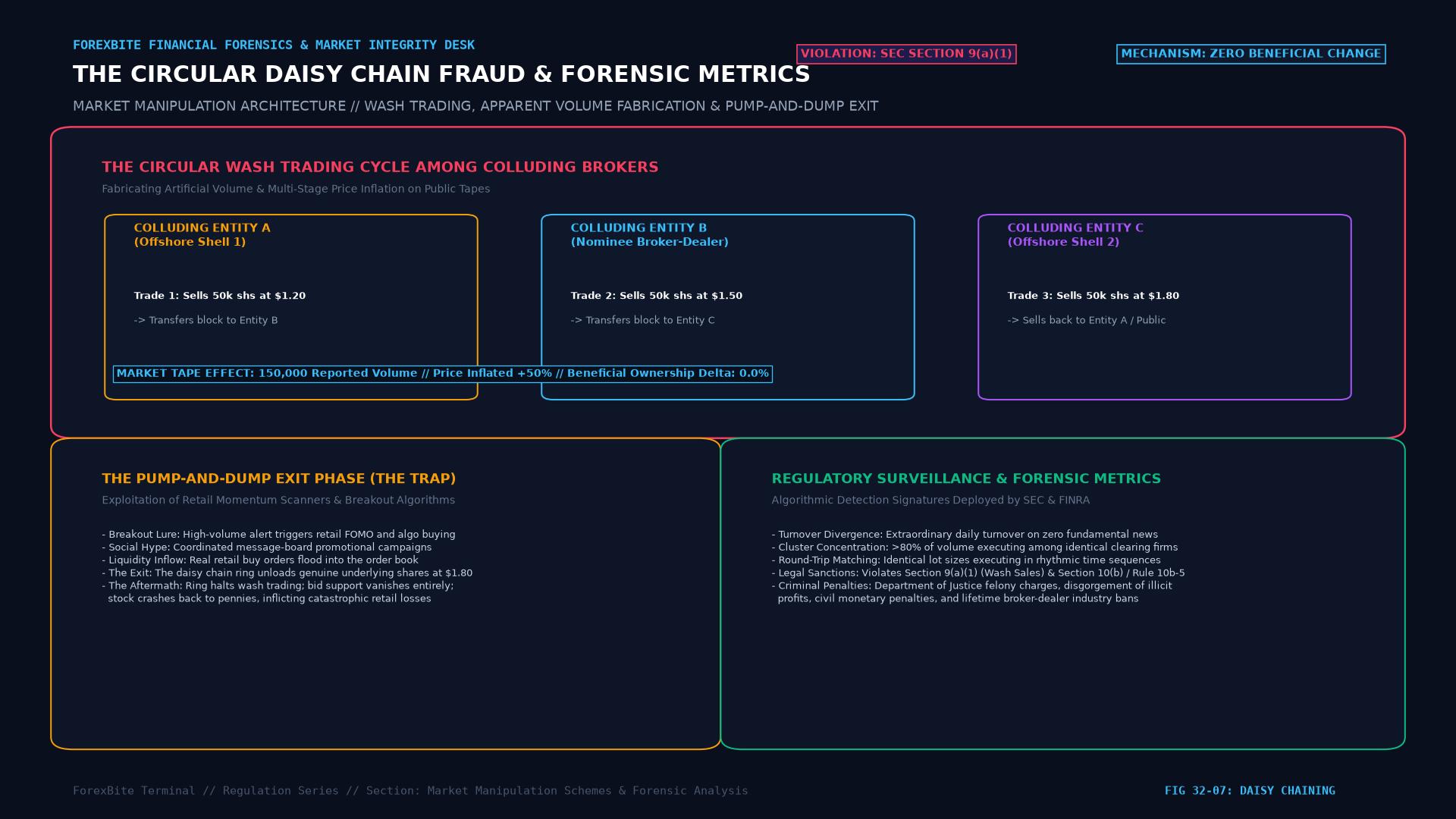 Figure: The circular wash trading mechanics of a daisy chain manipulation ring fabricating artificial market volume and trapping retail traders.
Technical Mechanics & Forensic Detection Metrics
Regulators (such as the US Securities and Exchange Commission - SEC and the Financial Industry Regulatory Authority - FINRA) deploy automated algorithmic surveillance systems to detect circular daisy chain patterns:
The Apparent vs. Net Beneficial Volume Equation
In a legitimate market, total reported trading volume ($V_{\text{total}}$) correlates directly with the net transfer of beneficial ownership across independent market participants:
$$\Delta \text{Beneficial Ownership} \approx V_{\text{total}}$$
In a daisy chain manipulation:
$$\text{Reported Tape Volume} = \sum_{k=1}^{m} V_{\text{circular}, k} \gg \Delta \text{True Beneficial Ownership} \approx 0$$
Forensic Indicators of a Daisy Chain:
- High Participant Concentration Ratio: A tiny group of broker-dealer clearing IDs accounts for over 80% to 90% of both buy-side and sell-side volume in an obscure micro-cap stock.
- Synchronized Round-Trip Velocity: High frequency of offsetting buy and sell orders executing within seconds or minutes between the same entities at pre-arranged stepping price tiers.
- Absence of Fundamental News: Massive volume surges (10x to 50x 30-day average volume) occurring in the total absence of regulatory SEC filings, corporate earnings, or press releases.
Comparative Matrix: Market Manipulation Paradigms
| Manipulation Tactic | Execution Mechanism | Intent | Regulatory Classification |
|---|---|---|---|
| Daisy Chaining | Circular trades among a collusive ring | Manufacture fake volume & price momentum | Felony Securities Fraud |
| Wash Trading | Single entity buying and selling to itself | Tax avoidance or faking crypto exchange volume | Illegal under Commodity Exchange Act |
| Painting the Tape | High-volume trades printed at market close | Manipulate closing price for margin reports | Market Manipulation (Securities Act §9) |
| Spoofing | Submitting large orders with intent to cancel | Move prices toward smaller resting orders | Illegal under Dodd-Frank Act |
Secondary Definition: Daisy Chaining in Interbank Counterparty Risk
In systemic risk and derivatives clearing, the term “daisy chain” carries a secondary, non-fraudulent meaning: it describes an extended chain of bilateral interbank counterparty exposures.
$$\text{Bank A} \xrightarrow{\text{Swap}} \text{Bank B} \xrightarrow{\text{Swap}} \text{Bank C} \xrightarrow{\text{Swap}} \text{Bank D}$$
If Bank A defaults, the sudden loss of cash flow can cause Bank B to default on its obligation to Bank C, triggering a domino collapse through the financial network. This structural vulnerability was the primary catalyst behind the post-2008 Dodd-Frank and EMIR mandates, which legally required standardized OTC derivatives to clear through Central Counterparties (CCPs), breaking the bilateral daisy chain.
Real-World Case Study: The “Boiler Room” Era & Penny Stock Fraud (1990s)
The height of organized daisy chaining occurred in the over-the-counter (OTC) Bulletin Board and Pink Sheets penny stock markets during the late 1980s and 1990s, most notoriously practiced by rogue brokerage firms such as Stratton Oakmont (founded by Jordan Belfort).
Anatomy of a Micro-Cap Daisy Chain:
1. The Acquisition: Stratton Oakmont acquired 85% of the restricted float of an obscure micro-cap company through foreign nominee accounts and offshore shell corporations.
2. The Daisy Chain: The firm's traders passed thousands of shares back and forth across multiple internal trading accounts, raising the quote from $0.50 to $4.50 over several days while printing artificial volume.
3. The Boiler Room Push: Hundreds of aggressive stockbrokers cold-called retail investors across America, pointing to the surging volume and price charts as proof of an imminent institutional takeover.
4. The Liquidation: When retail buy orders poured in, the firm dumped its real holdings at inflated prices, capturing millions in illicit profits. The stock collapsed back to pennies within weeks.
The scandal resulted in the passage of the Penny Stock Reform Act of 1990 and the implementation of FINRA’s automated Electronic Blue Sheets (EBS) surveillance platform.
Frequently Asked Questions (FAQ)
What is the legal difference between wash trading and daisy chaining?
Wash trading typically involves a single market participant (an individual or single entity) acting as both the buyer and seller of the same transaction (e.g., using two separate accounts owned by the same person) with zero change in beneficial ownership. Daisy chaining involves an organized conspiracy of multiple separate colluding individuals, brokerages, or offshore entities who trade the security in a circular chain to obscure the manipulative intent and evade simple wash-trading automated filters.
How do modern electronic crypto exchanges combat daisy chaining?
In cryptocurrency markets, unregulated offshore exchanges historically tolerated or facilitated daisy chaining and wash trading by proprietary market-making desks to artificially inflate their reported 24-hour trading volumes on data ranking aggregators (such as CoinMarketCap). Regulated centralized crypto exchanges combat this by implementing mandatory KYC/AML identity verification, transaction-level surveillance software (such as Chainalysis and TRM Labs), and imposing maker-taker trading fees that make high-volume circular trading economically unprofitable.
What penalties do perpetrators of daisy chaining face?
Under US federal securities laws (including Section 9(a) and Section 10(b) of the Securities Exchange Act of 1934 and Rule 10b-5), engaging in daisy chaining is a federal crime. Civil penalties imposed by the SEC include permanent bans from the securities industry, total disgorgement of all illicit trading profits plus prejudgment interest, and substantial monetary fines. Criminal prosecution by the Department of Justice (DOJ) routinely results in felony convictions and multi-year federal prison sentences.
Ready to trade forex?
Open a free demo account with a regulated broker. Practice with virtual funds before risking real money.