Date Draft
A date draft is a specialized bill of exchange or commercial draft that specifies a fixed, unconditional calendar payment date upon which the funds must be remitted, regardless of the date of formal acceptance by the drawee.
What Is a Date Draft?
In international trade finance and commercial banking, a date draft is a specific type of bill of exchange (or commercial draft) that mandates payment on a strictly designated calendar date specified on the face of the document (for example, “Pay to the order of Exporter Corp on October 15, 2026”).
The defining characteristic of a date draft is that its maturity date is completely fixed at the moment of issuance. Unlike a time draft (which matures a specified number of days after the buyer formally inspects and accepts the draft) or a sight draft (which is payable immediately upon demand), a date draft’s maturity date remains unaltered by shipping transit delays, port customs holdups, or the exact date on which the buyer (the drawee) signs the acceptance.
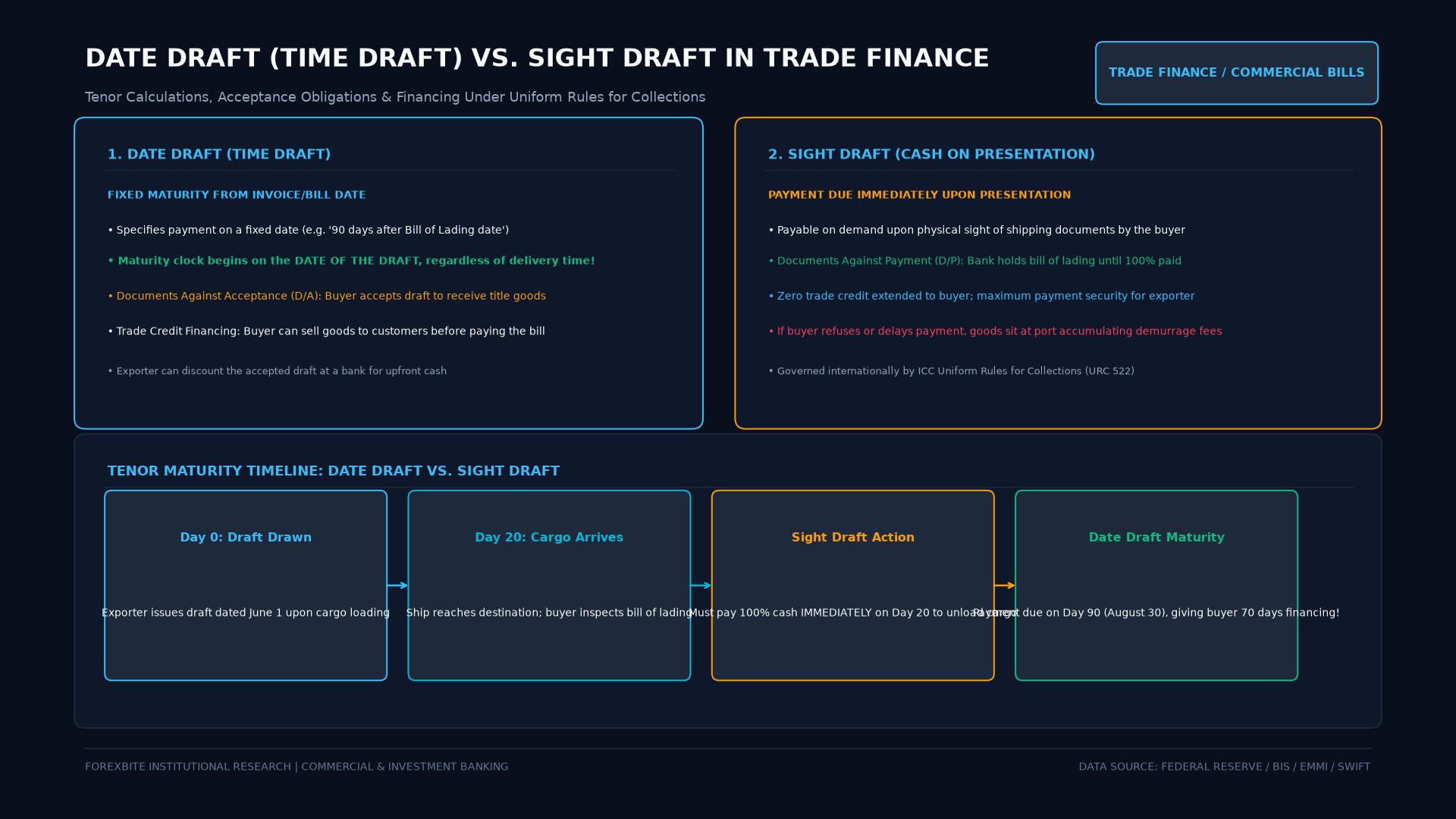 Figure: Negotiable trade instrument timeline: fixed maturity date anchored to invoice date regardless of acceptance date, versus sight and time drafts.
Technical Mechanics & Discounting Calculations
Date drafts provide vital financial certainty for exporters, enabling them to sell or discount the draft in the secondary money market before the fixed maturity date arrives—a process known as forfaiting or creating a Banker’s Acceptance (BA).
Mathematical Discounting Formulation
If an exporter holds an accepted date draft with face value $F$ maturing on fixed date $T$, and sells the instrument to a commercial bank $N$ days prior to maturity at an annualized discount rate $d$:
$$\text{Net Cash Proceeds } (P) = F \times \left( 1 - d \times \frac{N}{360} \right)$$
$$\text{Discount Fee} = F \times d \times \frac{N}{360}$$
Because the calendar maturity date is known with absolute certainty, the number of days $N$ is static and mathematically locked. In contrast, with a time draft (e.g., “90 days after sight”), the discounting bank cannot lock in $N$ until the importer formally accepts the documents abroad, introducing interest rate duration uncertainty.
Comparative Matrix: Commercial Draft Typologies
| Draft Type | Maturity Determination | Payment Timing | Primary Use Case | Seller Cash-Flow Predictability |
|---|---|---|---|---|
| Date Draft | Fixed calendar date stated at issuance | On the specified date, regardless of acceptance | Cross-border trade with seasonal financing | Maximum (Exact payment date known) |
| Sight Draft | Payable immediately upon presentation (“at sight”) | Immediate upon document inspection | High-risk buyers; cash-on-delivery | High |
| Time (Usance) Draft | $X$ days after date of acceptance or Bill of Lading | Variable; depends on acceptance date | Standard commercial credit terms (30/60/90 days) | Moderate (Subject to acceptance delay) |
| Clean Draft | Negotiable instrument without shipping docs attached | Immediate or fixed | Debt collection, intercompany sweeps | Variable |
Real-World Case Study: Cross-Border Agricultural Commodity Export Financing
Date drafts are heavily utilized in global agricultural commodity shipments, where ocean shipping times are volatile but commodity futures contract settlements require strict calendar alignment.
Anatomy of an Agricultural Date Draft:
- The Deal: A Brazilian soybean exporter ships 50,000 metric tons of soybeans to an industrial importer in Rotterdam in August.
- The Futures Link: The exporter hedged the harvest using November Soybean Futures on the Chicago Board of Trade (CBOT), requiring final cash settlement on November 20.
- The Draft: To ensure financing matches the futures hedge expiration, the exporter issues a Date Draft specifying maturity on exactly November 20, rather than a "60 days after sight" time draft.
- The Disruption: Unseasonal North Sea storms and port customs strikes delay ship unloading by three weeks; the importer does not physically accept the shipping documents until mid-October.
- The Resolution: Because the contract was governed by a Date Draft, the payment date remained locked on November 20. The collecting bank debited the Dutch importer's account on November 20, allowing the exporter to close its CBOT futures hedge without mismatch risk.
Frequently Asked Questions (FAQ)
What is the primary advantage of a date draft for an exporter?
The primary advantage is cash-flow certainty and duration management. With a standard time draft (“60 days after acceptance”), an uncooperative buyer or bureaucratic port customs authority can delay accepting the draft for weeks, pushing back the final payment date and increasing the exporter’s working capital financing costs. A date draft locks in the exact day the cash must be delivered, protecting the exporter from transit-driven payment postponements.
How does a date draft become a Banker’s Acceptance (BA)?
When a date draft is drawn on a major commercial bank under the terms of a documentary Letter of Credit (LC), the bank reviews the shipping documents. If all terms are compliant, the bank stamps the word “ACCEPTED” across the face of the draft and signs it. This signature transforms the private commercial date draft into a Banker’s Acceptance—an unconditional, primary obligation of the bank that can be immediately sold into the wholesale money market at prime rates.
What happens if the buyer refuses to accept a date draft upon presentation?
If the drawee (buyer) refuses to accept the date draft upon formal presentation, the collecting bank executes a legal “Notice of Dishonor” and formal protest under local commercial law (such as the Uniform Commercial Code in the US or the Bills of Exchange Act in the UK). Because the exporter’s bank retains constructive possession of the original Bills of Lading, the buyer cannot take legal delivery of the cargo at the port of destination; the exporter retains ownership and can redirect the goods to an alternative buyer.
Ready to trade forex?
Open a free demo account with a regulated broker. Practice with virtual funds before risking real money.