Date of Record (Record Date)
The date of record is the official cutoff date established by a corporation's board of directors to determine which registered shareholders are entitled to receive a declared dividend distribution or corporate voting rights.
What Is the Date of Record?
The date of record (commonly referred to simply as the record date) is the specific calendar cutoff date established by a corporation’s board of directors that dictates which investors are legally recognized as official shareholders on the company’s books.
In equity investing, the record date is the cornerstone of corporate action administration. Any investor registered on the company’s shareholder ledger as of the close of business on the record date is legally entitled to receive declared cash dividends, participate in stock splits, subscribe to rights offerings, and cast ballots at annual shareholder proxy meetings. Investors who purchase shares after this cutoff do not receive the declared corporate distribution.
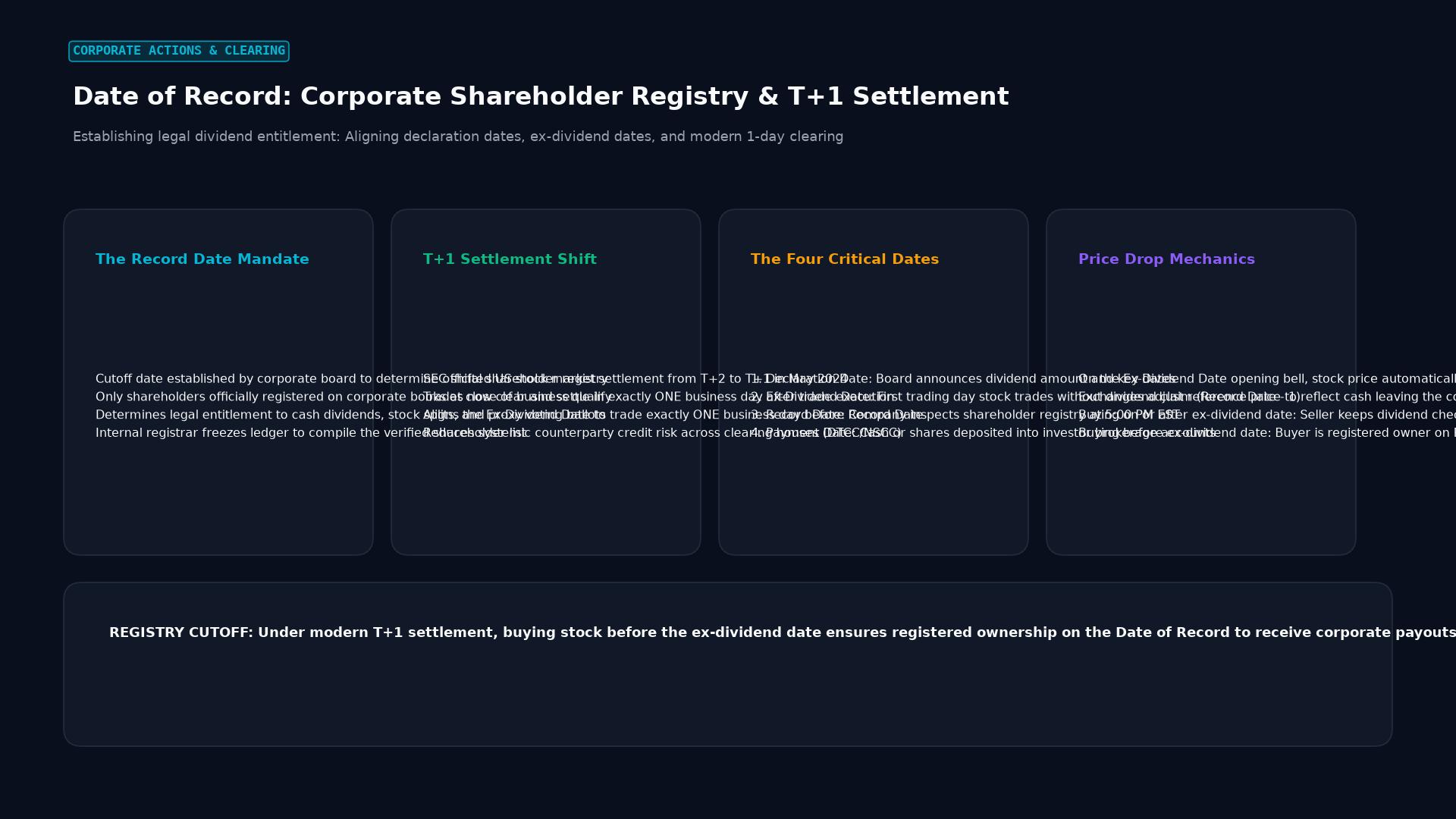 Figure: Establishing legal dividend entitlement: Aligning declaration dates, ex-dividend dates, and modern 1-day clearing
Technical Mechanics & The T+1 Settlement Interplay
Determining dividend entitlement is directly linked to the speed of trade clearing and settlement. Under securities regulations, ownership does not legally transfer at the moment a trader clicks “buy”; it transfers on the formal settlement date.
The T+1 Rule Formulation (May 2024 Reform)
Under the United States SEC Rule 15c6-1 amendment implemented on May 28, 2024, standard securities settlement in the US and Canada transitioned from T+2 to T+1 (Trade Date plus 1 Business Day).
$$\text{Settlement Date} = \text{Trade Date} + 1 \text{ Business Day}$$
$$\text{Ex-Dividend Date} = \text{Date of Record} - 1 \text{ Business Day}$$
Under this framework:
- If the Date of Record is Thursday, October 15:
- A trader must purchase the stock on or before Tuesday, October 13 (or Wednesday October 14 under T+1) to have their trade settle by Thursday evening.
- The Ex-Dividend Date is set on Wednesday, October 14. Anyone who buys the stock on or after the Ex-Dividend Date will settle on Friday, missing the record date cutoff.
Comparative Matrix: The Four Cardinal Dividend Dates
| Date Milestone | Deciding Authority | Operational Event | Market Price Impact |
|---|---|---|---|
| Declaration Date | Board of Directors | Corporate resolution announcing dividend amount and schedules | Positive sentiment catalyst |
| Ex-Dividend Date | Stock Exchange (NYSE/Nasdaq) | First trading day shares trade without dividend rights | Stock drops by exact dividend amount at open |
| Date of Record | Board of Directors | Transfer agent freezes official shareholder registry | None (Settlement milestone) |
| Payment Date | Corporate Treasury | Cash deposits or shares wired to brokerage accounts | Cash credited to investor accounts |
Real-World Case Study: The May 2024 T+1 Settlement Transition Shock
On May 28, 2024, US financial markets executed the most significant clearing overhaul in two decades, migrating from a T+2 settlement cycle to a T+1 settlement cycle.
Impact of the T+1 Migration on Dividend Dates:
1. The Historical T+2 Framework: For decades, the Ex-Dividend Date was set exactly two business days prior to the Record Date. If the Record Date was Friday, the Ex-Date was Wednesday.
2. The Compression (May 2024): The SEC compressed the timeline by 24 hours. The Ex-Dividend Date and the Record Date moved into adjacent business days: Ex-Date became exactly one business day prior to the Record Date.
3. The Corporate Operational Challenge: Corporate transfer agents (such as Computershare) and prime brokers had to overhaul automated ledger reconciliation systems, ensuring global institutional shareholders—particularly European and Asian asset managers operating across divergent time zones—had trades settled in 24 hours to secure dividend record rights.
Frequently Asked Questions (FAQ)
If I buy a stock on the Date of Record, do I receive the dividend?
No. This is one of the most common misconceptions in retail investing. To receive the dividend, your trade must settle on or before the Record Date. Because securities take one business day to settle (under standard T+1 settlement rules), purchasing a stock on the Record Date means your ownership will not legally settle until the following day. To receive the dividend, you must purchase the stock before the Ex-Dividend Date (at least one business day prior to the Record Date).
What happens to a stock’s price on the Ex-Dividend Date relative to the Record Date?
On the morning of the Ex-Dividend Date (which precedes the Record Date), the stock exchange automatically adjusts the opening price of the stock downward by the exact amount of the declared cash dividend. For example, if a company shares close at $100.00 and pays a $2.00 dividend, the exchange resets the opening benchmark price to $98.00. This occurs because the company’s corporate treasury is surrendering $2.00 in cash per share, and buyers on that day forward will not receive that capital.
How does “street name” registration affect the Date of Record?
Most retail investors do not hold physical paper stock certificates registered in their personal names; instead, their shares are held electronically in “street name” by their brokerage firm through the Depository Trust Company (DTC). On the Date of Record, the transfer agent verifies the total shares held by the DTC. The DTC then allocates the dividend rights downstream to the respective brokerage firms, which automatically credit the cash into individual retail accounts on the Payment Date.
Ready to trade forex?
Open a free demo account with a regulated broker. Practice with virtual funds before risking real money.