DAX 100
The DAX 100 was a benchmark German equity market index introduced by Deutsche Börse in 1994, tracking the 100 largest and most liquid publicly traded corporations in Germany, which subsequently evolved into the MDAX and modern expanded DAX 40 index structures.
What Was the DAX 100?
Introduced by Deutsche Börse in 1994, the DAX 100 was an institutional benchmark equity index designed to track the performance of the 100 largest and most actively traded publicly listed corporations on the Frankfurt Stock Exchange (Frankfurter Wertpapierbörse).
The DAX 100 combined Germany’s thirty premier blue-chip corporations—the constituent members of the flagship DAX 30 (now the DAX 40)—with the next seventy largest mid-cap enterprises. The index offered institutional investors, global macro hedge funds, and foreign asset managers a broader representation of the German industrial economy than the highly concentrated 30-member blue-chip index.
In 1996, Deutsche Börse restructured its index architecture: the mid-cap segment of the DAX 100 was formally separated to create the standalone MDAX (Mid-Cap DAX), and the broad umbrella index was subsequently superseded by the HDAX, which today aggregates the DAX, MDAX, and TecDAX.
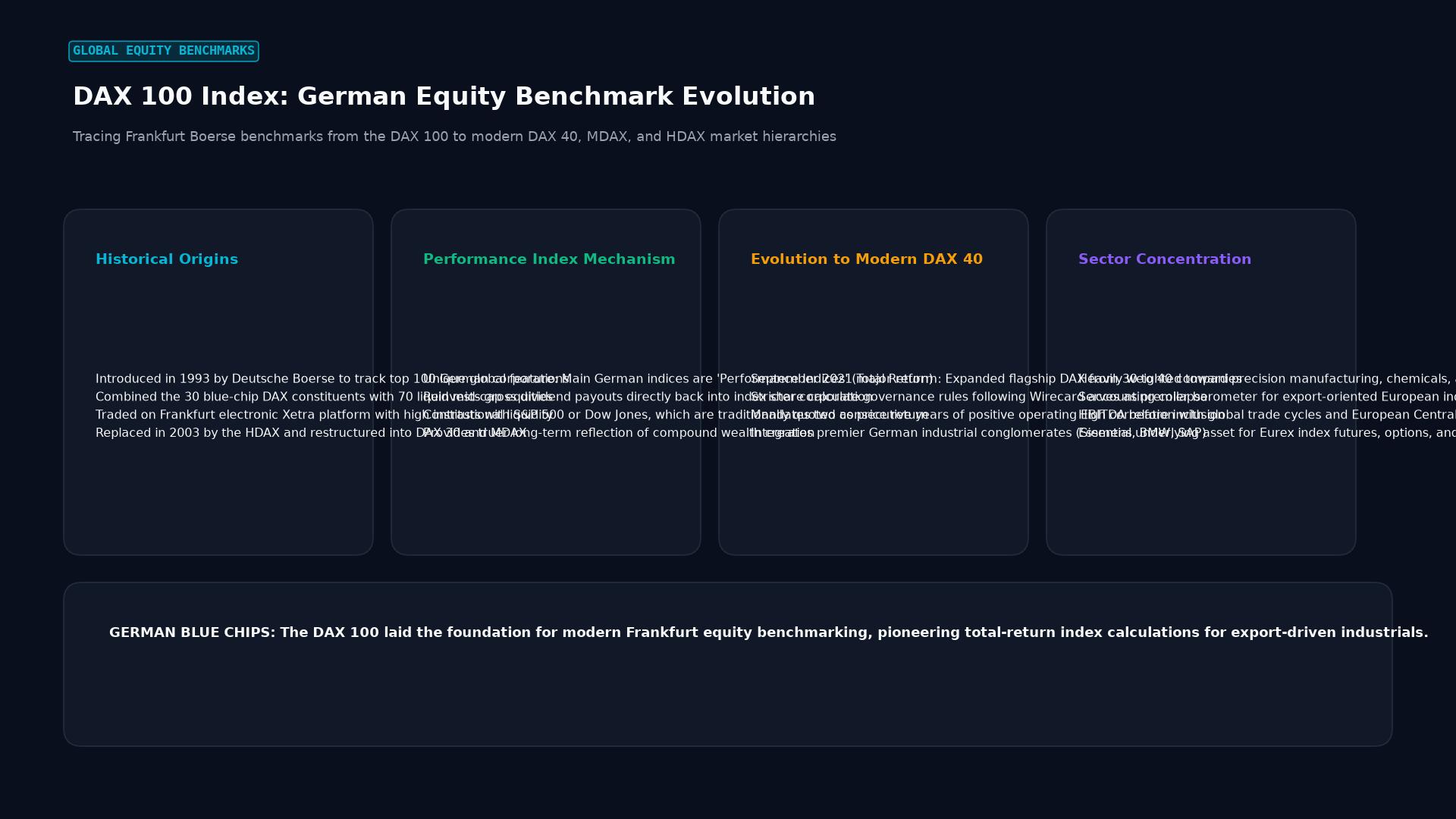 Figure: Tracing Frankfurt Boerse benchmarks from the DAX 100 to modern DAX 40, MDAX, and HDAX market hierarchies
Technical Mechanics & Mathematical Index Construction
Like all major equity benchmarks in the DAX family, the DAX 100 was computed using a Laspeyres index formula weighted by free-float market capitalization and calculated via Xetra electronic pricing:
The DAX Index Valuation Formula
$$I_t = K_t \times \frac{\sum_{i=1}^{n} p_{i,t} \cdot q_{i,t} \cdot f_{i,t} \cdot c_{i,t}}{\sum_{i=1}^{n} p_{i,0} \cdot q_{i,0}} \times 1,000$$
Where:
- $p_{i,t}$: Current secondary market price of share $i$ on the Xetra trading platform.
- $q_{i,t}$: Number of total issued shares of company $i$.
- $f_{i,t}$: Free-float factor, representing the percentage of shares available for public trading (excluding strategic founding family stakes and sovereign holdings).
- $c_{i,t}$: Weighting cap factor, ensuring no single corporate giant can exceed 10.0% of the total index weight on quarterly rebalancing dates.
- $K_t$: Index chaining and adjustment factor, smoothing out corporate capital actions (such as stock splits, cash dividends, and rights offerings).
The Performance Index Innovation (Performanceindex)
Unlike the S&P 500 or FTSE 100—which are conventionally quoted as “Price Indices” that drop when constituent stocks pay dividends—the primary quoted benchmark of the German DAX is a Total Return Performance Index (Performanceindex). Cash dividends paid by constituent companies are mathematically assumed to be fully reinvested gross into the index, preventing artificial chart gaps during annual German corporate dividend seasons.
Comparative Matrix: German Benchmark Indices
| Index | Number of Constituents | Market Cap Focus | Dividend Treatment | Primary Liquidity Venue |
|---|---|---|---|---|
| DAX 40 | 40 Mega-Caps | Blue-Chip Leaders | Total Return (Reinvested) | Xetra / Eurex Futures |
| DAX 100 (Historical) | 100 Equities | Large + Mid-Caps | Total Return | Floor + Early Electronic |
| MDAX | 50 Mid-Caps | Mid-Cap Growth Leaders | Total Return | Xetra |
| SDAX | 70 Small-Caps | Small-Cap Domestic | Total Return | Xetra |
| TecDAX | 30 Tech Equities | Technology & Telecom | Total Return | Xetra |
Real-World Case Study: The Wirecard Collapse & The 2021 DAX Expansion
The vulnerability of an overly concentrated index was exposed in June 2020 during the insolvency of German fintech darling Wirecard AG, which was admitted to the DAX 30 in 2018 after displacing banking giant Commerzbank.
Anatomy of an Index Governance Reform:
1. The Scandal: In June 2020, Wirecard revealed that €1.9 billion in cash balances reported on its balance sheet did not exist, leading to immediate insolvency and the arrest of top executives.
2. The Defect: Under legacy DAX rules, an insolvent company could remain in the benchmark index until the next scheduled quarterly review, forcing passive ETFs and pension funds to hold worthless shares.
3. The Overhaul (September 2021):
   * Deutsche Börse expanded the flagship DAX from 30 to 40 companies (absorbing the top 10 members of the MDAX).
   * Mandated that all constituents demonstrate two consecutive years of positive operating profitability (EBITDA) prior to admission.
   * Established a rapid 2-day expulsion protocol for any constituent filing for insolvency.
Frequently Asked Questions (FAQ)
What happened to the DAX 100 index in modern markets?
The DAX 100 was phased out and restructured by Deutsche Börse to provide more specialized institutional investment vehicles. In 1996, the mid-cap component of the DAX 100 was spun off to create the MDAX, while the overarching umbrella index encompassing the top 100 liquid German stocks was rebranded under the HDAX banner (which currently tracks approximately 100 corporations across the DAX, MDAX, and TecDAX).
Why does the German DAX reinvest dividends while the US S&P 500 does not?
The standard headline quote for the DAX is a Performance Index (DAX TR), which factors in both price appreciation and the full reinvestment of gross cash dividends. This structural choice was made in 1988 to reflect the total compound wealth generated by German enterprise. In contrast, the headline S&P 500 or Dow Jones Industrial Average are “Price Return” indices; their total return equivalents (S&P 500 TR) exist, but are not the primary figures quoted on mainstream evening financial news.
What is Xetra and what role did it play in DAX history?
Xetra (Exchange Electronic Trading) is the fully automated, electronic matching engine launched by Deutsche Börse in 1997. Prior to Xetra, DAX stocks were traded through traditional open-outcry floor specialists on the Frankfurt Stock Exchange. Xetra modernized German capital markets, enabling sub-millisecond algorithmic execution, ultra-tight bid-ask spreads, and unified order routing from global financial institutions. Today, over 95% of all German cash equity trading clears over Xetra.
Ready to trade forex?
Open a free demo account with a regulated broker. Practice with virtual funds before risking real money.