Deal Blotter
A deal blotter (trade blotter) is a real-time computerized ledger in an Order Management System that records, displays, and aggregates all executed transactions, pending orders, and cancellations for a trader or desk during a session.
What Is a Deal Blotter?
A deal blotter (universally termed a trade blotter or simply a blotter) is a real-time electronic ledger and operational dashboard utilized by traders, institutional dealing desks, and portfolio managers to capture, track, and monitor every order and executed transaction throughout a trading session.
Historically originating in the 19th and 20th centuries as a physical, paper-bound ledger where clerks manually inked (“blotted”) trade details on open-outcry exchange floors, modern deal blotters are sophisticated software modules embedded directly within Order Management Systems (OMS), Execution Management Systems (EMS), and electronic communication networks (such as the Bloomberg Terminal BLOT system or institutional FIX protocol platforms). The blotter provides an immutable, time-stamped audit trail that underpins real-time risk management, compliance monitoring, and back-office clearing reconciliation.
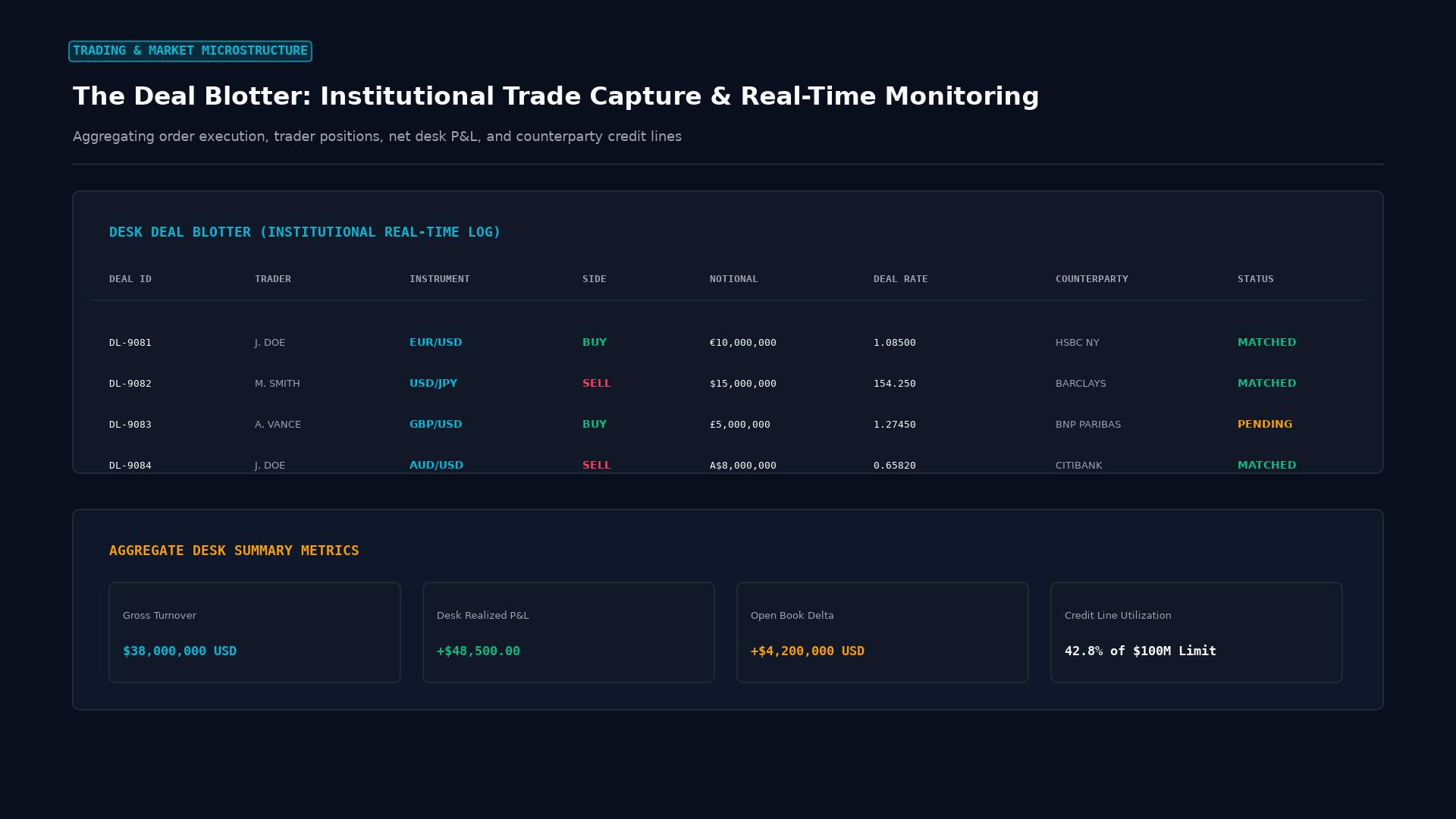 Figure: Front-office trading blotter dashboard tracking real-time trade execution status, desk net P&L attribution, currency delta exposures, and counterparty credit line utilization.
Key Takeaways
- Real-Time Execution Log: The blotter provides an immediate chronological record of all trade states: incoming orders, active working limits, partial fills, complete executions, and cancellations.
- The Core Risk Anchor: Dealing desks use blotter aggregations to instantly monitor their Net Open Position (NOP), gross trading volume, and floating profit-and-loss (P&L) across diverse currency pairs.
- Regulatory Audit Trail: Under global market abuse regulations (such as MiFID II in Europe and SEC/CFTC mandates in the U.S.), electronic blotters must maintain unalterable, microsecond-stamped logs of all order events for regulatory scrutiny.
- Retail Trading Equivalent: In retail platforms (such as MetaTrader 4/5, cTrader, or TradingView), the bottom “Trade” and “Account History” tabs perform the basic operational role of a deal blotter.
Anatomical Structure of a Modern Deal Blotter
An institutional blotter displays extensive transactional metadata organized into standardized columns:
| Blotter Field | Institutional Purpose | Example Entry |
|---|---|---|
| Order / Trade ID | Unique alphanumeric tracking identifier for regulatory reporting (UTI) | TRD-9081248-NYC |
| Timestamp | Execution time synchronized to atomic clocks (down to microseconds) | 2026-09-22 14:15:32.408124 UTC |
| Account / Fund | Sub-account or legal entity holding the position | Alpha-Macro-Fund-Sub04 |
| Instrument / Pair | Specific currency pair or derivative ticker | EUR/USD Spot |
| Side (Direction) | Buy (Long) or Sell (Short) | BUY |
| Quantity (Notional) | Volume in standard lots or base currency notional | 10,000,000 EUR (100 Lots) |
| Order Type | Market, Limit, Stop, Pegged, Iceberg, or TWAP/VWAP algorithm | LIMIT (At or Better) |
| Execution Rate | The exact fill price agreed upon with the counterparty | 1.08520 |
| Counterparty / Venue | ECN venue, dealer bank, or clearing broker | EBS Market / JPMorgan Dealer |
| Order Status | Current state of the order | FILLED (or PARTIAL, WORKING, CANCELED) |
| Commission / Fee | Explicit brokerage, exchange, or clearing charges | $35.00 USD |
The Operational Role Across Financial Departments
A deal blotter does not serve the execution trader alone; it is the vital operational link between three distinct tiers of an investment bank or hedge fund:
                          ┌────────────────────────┐
                          │   FRONT OFFICE         │
                          │   Execution Desk       │
                          │   Monitors fills & NOP │
                          └───────────┬────────────┘
                                      │
                                      ▼
                          ┌────────────────────────┐
                          │   MIDDLE OFFICE        │
                          │   Risk & Compliance    │
                          │   VaR, Credit Limits   │
                          └───────────┬────────────┘
                                      │
                                      ▼
                          ┌────────────────────────┐
                          │   BACK OFFICE          │
                          │   Settlement & Ops     │
                          │   SWIFT & Accounting   │
└────────────────────────┘- Front Office (Traders): Traders monitor order execution progress, verify algorithmic fill quality (measuring slippage against benchmark arrival price), and ensure desk risk limits are not breached.
- Middle Office (Risk Managers): Risk officers review blotters in real time to verify that traders do not exceed authorized Value at Risk (VaR) thresholds, currency position limits, or counterparty credit caps.
- Back Office (Settlement Clerks): Operations personnel take the confirmed blotter data, generate outgoing SWIFT MT300 trade confirmations, and transmit settlement instructions to clearing utilities like CLS Bank and DTCC.
Compliance Surveillance: Detecting Market Manipulation
Modern regulatory frameworks mandate automated algorithmic surveillance of deal blotters to detect fraudulent or illegal trading behavior:
- Spoofing & Layering: The compliance algorithm scans the blotter for high-frequency patterns where a trader submits large limit orders with no intention of executing them, immediately canceling them after manipulating market prices.
- Front-Running: Surveillance software cross-references the personal trading blotters of broker employees against client order blotters to ensure brokers never trade ahead of large client block orders.
- Wash Trading: Identifying fictitious transactions where a trader simultaneously buys and sells the same asset through linked accounts to artificially inflate reported volume.
Real-World Case Study: Resolving a Flash-Crash Order Dispute
During a sudden 150-pip flash crash in the British Pound following a geopolitical headline, an institutional hedge fund entered an algorithmic market order to sell £20,000,000 against USD.
The Dispute:
- The portfolio manager claimed their order was submitted at
1.2840and expected a fill around1.2835. - The bank’s execution statement reported an average fill price of
1.2720—costing the fund $230,000 in unexpected negative slippage. - The hedge fund threatened legal arbitration, alleging predatory execution delay by the dealer bank.
The Blotter Audit Investigation:
- Compliance officers extracted the Time-Sequenced Electronic Deal Blotter:
- Order Received at ECN Gateway:
14:02:15.112 UTC - Initial Liquidity Sweep at 1.2835: Only £2,000,000 available (partially filled).
- Order Routing to Secondary Books: Deep liquidity void detected; bid orders stepped down to 1.2710.
- Final Partial Fill Timestamp:
14:02:15.198 UTC(entire execution took only 86 milliseconds).
- Order Received at ECN Gateway:
- The blotter logs demonstrated that the bank’s automated smart-order router acted instantaneously without human interference, proving that the massive slippage was caused entirely by a lack of underlying market bids during the panic rather than broker negligence.
- The dispute was settled immediately based on the verified blotter audit trail.
Frequently Asked Questions
Can a trader edit or delete an entry on an electronic deal blotter?
No. Financial regulatory rules (including SEC Rule 17a-4 and FINRA standards) strictly prohibit the editing or deletion of blotter entries. If an erroneous trade is entered, it cannot be erased; the trader must enter an explicit offsetting correction or cancellation ticket, ensuring the historical audit trail remains 100% complete and transparent.
What is the difference between a deal blotter and a deal ticket?
A deal ticket is the detailed record of an individual single transaction (showing all specific terms for that one trade). A deal blotter is the aggregate, multi-row spreadsheet or table that compiles all individual deal tickets chronologically across an entire session or portfolio.
How often do institutional blotters synchronize with accounting ledgers?
Most institutional trading desks synchronize their deal blotters with general accounting and custody ledgers via automated end-of-day batch processing (typically triggered at the 5:00 PM EST daily cut-off). However, modern cloud-native systems increasingly operate on continuous real-time Straight-Through Processing (STP) pipelines.
Ready to trade forex?
Open a free demo account with a regulated broker. Practice with virtual funds before risking real money.