Debenture Stock
Debenture stock is a hybrid fixed-income security prevalent in British and Commonwealth corporate finance representing a loan of fixed capital issued in fractional, fungible units that pays guaranteed periodic interest and holds a prior claim over common equity.
What Is Debenture Stock?
Debenture stock is a specialized corporate debt instrument widely utilized across British, Commonwealth, and historical international corporate finance. Despite incorporating the word “stock” in its nomenclature, debenture stock is not an equity share; it represents a formal loan of capital to the issuing corporation that confers the status of a secured or senior creditor rather than a company shareholder.
The critical distinction between a standard bond and debenture stock lies in its issuance architecture:
- A traditional bond or debenture is typically issued as separate, discrete, numbered certificates of fixed denomination (e.g., $1,000 or £1,000 per certificate).
- Debenture stock, by contrast, is created as a single, collective, consolidated aggregate debt obligation held under a formal trust deed. Investors hold registered fungible fractional units (such as £100 tranches) that can be split, transferred, or traded in variable amounts on financial exchanges.
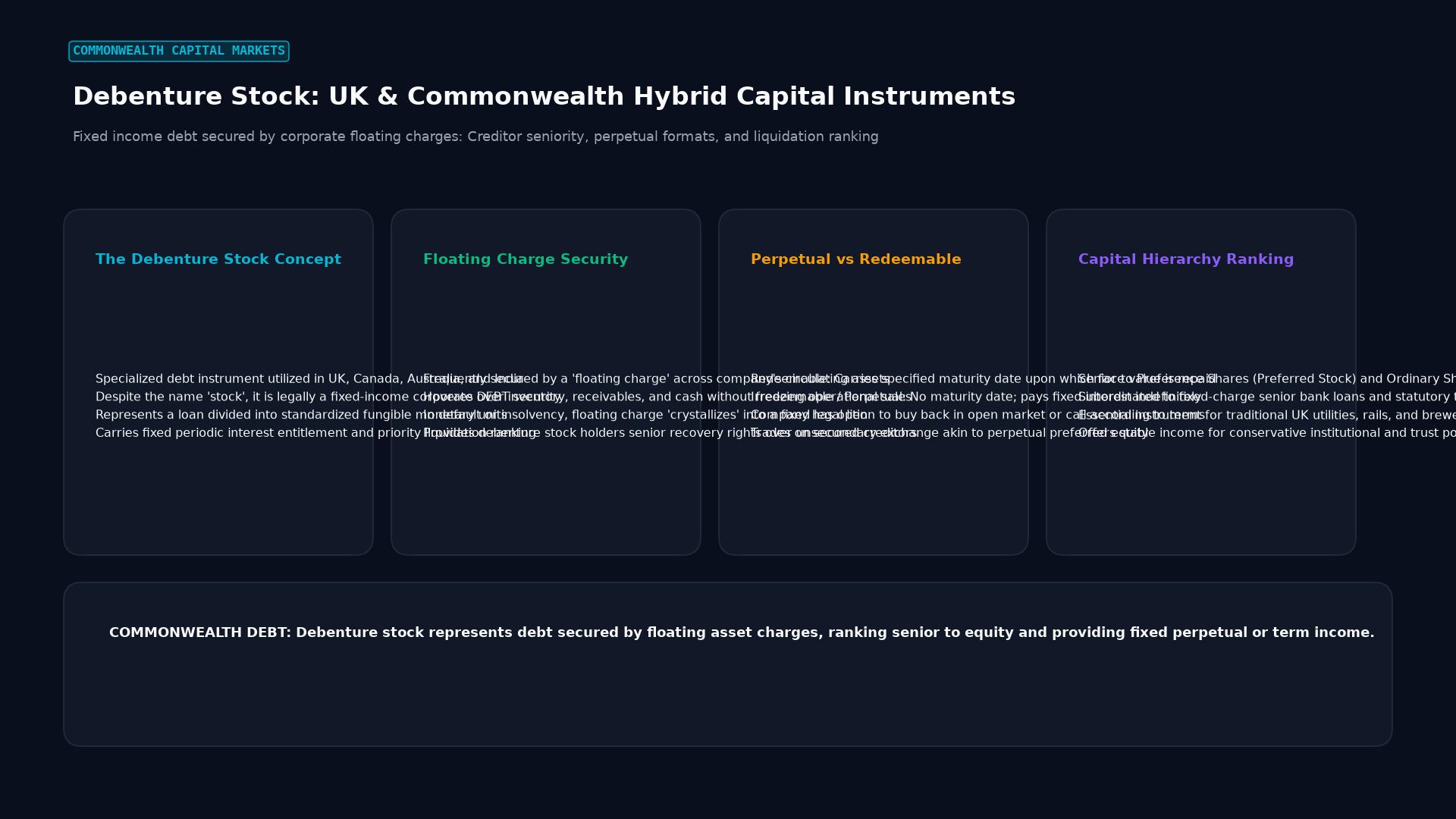 Figure: Fixed income debt secured by corporate floating charges: Creditor seniority, perpetual formats, and liquidation ranking
Technical Mechanics & The Law of Charges
Under English commercial law and Commonwealth corporate governance, debenture stock is secured against company assets through two legal mechanisms:
1. Fixed Charge (Mortgage Debenture Stock)
The debenture stock is legally attached to specific, identifiable, non-circulating corporate assets—most commonly corporate real estate, commercial buildings, long-term infrastructure, and heavy plant machinery. The corporation is legally prohibited from selling, leasing, or encumbering these assets without the explicit consent of the debenture stock trustee.
2. Floating Charge
The debenture stock is secured against a circulating, shifting pool of dynamic corporate assets—such as raw material inventories, warehouse stock, and trade accounts receivable. The corporation can freely sell and trade these assets in the ordinary course of business. However, upon an event of default or insolvency, the floating charge crystallizes into a fixed legal charge over whatever assets exist at that exact moment.
Pricing and Valuation Formulation
Debenture stock behaves mathematically like a long-dated or perpetual coupon-bearing bond:
$$P = \sum_{t=1}^{n} \frac{C}{(1 + y)^t} + \frac{F}{(1 + y)^n}$$
For Irredeemable (Perpetual) Debenture Stock—where principal is never repaid and interest flows indefinitely:
$$P_{\text{perpetual}} = \frac{C}{y}$$
Where $C$ is the fixed annual coupon payment and $y$ is the market-required fixed-income yield.
Comparative Matrix: Corporate Capital Instruments
| Security Instrument | Legal Nature | Security / Charge Status | Voting Rights? | Return Mechanism |
|---|---|---|---|---|
| Debenture Stock | Debt Obligation | Fixed or Floating Charge | None | Fixed contractual interest (Pre-tax) |
| Traditional Debenture | Debt Obligation | Often unsecured / negative pledge | None | Fixed contractual interest (Pre-tax) |
| Preference Shares | Hybrid Equity | Subordinated equity claim | Restricted / Contingent | Fixed cumulative dividend (After-tax) |
| Ordinary Shares | Pure Equity | Unsecured residual equity claim | Full voting rights | Variable dividends + capital appreciation |
Real-World Case Study: British Railway Debenture Stock (19th–20th Century)
The defining historical deployment of debenture stock occurred during the construction of the British railway network in the Victorian era.
Financing Britain's Industrial Backbone:
1. The Scale: Developing the Great Western Railway (GWR) and London & North Western Railway (LNWR) required tens of millions of pounds in long-dated capital.
2. The Instrument: The railway companies issued "4% Perpetual Debenture Stock," secured by a statutory first charge over railway roadbeds, stations, and locomotive rolling stock.
3. The Investor Class: British aristocrats, charitable trusts, and Church of England pension funds invested billions in debenture stock because it was legally classified as a "Trustee Investment"—guaranteeing an ironclad 4% annual coupon with zero default risk due to the immense physical liquidation value of the rail infrastructure.
4. Liquidity: Unlike clunky property mortgages, railway debenture stock traded with high liquidity in fractions on the London Stock Exchange for over a century until nationalization under the Transport Act of 1947.
Frequently Asked Questions (FAQ)
Why is it called debenture “stock” if it is actually debt?
In historical British corporate terminology, the word “stock” simply meant a consolidated mass of capital created by a company, whereas a “share” represented an indivisible single unit. Equity was called “capital stock,” and consolidated aggregate borrowings were called “debenture stock.” While modern American finance uses “stock” exclusively to denote equity ownership, Commonwealth legal jurisdictions continue to recognize debenture stock as a registered, fractional debt security.
What is the difference between redeemable and irredeemable debenture stock?
Redeemable debenture stock specifies a formal date of maturity (or redemption window) upon which the issuing corporation is contractually bound to repay the par value of the loan. Irredeemable debenture stock (perpetual debenture stock) has no maturity date; the issuer is never required to repay principal during its operating life, but must continue paying the fixed annual interest coupon indefinitely until the corporation undergoes voluntary dissolution or liquidation.
How does the interest on debenture stock differ from preferred dividends?
Interest paid on debenture stock is a contractual debt service expense deducted directly from corporate gross revenues before corporate income taxes are calculated, providing an interest tax shield. Furthermore, debenture interest must be paid regardless of whether the corporation earns a profit. Dividends on preferred stock, by contrast, represent an equity distribution paid out of after-tax net profits and can be legally suspended by the board of directors if the company experiences an unprofitable year.
Ready to trade forex?
Open a free demo account with a regulated broker. Practice with virtual funds before risking real money.