Deficit
A deficit is an economic condition where expenditures or monetary outflows exceed revenues or inflows over a given period, most prominently observed in government fiscal budgets, national trade balances, and current accounts.
What Is a Deficit?
In economics, public finance, and corporate accounting, a deficit is a negative financial balance that occurs when expenditures, liabilities, or cash outflows exceed total revenues, income, or cash inflows over a specified measurement period. A deficit represents a shortfall that must be bridged through borrowing (issuing debt), liquidating accumulated financial assets, or printing domestic fiat currency.
In macroeconomic analysis and foreign exchange strategy, the term refers primarily to three interrelated national metrics:
- Fiscal (Budget) Deficit: Occurs when a national government’s total expenditures (on infrastructure, defense, entitlements, and debt servicing) exceed its annual tax and tariff revenues.
- Trade Deficit: Occurs when a nation’s total expenditures on imported goods and physical merchandise exceed the revenues earned from its physical exports.
- Current Account Deficit: The broadest measure of international economic interaction, measuring the net flow of goods, services, cross-border investment income (dividends and interest), and unilateral transfer payments.
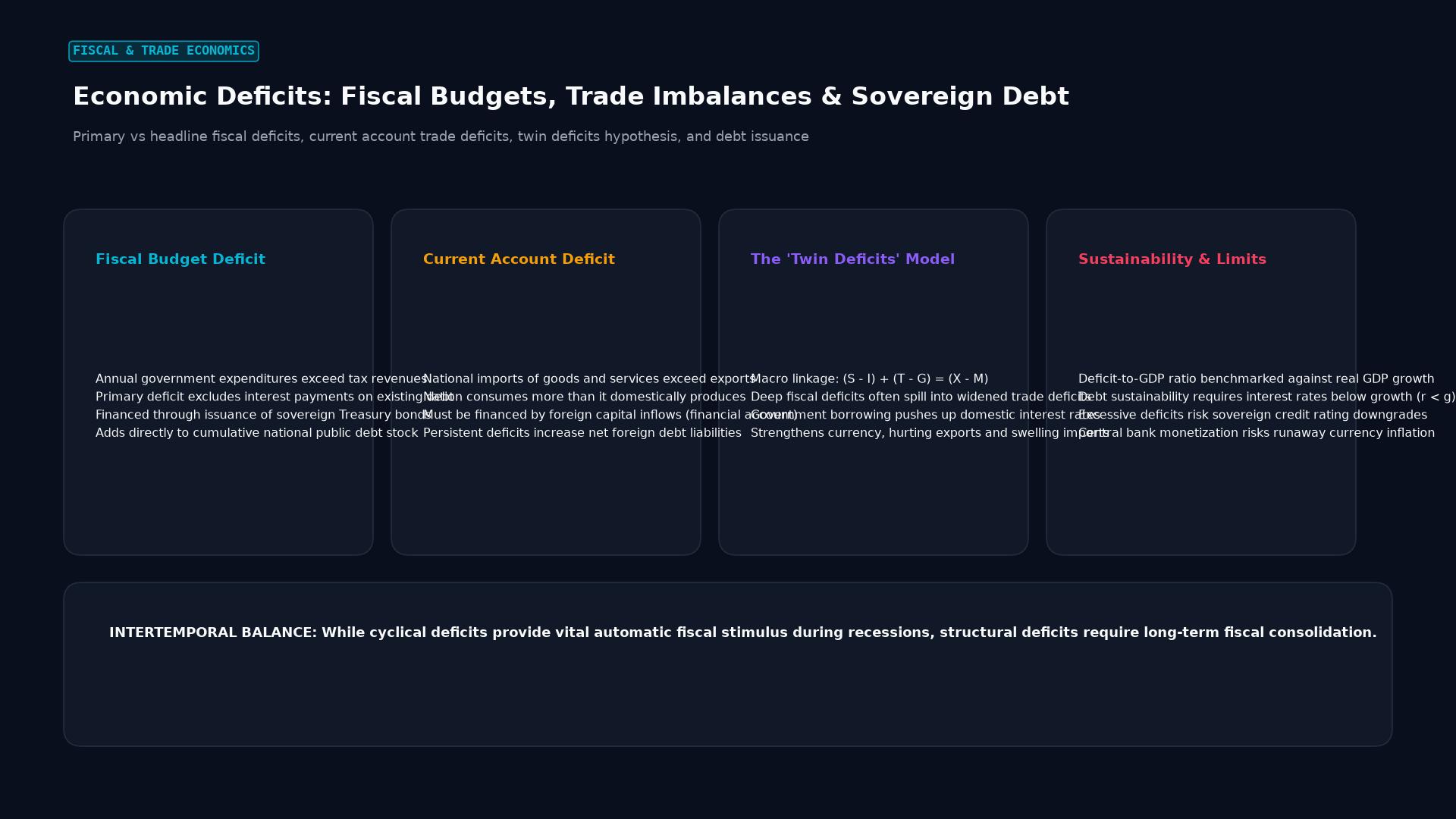 Figure: Primary vs headline fiscal deficits, current account trade deficits, twin deficits hypothesis, and debt issuance
Key Takeaways
- Flow vs. Stock (Deficit vs. Debt): A deficit is a dynamic annual flow (e.g., spending $1.5 trillion more than tax receipts in 2026); the national debt is the cumulative static stock of all past annual deficits added together over centuries.
- The Twin Deficits Hypothesis: An established macroeconomic relationship demonstrating that a large government budget deficit often expands a nation’s current account deficit by reducing national savings and stimulating demand for foreign imports.
- Currency Depreciation Pressure: A persistent current account deficit requires a constant, daily influx of foreign capital to balance; if foreign appetite for domestic assets wanes, the sovereign currency must devalue to re-equilibrate international trade.
- Structural vs. Cyclical Deficits: A cyclical deficit arises naturally during a recession due to falling tax receipts and rising automatic welfare spending; a structural deficit persists even when the economy operates at full employment and maximum capacity.
The Three Core Types of Macroeconomic Deficits
Understanding how deficits interact provides essential insight into sovereign debt yields and currency valuations:
| Deficit Category | Economic Definition | Primary Financing Method | Currency Market Implication |
|---|---|---|---|
| Fiscal (Budget) Deficit | Total Government Spending ($G$) exceeds Total Tax Receipts ($T$) | Issuing sovereign government bonds (e.g., U.S. Treasuries) | Heavy debt supply can push bond yields higher; risk of debt monetization |
| Trade Deficit | Value of Merchandise Imports ($M$) exceeds Exports ($X$) | Net outflow of domestic currency to foreign exporters | Continuous structural selling pressure on the domestic currency |
| Current Account Deficit | Broadest measure: Trade Balance + Net Factor Income + Net Transfers | Foreign Direct Investment (FDI) inflows or foreign portfolio investment | Requires high domestic interest rates to attract foreign financing capital |
The Twin Deficits Hypothesis: Mathematical Formulation
In national income accounting, the relationship between domestic savings, corporate investment, the government budget, and international trade is expressed via the fundamental identity:
$$Y = C + I + G + (X - M)$$
Rearranging this formula in terms of private domestic savings ($S = Y - C - T$):
$$(S - I) = (G - T) + (X - M)$$
$$\text{Or: } (M - X) = (G - T) + (I - S)$$
Where:
- $(M - X)$ = Trade / Current Account Deficit
- $(G - T)$ = Government Fiscal Budget Deficit
- $(I - S)$ = Private Investment Deficit (Private Investment exceeding Private Savings)
Economic Insight:
If domestic private savings are insufficient to fund both corporate investment ($I$) and a massive government budget deficit ($G - T$), the nation must import foreign capital. This capital inflow is mathematically mirrored by an equivalent current account deficit ($M - X$), creating the famous “Twin Deficits.”
Fiscal Deficit Expands (G > T) ──► National Savings Depleted ──► Attracts Foreign Capital ──► Current Account Deficit Blows OutForeign Exchange Transmission: How Deficits Drive Currency Trends
The impact of a national deficit on its currency depends on whether the market is focused on short-term yield or long-term structural solvency:
1. The Short-Run Yield Magnet (Appreciation)
To finance a ballooning fiscal deficit, the sovereign treasury must issue billions in new government bonds. If the central bank maintains tight monetary policy, high bond yields attract international yield-seeking capital, temporarily strengthening the domestic currency.
2. The Long-Run Balance of Payments Drag (Depreciation)
Over multi-year cycles, persistent current account deficits generate structural currency weakness. Because domestic consumers are continuously selling domestic currency to purchase foreign goods, foreign central banks and asset managers accumulate vast overseas currency reserves. If those foreign holders decide to diversify away from the currency, the exchange rate faces severe, chronic depreciation until domestic goods become cheap enough to eliminate the deficit.
Real-World Case Study: The UK “Mini-Budget” Deficit Crisis (September 2022)
In September 2022, the United Kingdom experienced a violent market revolt driven by unhedged fiscal deficit expansion:
The Crisis Sequence:
- The Announcement: The British government unveiled a “Mini-Budget” proposing £45 billion in unfunded tax cuts alongside massive energy subsidies, dramatically expanding the UK’s already substantial fiscal deficit without any spending cuts or independent fiscal oversight.
- The Bond Market Rebellion: Global bond investors balked at the reckless expansion of sovereign borrowing. Yields on 30-Year UK government bonds (Gilts) surged by an unprecedented 150 basis points in days, threatening the solvency of UK liability-driven investment (LDI) pension funds.
- The Currency Plunge: Investors dumped British Pounds alongside Gilts. GBP/USD collapsed from
1.1500down to an all-time historical low of1.0350within three trading sessions. - The Intervention: The Bank of England was forced to launch an emergency £65 billion temporary bond-buying program to avert a systemic banking collapse, and the UK government rescinded the tax cuts to restore fiscal credibility.
Frequently Asked Questions
Can a country run deficits indefinitely?
A reserve-currency nation like the United States (whose U.S. Dollar serves as the global medium of exchange and reserve asset) can sustain persistent twin deficits for decades because global central banks and sovereign wealth funds have structural demand for dollar-denominated assets. However, non-reserve emerging economies that run persistent deficits face rapid capital flight, currency collapse, and sovereign debt crises.
What is a “Primary Deficit”?
The primary deficit is the government’s fiscal deficit excluding net interest payments on its outstanding national debt ($\text{Primary Deficit} = \text{Total Deficit} - \text{Net Interest Payments}$). It reveals whether current government policy is living within its means before accounting for the historical legacy costs of past borrowing.
Is a trade deficit always a sign of economic weakness?
No. A trade deficit often reflects strong domestic consumer demand, high purchasing power, and an attractive domestic investment climate that draws in foreign capital. During economic booms, imports frequently surge, whereas during severe recessions, trade deficits often contract as domestic consumers drastically reduce spending.
Ready to trade forex?
Open a free demo account with a regulated broker. Practice with virtual funds before risking real money.