GDP Deflator
The GDP deflator (implicit price deflator) is a comprehensive macroeconomic inflation metric that measures the price level changes across all domestically produced final goods and services, converting Nominal GDP into Real GDP.
What Is the GDP Deflator?
The GDP deflator (formally designated as the Implicit Price Deflator for Gross Domestic Product) is a foundational macroeconomic indicator published by national statistical agencies (such as the U.S. Bureau of Economic Analysis - BEA). It measures the aggregate change in price levels across all final goods and services produced domestically within an economy over a given period.
While the widely tracked Consumer Price Index (CPI) measures price changes strictly within a fixed representative basket of consumer goods and household services, the GDP deflator captures inflation across the entire breadth of domestic economic production. It reflects price movements in consumer consumption, private corporate capital investments, government defense and infrastructure expenditures, and net exports. In national income accounting, the deflator provides the mathematical tool required to strip away the distorting effects of inflation, converting Nominal GDP into Real GDP.
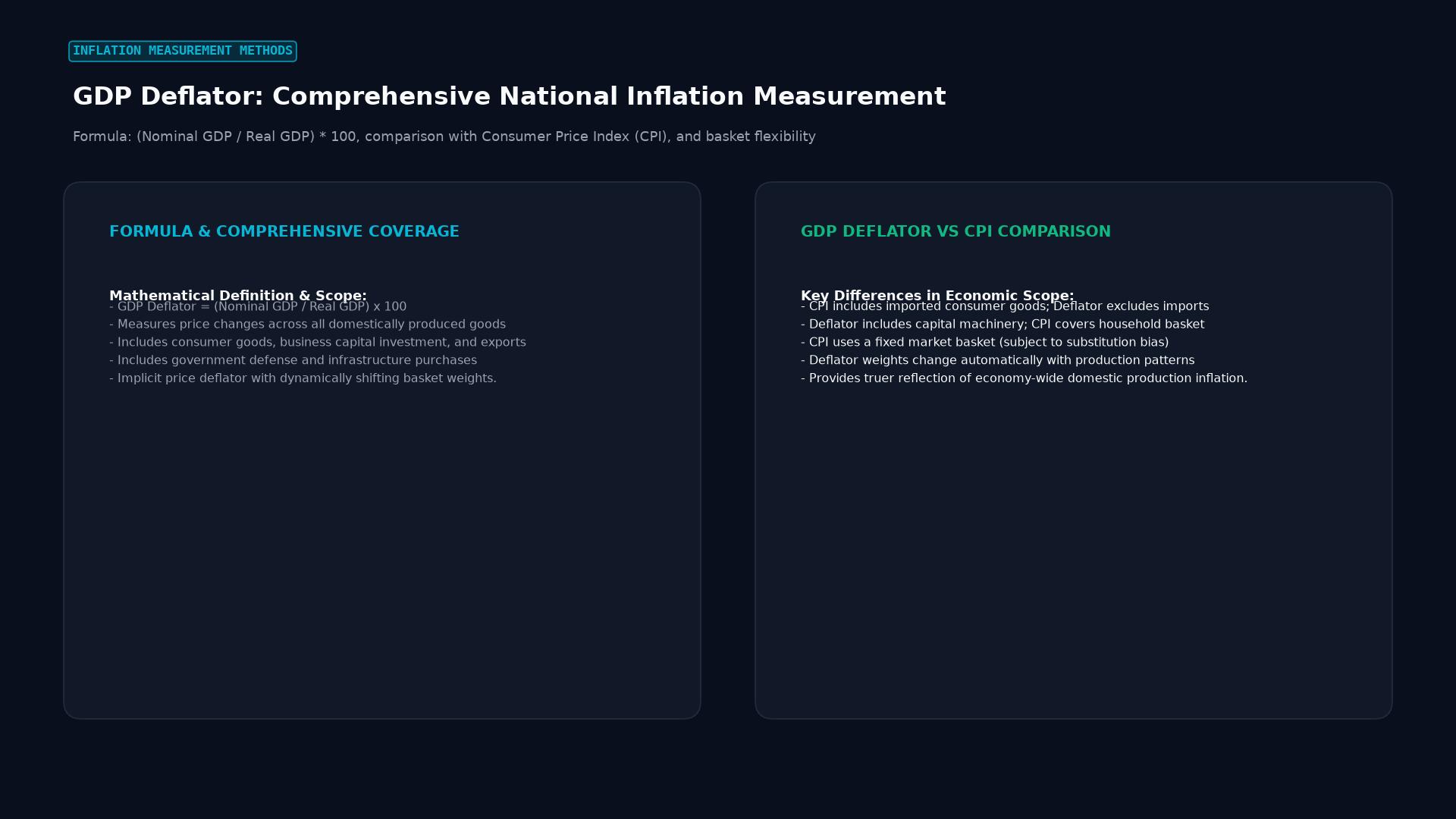 Figure: Formula: (Nominal GDP / Real GDP) * 100, comparison with Consumer Price Index (CPI), and basket flexibility
Key Takeaways
- The Real GDP Conversion Tool: Real GDP is derived mathematically by dividing Nominal GDP by the GDP Deflator: $\text{Real GDP} = (\text{Nominal GDP} / \text{Deflator}) \times 100$.
- Broader Coverage than CPI: Unlike the Consumer Price Index (which covers only urban consumer spending), the GDP deflator covers capital equipment, commercial factories, government expenditures, and software, reflecting economy-wide price pressures.
- Exclusion of Imports: The GDP deflator measures only goods and services produced domestically; foreign imports (e.g., imported foreign oil or imported consumer electronics) are completely excluded from the GDP deflator, whereas they directly affect the CPI.
- Flexible Weighting (Paasche Index): The GDP deflator is a dynamically weighted Paasche index, meaning its basket automatically shifts each quarter based on what consumers and businesses actually produce and purchase, eliminating substitution bias.
Mathematical Formulation and Calculations
The GDP Deflator establishes the relationship between nominal and inflation-adjusted economic output:
1. The GDP Deflator Equation
$$\text{GDP Deflator} = \left( \frac{\text{Nominal GDP}}{\text{Real GDP}} \right) \times 100$$
2. Calculating the Implied Annual Inflation Rate
To compute the annualized percentage rate of inflation between Period $t-1$ and Period $t$:
$$\text{Annual Inflation Rate} = \left( \frac{\text{Deflator}t - \text{Deflator}{t-1}}{\text{Deflator}_{t-1}} \right) \times 100%$$
Practical Numerical Example:
Assume a sovereign economy reports the following national accounts data for Year 2 (with Year 1 as the designated base year where $\text{Deflator} = 100.0$):
- Nominal GDP in Year 2: $25,000,000,000,000 USD ($25.0 Trillion)
- Real GDP in Year 2 (in Year 1 base prices): $20,000,000,000,000 USD ($20.0 Trillion)
$$\text{GDP Deflator} = \left( \frac{$25.0 \text{ Trillion}}{$20.0 \text{ Trillion}} \right) \times 100 = 125.0$$
Interpretation: The aggregate price level of all domestically produced goods and services has increased by 25.0% since the base year ($125.0 - 100.0$). Nominal output grew by 25% due strictly to inflation, while actual physical production remained at $20 trillion.
Comparison: GDP Deflator vs. Consumer Price Index (CPI)
Macroeconomic analysts scrutinize the divergence between the GDP Deflator and the Consumer Price Index to understand whether inflation is domestic or imported:
| Feature | GDP Deflator | Consumer Price Index (CPI) |
|---|---|---|
| Statistical Agency | Bureau of Economic Analysis (BEA) | Bureau of Labor Statistics (BLS) |
| Economic Coverage | All domestically produced final goods and services (C + I + G + X) | A fixed basket of consumer goods and services purchased by households |
| Treatment of Imports | Completely Excluded (Imports are not domestic production) | Included if purchased by domestic retail consumers (e.g., imported smartphones) |
| Treatment of Capital Goods | Included (Industrial machinery, commercial aircraft, factories) | Excluded (Consumers do not buy commercial machinery) |
| Index Weighting Methodology | Paasche Index: Flexible weights adjust automatically to current-quarter production | Laspeyres Index: Fixed basket weights updated periodically (vulnerable to substitution bias) |
| Release Frequency | Quarterly (Released alongside GDP reports) | Monthly (High-frequency economic release) |
Why the GDP Deflator Matters to Forex Traders
While high-frequency day traders focus on the monthly CPI and Core PCE prints, institutional macro hedge funds and central bank policy committees scrutinize the quarterly GDP Deflator:
1. Pure Domestic Inflation Signal
Because the GDP deflator excludes imports, a surging GDP deflator proves that inflation is being generated domestically by internal wage-price pressures and high corporate profit margins, rather than merely reflecting external supply chain shocks (like spiking global oil tanker freight rates). This provides central bankers with definitive justification to maintain hawkish interest rate policies, supporting the domestic currency.
2. Upstream Business Investment Pressures
If the GDP deflator rises significantly faster than the CPI, it reveals that the prices of corporate capital goods (steel, heavy equipment, industrial real estate) are inflating faster than consumer retail prices. This warns of impending corporate margin compression, prompting institutional desks to reallocate capital out of cyclical equities into foreign currency fixed income.
GDP Deflator Surges Above CPI ──► Confirms Domestic Wage-Push Inflation ──► Hawkish Rate Expectations ──► Currency RalliesReal-World Case Study: Dissecting an Energy Shock Divergence
During an international geopolitical energy crisis, global crude oil prices surge from $70 to $130 per barrel over six months:
The Divergent Inflation Prints:
- Consumer Price Index (CPI): Surges from 2.5% to 8.2% as gasoline, home heating oil, and imported consumer goods skyrocket in price.
- GDP Deflator: Rises modestly from 2.0% to 3.1%.
The Institutional Interpretation:
- Because the country is a net oil importer, foreign energy imports are deducted from national GDP ($X - M$).
- The massive price spike in imported oil directly inflates the consumer CPI basket, but it is subtracted from the GDP deflator calculation.
- Foreign exchange desks recognize that the domestic manufacturing economy is not overheating organically; rather, national income is being transferred overseas to foreign energy producers.
- Armed with this insight, currency traders anticipate that the central bank cannot hike rates aggressively without plunging the country into a severe stagflationary recession, prompting a selloff in the sovereign currency against commodity-exporting currencies.
Frequently Asked Questions
Can the GDP deflator be negative?
The GDP deflator index value itself cannot be negative (it is indexed to 100 in the base year). However, the rate of change of the GDP deflator can be negative during periods of economic deflation, where the overall price level of domestically produced goods declines year-over-year (as observed in Japan during the 1990s and 2000s).
What is the Personal Consumption Expenditures (PCE) Deflator?
The PCE Price Index (PCE Deflator) is a sub-component of the broader GDP deflator that isolates only personal consumption expenditures while utilizing the GDP deflator’s flexible Paasche weighting methodology. The Core PCE Deflator is the Federal Reserve’s single most preferred benchmark metric for targeting its official 2.0% long-term inflation mandate.
Why is the GDP deflator released less frequently than CPI?
Compiling the GDP deflator requires calculating the total gross domestic product of the entire nation, aggregating commercial balance sheets, government budgets, industrial output, and cross-border customs declarations. This massive data collection process can only be executed on a quarterly basis, with successive “Advance,” “Second,” and “Final” revisions.
Ready to trade forex?
Open a free demo account with a regulated broker. Practice with virtual funds before risking real money.