Delivery
Delivery is the final post-trade settlement process whereby the seller transfers the underlying physical asset, commodity, or foreign currency to the buyer, or where both counterparties satisfy obligations via net cash settlement.
What Is Delivery in Financial Markets?
In financial trading, derivatives, and foreign exchange, delivery represents the ultimate legal fulfillment and settlement of a contractual transaction. It is the process by which the seller formally transfers ownership of the contracted underlying instrument—whether physical commodities, corporate shares, or sovereign foreign currencies—to the buyer against the reciprocal delivery of agreed cash payment on the value date.
In modern financial architecture, transactions resolve into one of two fundamental settlement modalities:
- Physical Delivery: Counterparties exchange the actual physical underlying asset. In foreign exchange, physical delivery entails electronically wiring real currency funds between commercial bank accounts across national central bank settlement systems (such as Fedwire, TARGET2, or CHAPS). In commodities, it entails delivering physical warehouse receipts (warrants) for crude oil, gold bullion, or grain.
- Cash Settlement (Non-Deliverable): No physical asset or principal currency changes hands. Instead, on the maturity date, counterparties calculate the mathematical difference between the contracted rate and the prevailing market spot settlement rate, with the losing party wiring a single net cash difference to the winning party (prominent in index futures, options, and Non-Deliverable Forwards - NDFs).
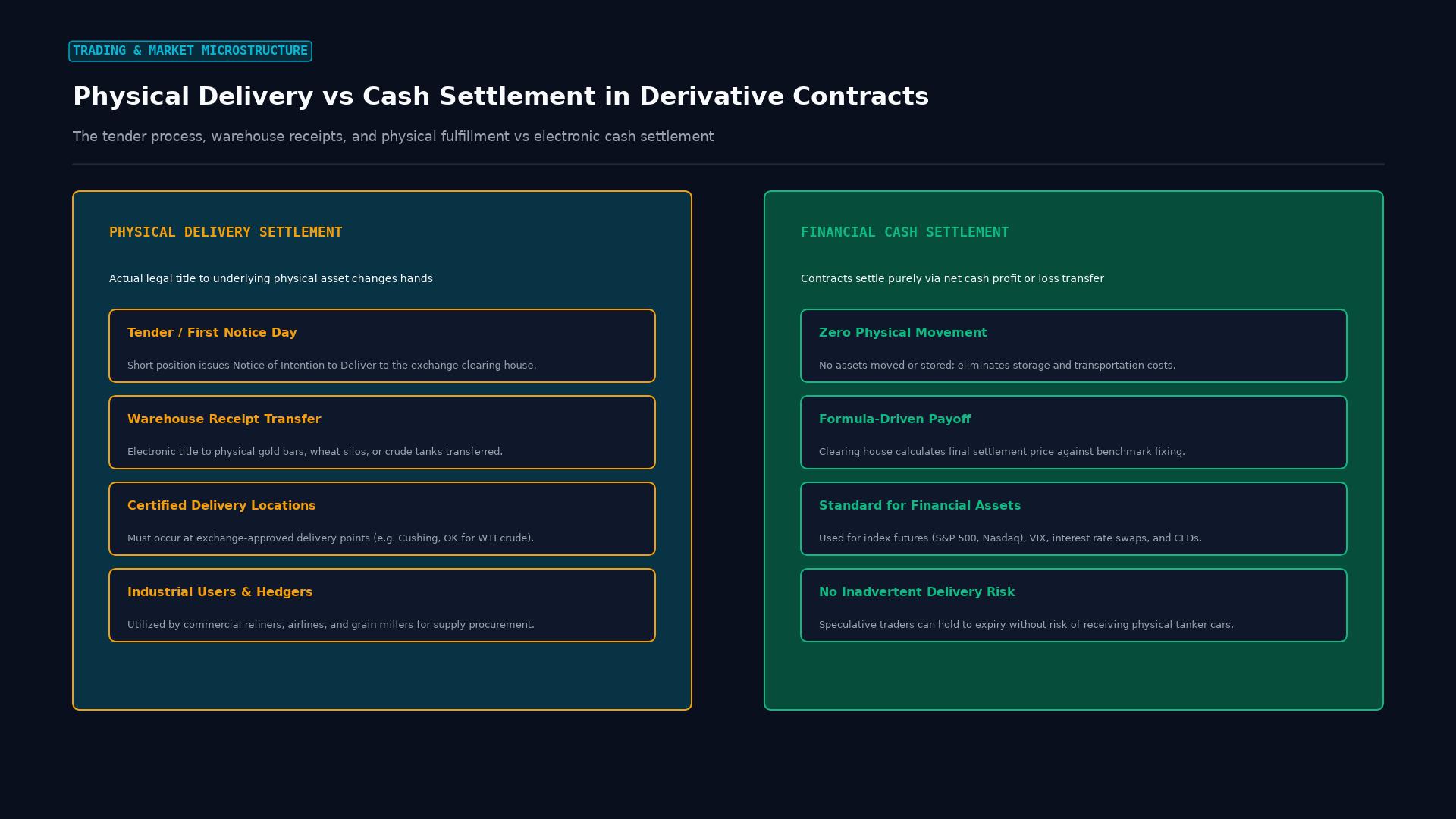 Figure: Contractual settlement mechanisms: physical warehouse title delivery at certified exchange depositories versus automated financial cash settlement against fixing indices.
Key Takeaways
- Physical Delivery in FX: In institutional interbank spot forex, “physical delivery” is electronic; it means actual sovereign currency reserves are transferred between commercial banks via central bank RTGS rails or Continuous Linked Settlement (CLS).
- Retail Rolling Spot Avoidance: Retail forex traders almost never take physical delivery. Retail brokers automatically “roll over” open spot positions at the 5:00 PM EST daily cut-off via Tom-Next swaps, postponing physical delivery indefinitely.
- First Notice Day in Commodity Futures: Traders holding long positions in deliverable commodity futures (such as WTI crude oil or wheat) must liquidate or roll their contracts before First Notice Day to avoid receiving thousands of physical barrels or bushels at exchange delivery points.
- Non-Deliverable Forwards (NDFs): Used for emerging market currencies with capital controls (such as the Indian Rupee, Brazilian Real, or Korean Won), where physical delivery is prohibited by domestic law and trades must settle offshore in U.S. Dollars.
Physical Delivery vs. Cash Settlement
The table below contrasts the mechanical requirements, operational risks, and market applications of the two delivery methods:
| Feature | Physical Delivery | Cash Settlement |
|---|---|---|
| Obligation | Transfer 100% of underlying asset and payment | Settle net cash profit or loss in benchmark currency |
| Capital Intensity | Requires 100% gross notional liquidity funding | Requires only net difference margin |
| Settlement Risk | High (Herstatt risk if counterparties settle asynchronously) | Negligible (Single net cash transfer eliminates principal risk) |
| Delivery Infrastructure | Central bank RTGS rails, bonded warehouses, tanker terminals | Standard electronic wire transfer / broker ledger |
| Typical Instruments | Interbank Spot FX, Deliverable FX Forwards, Gold Bullion | CFDs, Retail Spot FX, Stock Index Futures, FX NDFs |
Physical Currency Delivery via CLS Bank
In the institutional foreign exchange market, physical currency delivery across G10 currencies is coordinated by Continuous Linked Settlement (CLS Bank) to eliminate settlement risk:
Bank A sells EUR 10M to Bank B ──► Trade Matched at CLS ──► PvP Simultaneous Settlement ──► Accounts Credited- Trade Submission: Bank A and Bank B execute an OTC spot trade (€10,000,000 against $10,850,000 USD) and submit matched instructions to CLS.
- Multilateral Netting: CLS consolidates the trade with thousands of other institutional positions, calculating each bank’s single net funding obligation per currency.
- Payment-versus-Payment (PvP) Delivery: CLS executes simultaneous electronic delivery across central bank reserve accounts at the Federal Reserve and the European Central Bank. Bank A receives its dollars if and only if Bank B simultaneously receives its euros.
Non-Deliverable Forwards (NDFs): Bypassing Physical Delivery
In countries that enforce strict capital controls to prevent currency flight, foreign investors are legally prohibited from holding onshore domestic bank accounts or physically exporting national currency. Financial markets bypass this barrier using Non-Deliverable Forwards (NDFs):
$$\text{Cash Settlement Payout} = \text{Notional Amount} \times \left( \frac{\text{Settlement Rate} - \text{Contracted NDF Rate}}{\text{Settlement Rate}} \right)$$
Practical NDF Execution (USD/INR):
- A multinational firm enters an offshore NDF contract to sell $10,000,000 USD against Indian Rupee (INR) at an agreed rate of
83.50. - At maturity, the Reserve Bank of India’s official fixing rate settles at
84.00(the Rupee depreciated). - Instead of delivering 835,000,000 physical Indian Rupees, the counterparties settle the trade offshore in New York: $$\text{Payout (in USD)} = $10,000,000 \times \left( \frac{84.00 - 83.50}{84.00} \right) = $59,523.81 \text{ USD}$$
- The corporate hedger receives $59,523.81 USD in cash, completely satisfying the contract with zero physical Indian currency transferred across borders.
Real-World Case Study: Physical Delivery Chaos in April 2020 WTI Oil
The inherent risk of physical delivery was dramatically demonstrated on April 20, 2020, during the expiration of the May 2020 WTI crude oil futures contract:
The Physical Bottleneck:
- Retail exchange-traded funds and inexperienced retail speculators bought near-month WTI crude oil futures contracts (
CL) trading around $10 to $15 per barrel, unaware that the contract mandated physical delivery at Cushing, Oklahoma. - Due to global pandemic lockdowns, commercial oil tanks, pipelines, and rail cars at Cushing were 100% full.
- Physical delivery rules state that if a trader holds a long contract past the expiration cut-off, they must take physical delivery of 1,000 barrels of crude oil per contract at Cushing pipeline manifolds.
The Collapse:
- Commercial storage operators refused to accept new oil at any price.
- Speculators who lacked physical storage permits or transport pipelines faced catastrophic regulatory fines for failing to take delivery.
- Desperate to avoid physical delivery, traders paid buyers to take the contracts off their hands, driving the price down into negative territory to settle at an unprecedented -$37.63 per barrel.
- The disaster forced retail brokers worldwide to update their automated risk management software, automatically liquidating deliverable contracts days before First Notice Day.
Frequently Asked Questions
Can a retail forex trader request physical currency delivery from their broker?
No. Standard retail forex brokerages (MetaTrader, cTrader) operate as Contract for Difference (CFD) or rolling spot providers. Their platforms are not connected to commercial wire delivery rails. If an individual requires physical foreign banknotes or international wire transfers, they must utilize specialized foreign exchange payment companies or commercial banks.
What is “First Notice Day” in futures markets?
First Notice Day (FND) is the earliest date upon which an exchange clearinghouse can formally assign physical delivery notices to long futures contract holders. To avoid delivery obligations, financial speculators routinely close or roll their positions to the subsequent month prior to FND.
How does delivery work in retail stock investing?
When you purchase shares of stock through a retail brokerage (e.g., Apple or Microsoft), physical paper stock certificates are not delivered. Instead, ownership is delivered electronically via book-entry registration at the central securities depository (The Depository Trust Company - DTC), crediting the shares to your broker in “street name.”
Ready to trade forex?
Open a free demo account with a regulated broker. Practice with virtual funds before risking real money.