Depreciation
Depreciation is the gradual decrease in the market value of an asset over time, most prominently referring to the market-driven decline in the purchasing power and exchange rate of a floating sovereign currency.
What Is Depreciation?
In economics, finance, and accounting, the term depreciation carries two fundamental meanings depending on the context:
- In Macroeconomics and Foreign Exchange (Currency Depreciation): Depreciation is the decrease in the purchasing power and relative market valuation of a nation’s currency against foreign currencies in an open, floating exchange rate system. Unlike official government decrees, currency depreciation is driven organically by the free-market forces of supply and demand—sparked by factors such as interest rate differentials, higher domestic inflation, widening trade deficits, and institutional capital flight.
- In Corporate Accounting (Asset Depreciation): Depreciation is the systematic, non-cash accounting allocation of the historical cost of a physical tangible asset (such as commercial buildings, factory machinery, vehicle fleets, or IT infrastructure) over its estimated useful economic lifespan.
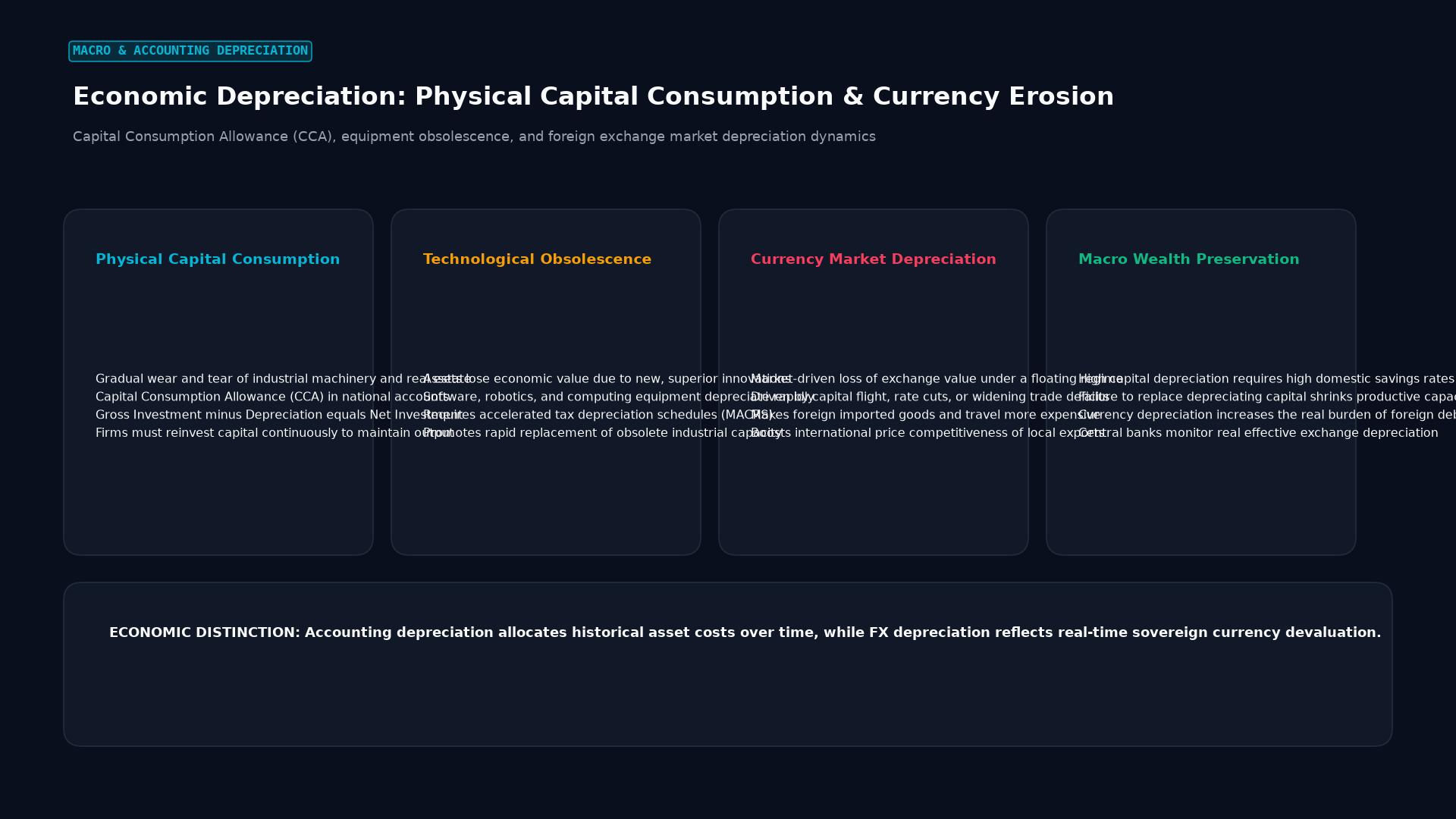 Figure: Capital Consumption Allowance (CCA), equipment obsolescence, and foreign exchange market depreciation dynamics
Key Takeaways
- Depreciation vs. Devaluation: While both describe a currency losing value, depreciation occurs automatically in floating regimes through open market trading; devaluation is an official policy reduction of a fixed or pegged exchange rate by a central bank.
- The Competitive Export Advantage: A depreciating currency makes domestic manufactured goods and agricultural products cheaper and more competitive for foreign international buyers, stimulating export volumes.
- The Imported Inflation Threat: Depreciation raises the domestic cost of imported raw materials, food, and energy (such as crude oil priced in U.S. Dollars), fueling imported cost-push inflation.
- The J-Curve Mechanism: Following currency depreciation, a nation’s trade balance often deteriorates in the short run due to pre-existing import contracts before improving in the long run as export volumes expand (satisfying the Marshall-Lerner Condition).
What Drives Currency Depreciation?
In the international foreign exchange market, an exchange rate depreciates when the supply of the currency entering the market exceeds the international demand for that currency. The primary macroeconomic catalysts include:
1. Interest Rate Divergence (Carry Outflows)
When a domestic central bank cuts benchmark interest rates while foreign central banks hike or hold rates steady, global institutional capital flees the low-yielding domestic currency to seek higher yields abroad. Investors sell the domestic currency, causing it to depreciate.
2. High Relative Inflation
Under the theory of Relative Purchasing Power Parity (PPP), if Country A experiences 8% annual inflation while Country B experiences only 2%, the currency of Country A must depreciate by approximately 6% over time to equalize real consumer purchasing power between the two nations.
3. Chronic Current Account & Trade Deficits
A nation that consistently imports substantially more physical goods and services than it exports generates an ongoing structural outflow of domestic currency to foreign exporters. If foreign investors do not reinvest those funds back into domestic assets, the currency depreciates.
4. Expansionary Monetary Policy & Debt Monetization
Aggressive money printing (Quantitative Easing) dilutes the supply of the fiat currency in circulation, eroding its scarcity value relative to foreign peers.
Economic Consequences of Currency Depreciation
Currency depreciation produces a complex web of economic winners and losers across a national economy:
| Economic Sector | Impact of Depreciation | Operational Explanation |
|---|---|---|
| Domestic Exporters | Major Beneficiary (Positive) | Products become cheaper in foreign markets; export volumes and local-currency revenues expand |
| Domestic Tourism & Hospitality | Beneficiary (Positive) | Foreign visitors find hotels and dining more affordable, driving inbound foreign tourism spending |
| Domestic Consumers | Negative (Erosion of Wealth) | Imported consumer electronics, imported food, and foreign travel become significantly more expensive |
| Import-Dependent Manufacturers | Negative (Margin Squeeze) | Factories that rely on imported raw materials (e.g., imported steel or energy) face surging production costs |
| Foreign-Currency Debtors | Severe Hazard (Insolvency) | Corporations that borrowed in U.S. Dollars must generate more devalued domestic currency to service their debts |
Real-World Case Study: The Post-Brexit British Pound Depreciation (2016)
On June 23, 2016, the United Kingdom voted in a national referendum to leave the European Union (the Brexit vote):
The Market Shock:
- Prior to the referendum results, the British Pound traded at
1.5000against the U.S. Dollar. - As vote counts confirmed the UK’s exit from the European single market, global institutions initiated massive capital reallocations.
The Depreciation Sequence:
- Immediate Market Plunge: In the overnight Asian and London trading sessions of June 24, 2016, GBP/USD collapsed from
1.5000to1.3225—a historic single-day depreciation of over 10% (-1,800 pips). - Subsequent Trajectory: Over the subsequent months, continued economic uncertainty drove the Pound down to
1.2000(a cumulative ~20% depreciation). - Macroeconomic Fallout:
- Inflation Surged: UK headline CPI inflation jumped from 0.5% in mid-2016 to over 3.1% by late 2017, directly driven by the surging cost of imported European foodstuffs and consumer goods.
- Export Surge: UK multinational corporations listed on the FTSE 100 index (which generate over 75% of their revenues overseas in USD and EUR) enjoyed record corporate earnings when translated back into depreciated Pounds, pushing the FTSE 100 to all-time highs.
Frequently Asked Questions
Can a central bank stop its currency from depreciating?
Yes, but only if it possesses sufficient foreign exchange reserves. A central bank can intervene in the spot foreign exchange market by selling its U.S. Dollar or Euro reserves and buying back its domestic currency to prop up the exchange rate. Alternatively, it can enact aggressive interest rate hikes or impose capital controls to halt outbound money flows.
How does depreciation differ in corporate accounting?
In accounting, depreciation is an internal non-cash bookkeeping entry that spreads the cost of a physical capital asset (such as an office building or factory robot) over its useful life using formulas like Straight-Line Depreciation ($\text{Annual Expense} = [\text{Cost} - \text{Salvage Value}] / \text{Useful Life}$). It reduces reported taxable net income without requiring a cash outflow.
Does currency depreciation always cause inflation?
In open, import-dependent economies, currency depreciation almost invariably triggers imported inflation. However, in large, self-sufficient continental economies with deep domestic supply chains (such as the United States), the pass-through rate of currency depreciation into consumer inflation is significantly more muted.
Ready to trade forex?
Open a free demo account with a regulated broker. Practice with virtual funds before risking real money.