Trade Details
Trade details (transaction details or economic terms) are the mandatory, standardized parameters required to legally execute, book, reconcile, and settle a financial transaction between counterparties.
What Are Trade Details?
In financial markets, electronic trading, and international banking, trade details (formally termed the economic terms or transaction parameters of a trade) comprise the mandatory, immutable set of contractual specifications agreed upon by counterparties at the moment of execution. Without complete and mutually validated trade details, a financial contract cannot be legally recognized, processed by an Order Management System (OMS), or cleared across interbank settlement rails.
In modern electronic markets, trade details are encoded and transmitted in microseconds using international communication standards—such as the Financial Information eXchange (FIX) protocol for execution and SWIFT messaging (MT300/pacs.008) for post-trade clearing. In retail forex trading, trade details represent the essential inputs configured by the trader in the order execution window (currency pair, lot size, direction, and stop-loss/take-profit boundaries) before submitting an order to the broker.
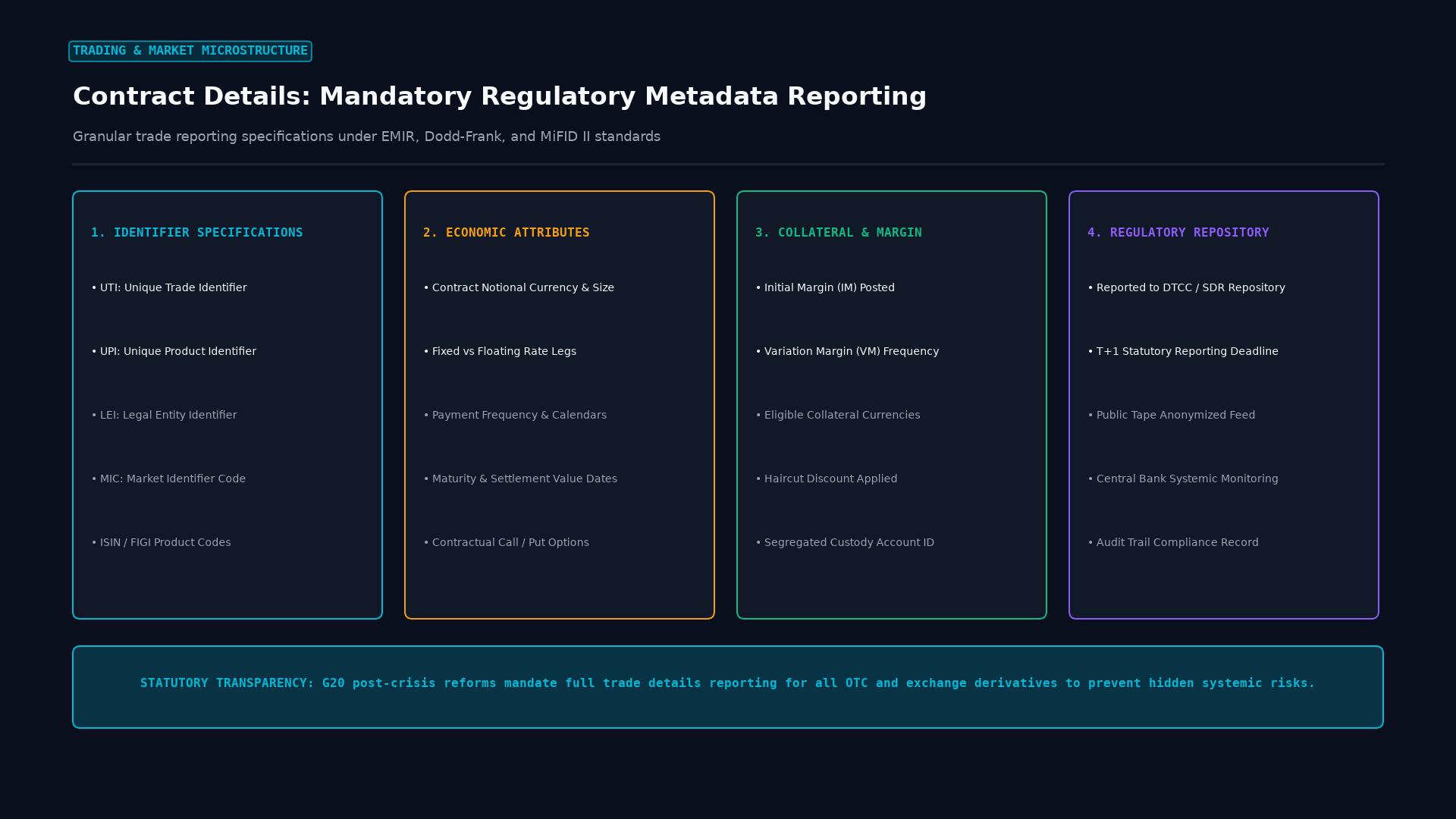 Figure: Statutory trade reporting parameters under EMIR and Dodd-Frank: Unique Trade Identifiers (UTI), Legal Entity Identifiers (LEI), economic terms, and SDR repository submission.
Key Takeaways
- The Seven Mandatory Economic Terms: Every valid foreign exchange transaction requires seven core details: Instrument/Pair, Side (Buy/Sell), Volume/Quantity, Execution Rate, Trade Date/Time, Value (Settlement) Date, and Counterparty Identity.
- Protocol Standardization (FIX Protocol): Global electronic trading venues enforce automated validation of trade details using designated numeric tags (e.g., FIX Tag 55 for Symbol, Tag 54 for Side, Tag 38 for Quantity).
- Settlement Break Prevention: A discrepancy in even one single trade detail (such as a 1-pip variance in rate or an incorrect value date) causes an automated trade break, halting settlement until middle-office clerks manually resolve the mismatch.
- ISDA Legal Enforceability: Under International Swaps and Derivatives Association (ISDA) master agreements, the confirmed trade details constitute the definitive legal evidence of a binding derivative contract in court.
The Essential Parameters of an Institutional FX Trade
To execute and settle an Over-the-Counter (OTC) spot, forward, or swap transaction, middle and back-office clearing engines require specific standardized fields:
| Trade Detail Field | Technical Designation | Functional Purpose | Real-World Example |
|---|---|---|---|
| 1. Instrument / Pair | FIX Tag 55 (Symbol) |
Identifies the base and quote currency traded | EUR/USD |
| 2. Side (Direction) | FIX Tag 54 (Side) |
Specifies whether base currency is bought or sold | 1 = Buy (Long), 2 = Sell (Short) |
| 3. Order Quantity | FIX Tag 38 (OrderQty) |
Gross volume of base currency notional | 10,000,000 (€10M EUR / 100 Lots) |
| 4. Execution Rate | FIX Tag 44 (Price) |
The contractual exchange rate agreed upon | 1.08525 |
| 5. Order Type | FIX Tag 40 (OrdType) |
Execution condition (Market, Limit, Stop, TWAP) | 2 = Limit Order |
| 6. Trade Timestamp | FIX Tag 60 (TransactTime) |
Precise UTC time of order matching | 2026-09-22 14:15:32.418 UTC |
| 7. Value Date | FIX Tag 64 (SettlDate) |
Delivery date for the exchanged cash currencies | 2026-09-24 (T+2 Spot Settlement) |
| 8. Counterparties | FIX Tag 448 (PartyID) |
Legal Entity Identifiers (LEI) of both parties | Bank A (LEI) vs. Asset Manager B (LEI) |
| 9. Settlement (SSIs) | Standing Settlement Instructions | Beneficiary bank BIC routing numbers and accounts | Federal Reserve NY / Deutsche Bundesbank |
Standardization via the FIX Protocol
Before the advent of standardized electronic protocols in the 1990s, trade details were communicated verbally over telephone lines, leading to frequent misunderstandings and transcription errors. Modern electronic institutional trading relies on the Financial Information eXchange (FIX) protocol, which encodes trade details into clean, machine-readable key-value pairs:
Sample FIX Protocol Execution Message (35=8):
8=FIX.4.4 | 9=178 | 35=8 | 49=BROKER_A | 56=FUND_XYZ | 34=1042 | 52=20260922-14:15:32.418 |
11=ORD_98412 | 37=EXEC_09182 | 150=2 | 39=2 | 55=EUR/USD | 54=1 | 38=10000000 | 44=1.08525 |
31=1.08525 | 32=10000000 | 64=20260924 | 10=182 |
Each number before the equal sign represents a specific trade detail:
35=8indicates an Execution Report.55=EUR/USDdefines the Currency Pair.54=1denotes a Buy Order.38=10000000designates a 10,000,000 unit volume.44=1.08525specifies the Agreed Fill Price.
Trade Details in Retail Forex Trading
For retail traders utilizing trading software (like MetaTrader, cTrader, or mobile broker apps), trade details represent the essential input fields in the order dialogue box:
Retail Order Entry Dialogue Box:
┌────────────────────────────────────────────────────────┐
│  ORDER TICKET: GBP/USD Spot                            │
├────────────────────────────────────────────────────────┤
│  Symbol: [ GBP/USD ]                                   │
│  Volume: [ 0.50 Lots (50,000 Units) ]                  │
│  Type: [ Pending Order: Buy Limit ]                    │
│  Price: [ 1.27500 ]                                    │
│  Stop Loss: [ 1.27100 ]       Take Profit: [ 1.28500 ] │
│  Expiration: [ Good 'Til Cancelled (GTC) ]             │
├────────────────────────────────────────────────────────┤
│               [ PLACE ORDER: BUY LIMIT ]               │
└────────────────────────────────────────────────────────┘
If a retail trader fails to specify crucial trade details—such as omitting a stop-loss order or selecting an incorrect volume size (e.g., entering 5.0 lots instead of 0.50 lots)—the trading terminal executes the exact parameters submitted, holding the trader fully liable for the resulting risk.
Real-World Case Study: Resolving a Post-Trade Value Date Mismatch
An institutional macro hedge fund in London executes a spot forward purchase of $25,000,000 USD against Canadian Dollars (CAD) with a North American investment bank.
The Error:
- The London trader contracted the trade for settlement on June 30.
- The bank’s back-office system booked the value date as July 2 (overlooking that June 30 was a standard business day in Canada).
The Breakdown and Resolution:
- Two hours post-execution, the hedge fund’s automated middleware cross-referenced the incoming SWIFT MT300 confirmation message against its internal trade ticket details.
- The system flagged a Critical Exception Break: Value Date Mismatch (June 30 vs. July 2).
- Because the value dates did not match, the trade could not be submitted to Continuous Linked Settlement (CLS).
- Middle-office operations retrieved the time-stamped chat audit log, confirming the agreed trade details specified June 30.
- The bank amended the trade details in its booking ledger, re-issued a corrected confirmation, and successfully cleared the $25 million transfer on June 30, preventing thousands of dollars in overnight interest rate overdraft penalties.
Frequently Asked Questions
What happens if counterparties disagree on the execution rate trade detail?
If counterparties discover a price discrepancy upon reviewing confirmations (e.g., 1.0850 vs. 1.0855), the trade is immediately flagged as an “Unmatched Break.” Operations staff review recorded telephone audio tapes or time-stamped electronic chat logs. If a genuine misunderstanding occurred, the trade is cancelled by mutual consent and re-executed at the prevailing market rate.
What is “Time in Force” in trade details?
Time in Force (TIF) is a specific order detail (FIX Tag 59) that dictates how long an order remains active before expiring:
- Day Order (DAY): Automatically cancels at the end of the current trading session.
- Good ’Til Cancelled (GTC): Remains active indefinitely until filled or manually cancelled.
- Immediate or Cancel (IOC): Fills whatever volume is available immediately and cancels the rest.
- Fill or Kill (FOK): Must be filled in its entirety immediately, or the entire order is cancelled.
Are trade details confidential?
Under global market regulations, trade details are confidential between the counterparties. However, post-2008 derivatives regulations (Dodd-Frank Title VII and EMIR) legally require counterparties to report anonymized transaction details to centralized Trade Repositories (such as DTCC) for systemic risk monitoring.
Ready to trade forex?
Open a free demo account with a regulated broker. Practice with virtual funds before risking real money.