Deutsche Mark (DEM)
The Deutsche Mark (DEM, D-Mark) was the official sovereign currency of Germany from 1948 until its replacement by the Euro in 1999, renowned globally as the anchor of European price stability.
What Was the Deutsche Mark (DEM)?
The Deutsche Mark (ISO 4217 code: DEM, commonly termed the D-Mark or Deutschmark in English) was the official sovereign currency of West Germany from 1948, of reunified Germany from 1990, until its official replacement by the Euro (EUR) on January 1, 1999 (with physical banknotes and coins circulating until early 2002).
Throughout the second half of the twentieth century, the Deutsche Mark was widely regarded as the world’s premier hard currency alongside the U.S. Dollar and the second most held reserve currency globally. Revered for its steadfast purchasing power and ultra-low inflation rates, the D-Mark was managed with legendary independence by the Deutsche Bundesbank (Germany’s central bank). The monetary credibility and operational framework of the Bundesbank served as the direct intellectual and institutional blueprint for the creation of the European Central Bank (ECB).
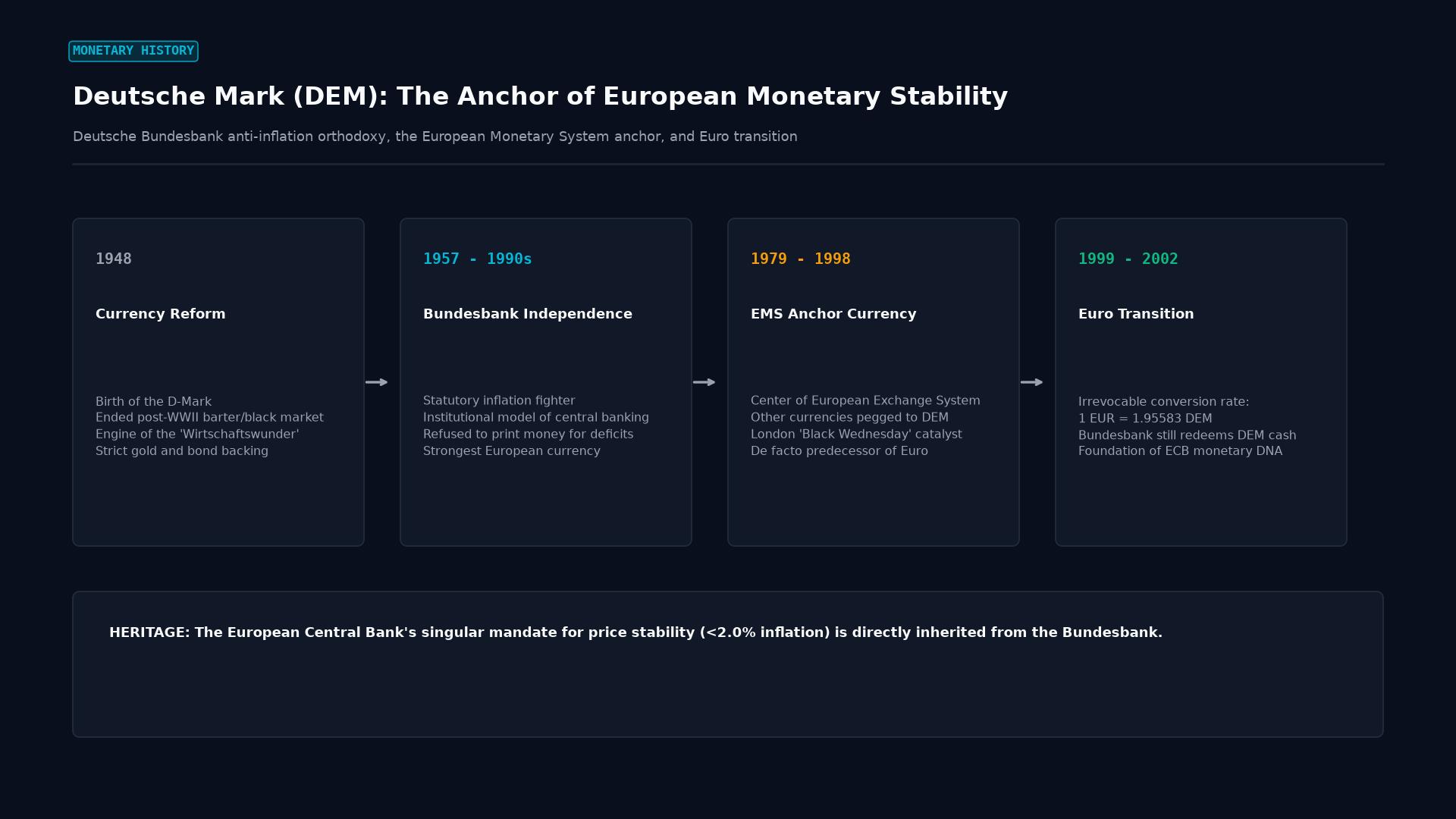 Figure: Historical monetary cornerstone: Deutsche Bundesbank anti-inflation orthodoxy, European Monetary System anchor, and Euro DNA foundation.
Key Takeaways
- The Miracle of the D-Mark (Wirtschaftswunder): Introduced on June 20, 1948, to replace the worthless Reichsmark, the D-Mark instantly ended black markets and shortages, sparking West Germany’s miraculous post-WWII economic recovery.
- The Bundesbank Doctrine: Formed in reaction to the catastrophic Weimar hyperinflation of 1923, the Bundesbank maintained a singular, statutory obsession with price stability, refusing to compromise monetary discipline for short-term political objectives.
- Anchor of the European Monetary System (EMS): In the 1970s, 1980s, and 1990s, the D-Mark served as the de facto anchor currency of Europe; neighboring nations had to adjust their interest rates to match the Bundesbank to maintain their currency pegs under the Exchange Rate Mechanism (ERM).
- Permanent Convertibility: Unlike many legacy European currencies whose redemption windows expired, the Deutsche Bundesbank guarantees the conversion of physical Deutsche Mark banknotes and coins into Euros indefinitely without fees or expiration dates at the fixed legal rate of 1.95583 DEM per EUR.
The Birth of a Hard Currency: The 1948 Currency Reform
Following World War II, Germany was crippled by a destroyed economy and severe barter trading; the wartime Reichsmark had lost all purchasing power, with American cigarettes functioning as the de facto currency.
On Sunday, June 20, 1948, Western Allied authorities and German economic director Ludwig Erhard executed a secret, overnight currency reform:
- The Deutsche Mark was introduced, backed by strict legal limits on central bank credit creation.
- Every citizen was granted a starting quota of 40 D-Marks in cash (followed by an additional 20 D-Marks later).
- Simultaneously, Erhard unilaterally abolished wartime price controls and rationing.
- The Overnight Transformation: On Monday morning, shopkeepers who had hoarded goods brought their inventory out to sell for the new trusted currency. Store shelves were instantly filled, consumer confidence returned, and the foundation for the German economic miracle (Wirtschaftswunder) was established.
The D-Mark in International Finance: The Pre-Euro Reserve Giant
Before the launch of the Euro in 1999, the Deutsche Mark was the undisputed heavyweight of European foreign exchange trading:
| Currency Dimension | Historical Deutsche Mark Profile (1980s–1990s) | Modern Comparison (Euro) |
|---|---|---|
| Global FX Reserves | 14% to 18% of all global foreign exchange reserves (Ranked #2 behind USD) | Euro accounts for ~20% of global reserves |
| Primary Trading Pair | USD/DEM was the world’s most actively traded currency pair | Replaced by EUR/USD (the modern global volume leader) |
| Central Bank | Deutsche Bundesbank (Frankfurt am Main) | European Central Bank (Frankfurt am Main) |
| Sub-Units | 1 Deutsche Mark = 100 Pfennigs (Pf.) | 1 Euro = 100 Cents |
| Irrevocable Conversion Rate | 1 EUR = 1.95583 DEM (Fixed December 31, 1998) | Benchmark single currency |
Real-World Case Study: “Black Wednesday” (September 16, 1992)
The immense gravitational pull of the Deutsche Mark triggered one of the most famous speculative events in financial history:
The Geopolitical Setup:
- Following German Reunification in 1990, the German government spent hundreds of billions of D-Marks rebuilding the former East Germany, stimulating massive inflationary pressure.
- True to its anti-inflation mandate, the Bundesbank aggressively hiked interest rates (pushing benchmark rates to 8.75%) to cool German inflation.
- Under the European Exchange Rate Mechanism (ERM), other European nations were legally required to keep their currencies pegged to the D-Mark within a $\pm 2.25%$ band.
- The British Dilemma: The United Kingdom was in a severe domestic recession with high unemployment, yet to keep the British Pound pegged to the surging D-Mark, the Bank of England was forced to keep domestic UK interest rates punitively high (10% to 12%).
The Speculative Attack:
- Legendary macro hedge fund manager George Soros (Quantum Fund) recognized an economic impossibility: Britain could not maintain high interest rates without destroying its domestic housing and banking sector.
- Soros borrowed billions of British Pounds and aggressively sold them in the spot market to buy Deutsche Marks.
- On September 16, 1992 (“Black Wednesday”), despite the Bank of England hiking rates to 15% and burning billions in foreign reserves, the Pound shattered its lower ERM boundary.
- Britain formally crashed out of the ERM and floated the Pound, while Soros generated an iconic $1 billion profit betting on the unassailable strength of the Deutsche Mark.
Transition into the Euro: Legacy and Monetary Blueprint
On January 1, 1999, the Deutsche Mark formally ceased to exist as an independent floating currency, becoming a non-decimal denomination of the Euro at the exact statutory conversion rate:
$$\text{Euro Amount} = \frac{\text{Deutsche Mark Amount}}{1.95583}$$
The Bundesbank’s Enduring Legacy on the ECB:
When European leaders negotiated the Maastricht Treaty, the German public was intensely reluctant to surrender their beloved, stable D-Mark for an unproven pan-European currency. To secure German approval, the Eurozone adopted the Bundesbank’s operational philosophy verbatim:
- The European Central Bank was headquartered in Frankfurt am Main, Germany.
- The ECB was granted absolute statutory independence from European political interference.
- The ECB’s primary and overriding constitutional mandate was codified strictly as price stability (maintaining inflation below, but close to, 2%).
Frequently Asked Questions
Can old Deutsche Mark banknotes still be exchanged for Euros today?
Yes. Unlike the central banks of France, Italy, or Greece (which terminated the redemption of French Francs, Italian Lire, and Greek Drachmas years ago), the Deutsche Bundesbank continues to exchange valid DEM banknotes and coins indefinitely at its headquarters and branches throughout Germany at the exact official rate of 1.95583 DEM per Euro, with zero service fee.
How much Deutsche Mark cash is still unexchanged?
According to official Bundesbank registry data, more than 12 billion Deutsche Marks (worth approximately €6.2 billion) have never been redeemed. These missing notes and coins reside in private collections, forgotten home vaults, or were lost during the pre-2002 transition.
What was the relationship between the D-Mark and the Swiss Franc?
Historically, the Deutsche Mark and the Swiss Franc (CHF) maintained an exceptionally strong positive correlation. Both currencies were recognized by international markets as the ultimate European safe-haven assets, appreciating rapidly during Cold War geopolitical crises or global dollar weakness.
Ready to trade forex?
Open a free demo account with a regulated broker. Practice with virtual funds before risking real money.