Appreciation
Appreciation refers to an increase in the value of one currency relative to another within a floating exchange rate system, driven by free-market forces of supply and demand. It is distinct from revaluation, which occurs via an official government or central bank adjustment under a fixed exchange rate regime.
Understanding Currency Appreciation
In international foreign exchange markets, a currency never rises or falls in a vacuum. Because currencies trade strictly in pairs, currency appreciation describes a scenario where one currency gains purchasing power against another over a specific timeframe. For example, if the EUR/USD exchange rate climbs from 1.0500 to 1.1200, the Euro has appreciated against the US Dollar—each Euro now commands more American dollars. Inversely, the US Dollar has depreciated against the Euro.
Appreciation occurs spontaneously through the interaction of global buyers and sellers on decentralized interbank networks. When international demand for a nation’s assets, goods, or services outpaces the willingness of domestic residents to sell their currency, upward pressure mounts on the exchange rate.
A vital economic distinction must be drawn between appreciation and revaluation:
- Appreciation takes place under a floating or flexible exchange rate regime, governed by open-market dynamics.
- Revaluation represents a deliberate, administrative decision by a sovereign government or central bank to reset the official parity of a pegged or fixed currency upward.
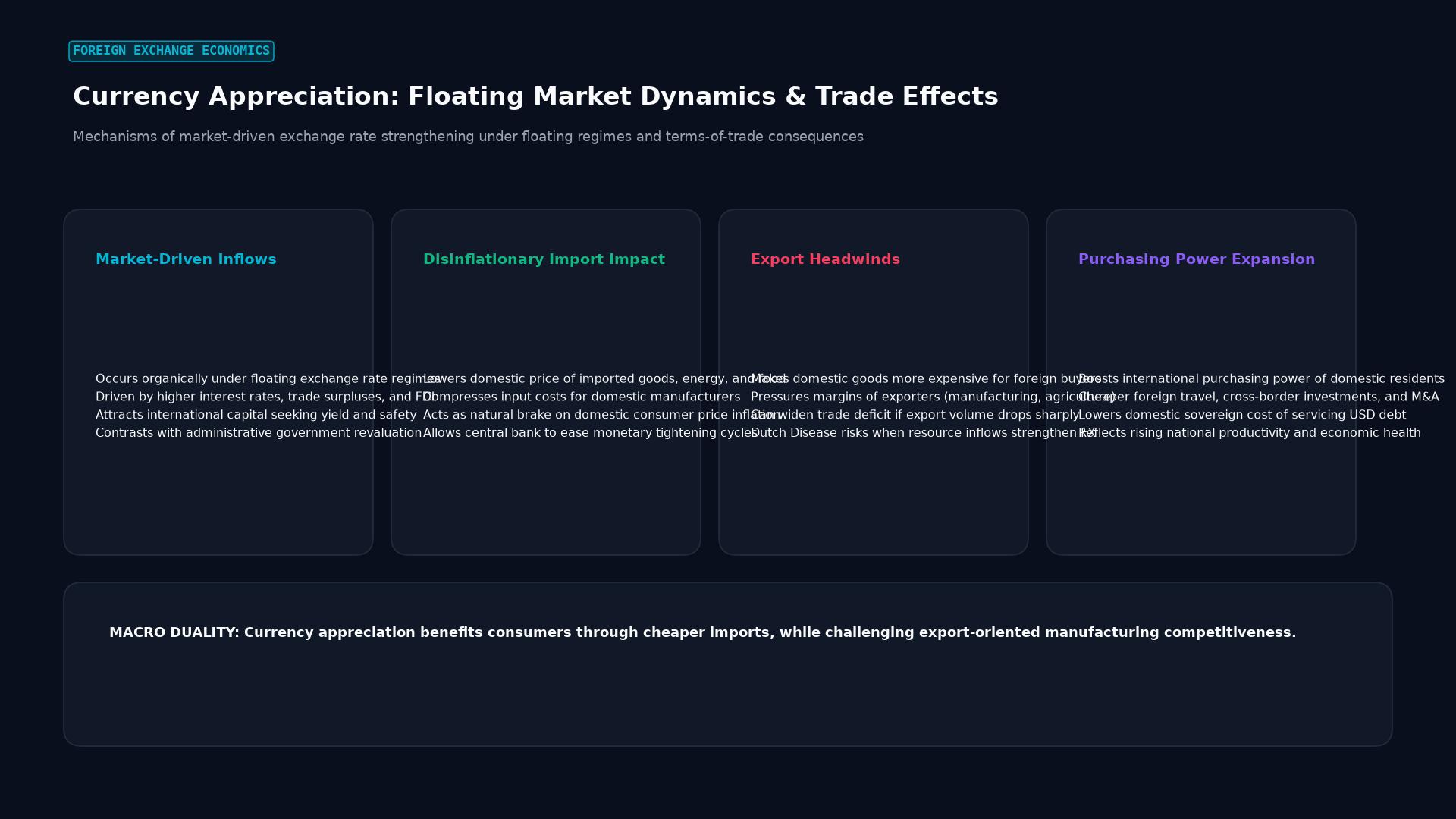 Figure: Mechanisms of market-driven exchange rate strengthening under floating regimes and terms-of-trade consequences
Core Drivers of Currency Appreciation
Currency values fluctuate in response to shifting macroeconomic fundamentals, financial market sentiment, and capital flows. Five primary catalysts drive sustained currency appreciation:
1. Interest Rate Differentials
Capital flows toward higher yields. When a nation’s central bank raises its benchmark interest rate relative to other central banks, domestic sovereign bonds and commercial deposits become more lucrative to international institutional investors. Global asset managers sell low-yielding currencies to purchase the higher-yielding currency, generating sustained buying demand. This phenomenon underpins the classic forex carry trade.
2. Economic Growth and Foreign Direct Investment (FDI)
Robust economic expansion attracts long-term corporate investment. Multinationals acquiring domestic companies, constructing production facilities, or buying local real estate must first convert foreign revenues into the domestic currency. This steady real-money demand creates a structural tailwind for the currency that can persist for years.
3. Current Account Surpluses
A nation that exports significantly more physical goods and services than it imports runs a current account surplus. Foreign purchasers must acquire the exporting nation’s currency to settle transactions, creating an ongoing commercial bid in the foreign exchange market. Economies like Germany, Japan, and Singapore have historically experienced long-term currency strength supported by substantial trade surpluses.
4. Improving Terms of Trade
The “terms of trade” index measures the ratio of export prices to import prices. When prices for a country’s primary export commodities rise faster than the cost of its imports, each unit of exports buys more foreign goods. Commodity-exporting nations—such as Australia (iron ore and coal), Canada (crude oil), and Norway (natural gas)—routinely experience sharp currency appreciation during global raw-material booms.
5. Safe-Haven Dynamics
During periods of geopolitical conflict, global banking stress, or recessionary shocks, market participants liquidate speculative assets and seek refuge in stable currencies. Currencies like the Swiss Franc (CHF) and the US Dollar (USD) historically appreciate during global panics because investors prioritize capital preservation, legal protections, and deep sovereign bond liquidity over yield.
The Economic Consequences of Appreciation
While currency appreciation sounds intuitively positive, its impact on the real economy is a double-edged sword:
The Positive Effects
- Tamed Domestic Inflation: An appreciating currency makes imported food, energy, electronics, and industrial components cheaper in domestic terms, directly lowering consumer price pressures.
- Cheaper Foreign Travel and Debt Servicing: Domestic citizens travel abroad at lower relative costs, and domestic corporations with foreign-currency-denominated debt find their debt service burdens reduced in local terms.
The Negative Effects
- Diminished Export Competitiveness: As the currency strengthens, domestic manufacturers find their goods more expensive for foreign buyers. This can suppress manufacturing output, squeeze corporate margins, and lead to job losses in export-reliant sectors.
- Deflationary Headwinds: Sustained currency strength can depress inflation below a central bank’s target, leading to stagnation. This frequently prompts central banks like the Swiss National Bank (SNB) or the Bank of Japan (BoJ) to intervene verbally or through direct market selling to prevent runaway appreciation.
Practical Forex Trading Example
Consider the 2022–2023 macroeconomic cycle in the foreign exchange market.
The US Federal Reserve embarked on one of the most aggressive monetary tightening campaigns in modern history, raising the Federal Funds Rate from near zero (0.00%–0.25%) up to 5.25%–5.50% to combat post-pandemic inflation. Meanwhile, the European Central Bank (ECB) lagged significantly in its hiking cycle, and the Bank of Japan maintained negative interest rates (-0.10%).
The widening interest rate differential catalyzed massive capital inflows into US Dollar assets:
- Global investors bought US Treasury bills yielding over 5%.
- In July 2021, EUR/USD traded near 1.1800.
- By September 2022, EUR/USD plunged below parity to 0.9535.
Over this 14-month stretch, the US Dollar experienced dramatic appreciation against the Euro. A trader who recognized that the Fed’s aggressive posture would create an insurmountable interest rate differential could enter short EUR/USD positions, capturing over 2,000 pips of trend appreciation while collecting positive daily rollover swap on the dollar yield advantage.
Key Takeaways
- Currency appreciation is the market-driven increase in a currency’s purchasing power relative to another currency under a floating exchange rate.
- It is distinct from revaluation, which is an administrative decree by a government in a pegged regime.
- Key catalysts include widening interest rate differentials, economic growth, trade surpluses, rising commodity prices, and safe-haven demand.
- Appreciation dampens domestic inflation by lowering import costs, but hurts domestic exporters by making their products more expensive abroad.
- Central banks monitor rapid appreciation closely and may intervene if excessive currency strength threatens domestic employment or export competitiveness.
FAQ
How does appreciation differ from inflation? Appreciation measures the value of a currency compared to another foreign currency in the international exchange market. Inflation measures the domestic purchasing power of a currency for everyday goods and services within its own country. A currency can appreciate against foreign peers while still experiencing domestic inflation.
Why would a central bank want to stop its currency from appreciating? When a currency becomes excessively strong, its export industries struggle to sell goods abroad, which can trigger factory slowdowns and rising unemployment. Central banks may intervene by cutting interest rates or selling their own currency in the open market to protect their economic competitiveness.
Can a currency appreciate against one currency while depreciating against another? Yes. Because exchange rates are quoted in pairs, a currency can gain strength against one peer while losing ground against a stronger peer. For example, the British Pound might appreciate against the Euro during a European energy crisis, while simultaneously depreciating against a surging US Dollar.
Ready to trade forex?
Open a free demo account with a regulated broker. Practice with virtual funds before risking real money.