Fiat Currency
A fiat currency is a government-issued national currency that is not backed by a physical commodity such as gold or silver. Its value is derived entirely from public trust in the issuing government, legal tender laws, and central bank monetary stability rather than intrinsic material worth.
What Is a Fiat Currency?
A fiat currency is an unbacked, government-issued medium of exchange that holds legal tender status by official sovereign decree. The term originates from the Latin word fiat, which translates to “let it be done” or “by decree.”
Unlike physical commodity money—such as gold, silver, copper, or salt—a paper dollar bill, euro note, or bank account digital credit possesses virtually zero intrinsic material value. A piece of cotton-linen paper bearing the portrait of a historical leader has no industrial utility and cannot be redeemed at the national treasury for a fixed quantity of precious metal.
Instead, a fiat currency functions as money because:
- The Government Declares It: The state establishes by statutory law that the currency constitutes legal tender for all public and private debts.
- The Public Accepts It: Economic participants maintain collective confidence that merchants, employers, and foreign trading partners will readily accept the currency in exchange for physical goods, labor, and assets.
- The State Taxes in It: The government demands that all citizens and corporations pay domestic taxes exclusively in the national fiat currency, anchoring a permanent baseline demand for the money.
Today, every major national currency in the global economy—including the US Dollar, Euro, Japanese Yen, British Pound, and Chinese Renminbi—is a fiat currency.
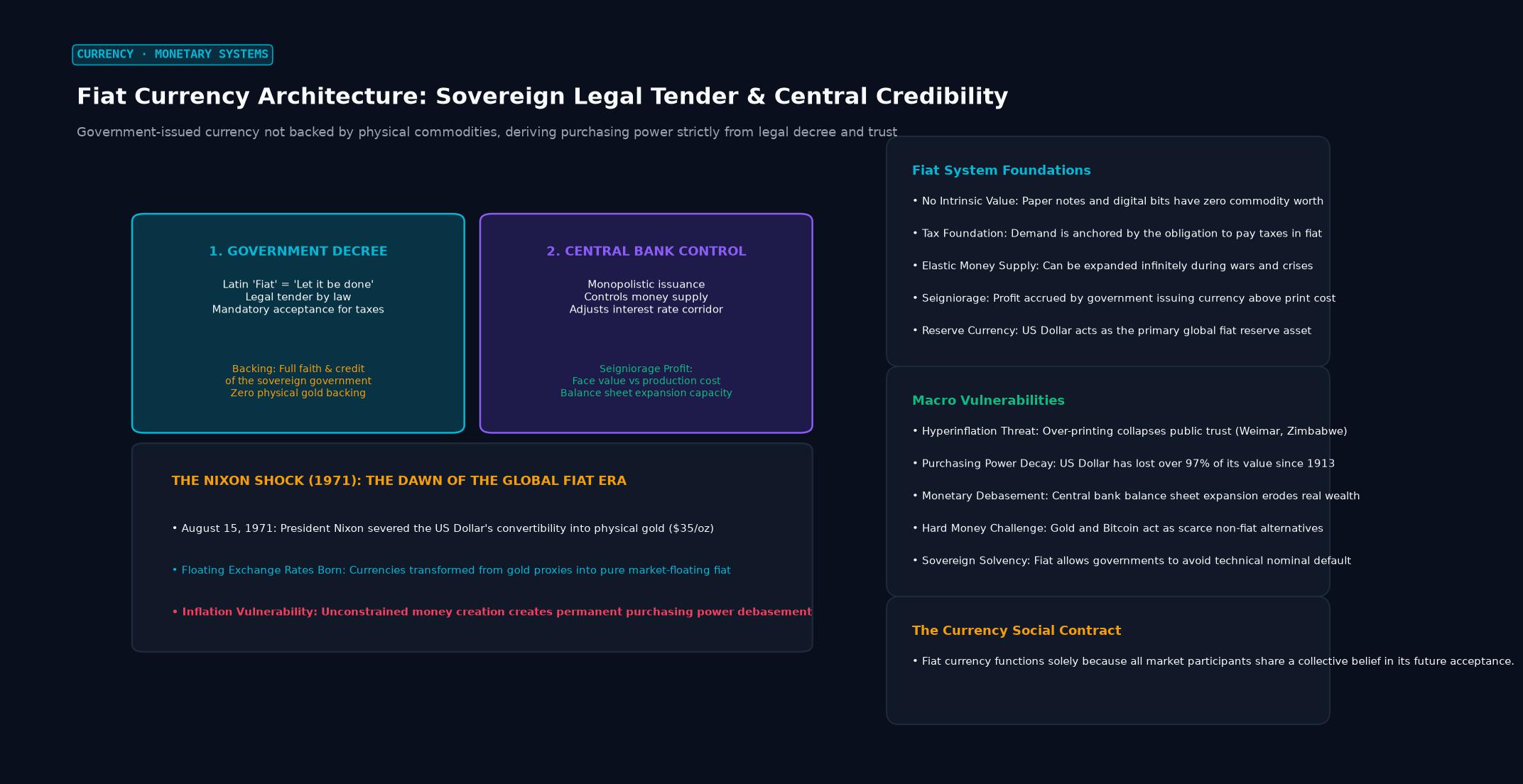 Figure: Government-issued currency not backed by physical commodities, deriving purchasing power strictly from legal decree and trust
The Evolutionary Spectrum of Money
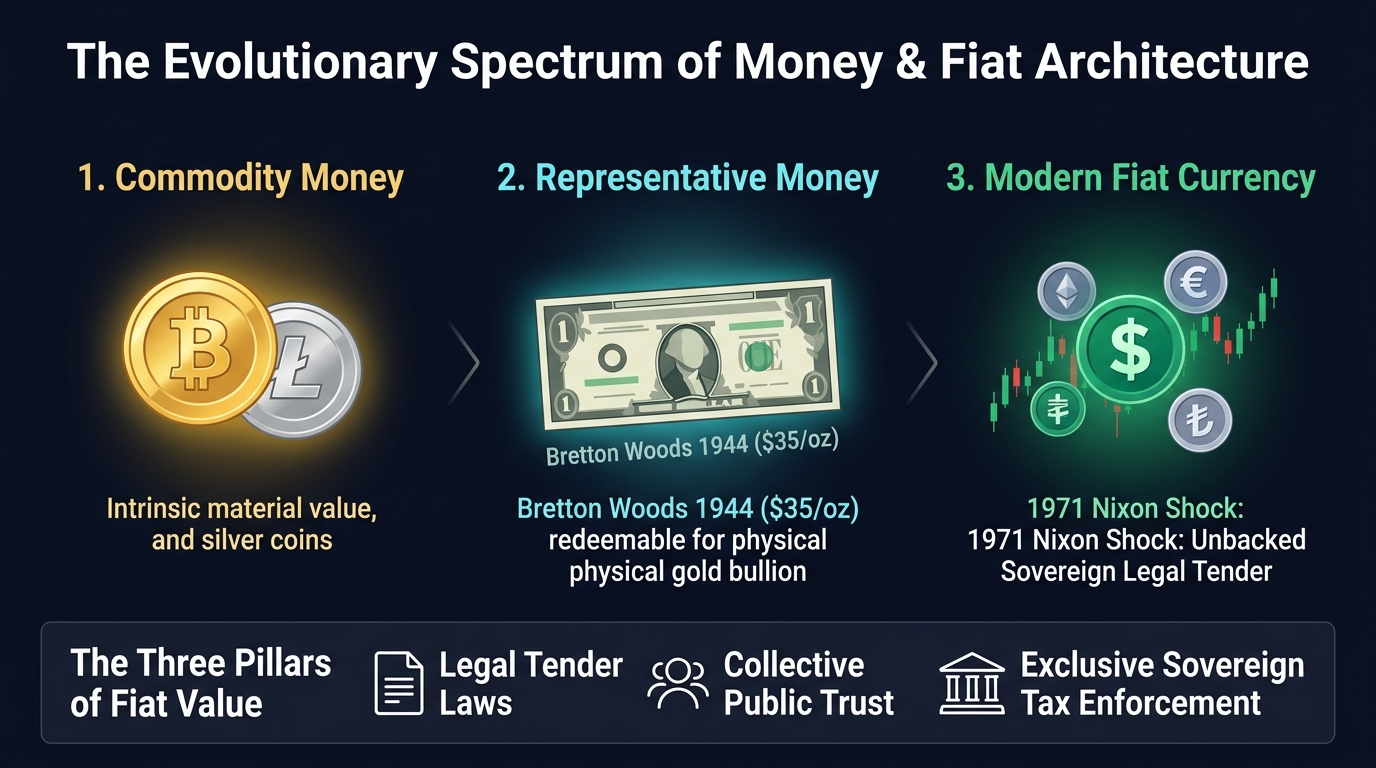
To understand how modern fiat systems operate, economists trace the historic evolution of monetary exchange through three distinct phases:
1. Commodity Money
The earliest form of monetary exchange. The medium of exchange itself possessed intrinsic, verifiable physical value independent of government decree. Gold, silver, bronze coins, and even livestock, tea bricks, and tobacco served as commodity money. Its supply was strictly limited by the physical difficulty of mining and refining the raw material.
2. Representative Money (The Gold Standard)
As global trade expanded, carrying heavy bags of physical gold and silver across oceans became impractical and hazardous. Governments and private commercial banks issued lightweight paper banknotes and gold certificates that acted as “representative money.” The paper note bore a legal promise that the bearer could present it at a bank vault and redeem it on demand for a fixed, statutory weight of gold or silver bullion.
3. Fiat Money
The final evolutionary leap. Governments severed the legal link between paper currency and precious metals. The currency became completely unbacked, floating freely based on macroeconomic supply, demand, and sovereign credibility.
The Watershed Moment: The 1971 “Nixon Shock”
The modern global fiat regime was born on August 15, 1971.
Following World War II, the Bretton Woods Agreement (1944) established an international gold exchange standard. Global currencies were pegged at fixed rates to the US Dollar, and the United States government guaranteed foreign central banks that it would redeem US Dollars for physical gold at a fixed price of $35 per troy ounce.
By the late 1960s, heavy US federal spending on the Vietnam War and domestic social programs expanded the volume of US paper dollars circulating overseas far beyond the total physical gold stored in the vaults of Fort Knox and the Federal Reserve Bank of New York. Recognizing this shortfall, foreign nations (led by France) began systematically demanding physical gold redemption for their dollar holdings.
Facing a catastrophic run on the nation’s gold reserves, President Richard Nixon addressed the American public on live television, announcing that he was “temporarily suspending the convertibility of the dollar into gold.”
The “temporary” suspension became permanent. The Bretton Woods fixed peg structure collapsed, and by March 1973, the major currencies of the world detached from gold and began floating freely against one another on decentralized interbank markets, creating the modern multi-trillion-dollar foreign exchange market.
Advantages and Systemic Risks of Fiat Systems
The global transition to fiat currency offered immense economic flexibility, but introduced severe existential vulnerabilities:
The Economic Advantages
- Monetary Policy Flexibility: Under a rigid gold standard, a nation’s money supply is constrained by how much physical metal miners pull out of the ground. In a fiat system, a central bank can dynamically expand or contract the money supply and adjust interest rates to smooth out recessions, provide emergency liquidity during banking panics, and support employment.
- Cost Efficiency: Storing, transporting, insuring, and testing physical gold bullion requires immense physical infrastructure and expense. Digital and paper fiat currencies can be created, transferred, and cleared across global fiber-optic networks at near-zero friction.
The Systemic Vulnerabilities
- The Threat of Unchecked Debasement: Because fiat currency has no physical anchor, governments face an irresistible political temptation to finance budget deficits by printing unbacked money.
- Hyperinflationary Collapse: When a government prints fiat currency excessively to monetize sovereign debt, public confidence in the currency evaporates. Without physical backing, the value of the money collapses to zero. Historical catastrophes—such as the Weimar Republic in 1923, Zimbabwe in 2008, and Venezuela in 2018—demonstrate that unconstrained fiat printing leads directly to hyperinflation and societal ruin.
Fiat Currencies and Foreign Exchange Trading
In the contemporary foreign exchange market, trading volume exceeds $7.5 trillion per day. Because every fiat currency is unbacked, forex trading is fundamentally a relative game of confidence.
When a trader executes a long position in EUR/USD, they are not buying an absolute asset like a share of stock or a barrel of oil. They are exchanging one fiat currency for another, expressing a conviction that:
- The European Central Bank will maintain superior monetary discipline,
- Eurozone interest rates will provide a superior yield, or
- European economic fundamentals will outperform those of the United States.
Every currency pair reflects the shifting balance of trust between two sovereign central banks and their respective national economies.
Key Takeaways
- Fiat currency is government-issued legal tender not backed by physical gold, silver, or any tangible commodity.
- Its value is derived from statutory law, government taxation requirements, and public confidence in central bank stability.
- The global financial architecture transitioned entirely to a fiat standard following the 1971 Nixon Shock.
- Fiat money gives central banks the power to inject liquidity and counter recessions, but risks hyperinflation if abused.
- Modern foreign exchange trading is the continuous, relative valuation of competing floating fiat currencies against one another.
FAQ
Why does the government accept fiat money for taxes? Governments establish statutory legal tender laws and mandate that all taxes, fines, and legal debts must be settled in the national currency. This legal requirement creates a perpetual, non-negotiable domestic demand for the currency.
Can fiat currency collapse completely? Yes. Throughout history, hundreds of fiat currencies have failed and vanished completely when excessive money printing destroyed public trust. In every case, citizens abandoned the fiat paper and reverted to foreign hard currencies, precious metals, or barter.
Is cryptocurrency a fiat currency? Generally, no. Cryptocurrencies like Bitcoin are decentralized, cryptographic digital assets operating on open blockchains without a sovereign government decree or central bank issuer. However, government-backed “Central Bank Digital Currencies” (CBDCs) are direct digital versions of national fiat currencies.
Ready to trade forex?
Open a free demo account with a regulated broker. Practice with virtual funds before risking real money.