Discount Rate
The discount rate is the interest rate charged by a central bank, such as the Federal Reserve, to eligible commercial depository institutions on short-term collateralized loans obtained directly through the central bank's discount window facility.
What Is the Discount Rate?
The discount rate is the official interest rate at which commercial banks and other depository institutions can borrow emergency or short-term liquidity directly from their regional Federal Reserve Bank (or respective national central bank). This lending takes place through the central bank’s Discount Window, a cornerstone credit facility established to prevent systemic banking panics and preserve financial stability.
To access the discount window, a borrowing bank must pledge high-grade collateral, such as US Treasury securities, agency mortgage-backed securities, or eligible municipal and corporate debt. The central bank applies a “haircut” (a percentage deduction from the collateral’s market value) to insulate itself against credit risk.
In modern central banking, the discount rate functions primarily as a safety valve rather than an active daily policy target. It sets an effective upper bound on short-term money market rates, ensuring that solvent commercial institutions have access to liquidity even if private interbank funding markets seize up.
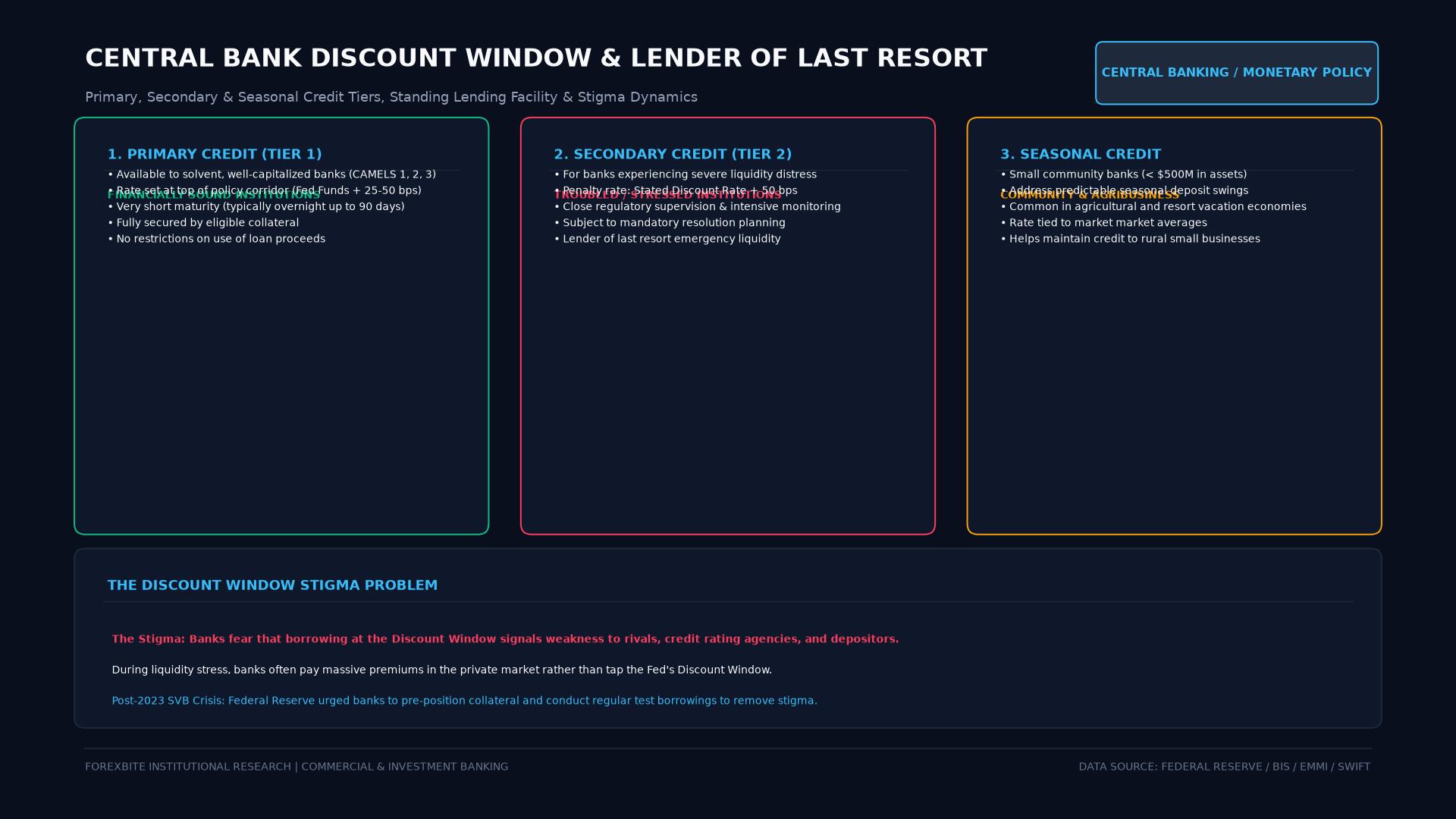 Figure: Federal Reserve Discount Window lending facilities: Primary Credit (sound banks), Secondary Credit, and Seasonal Credit standing arrangements.
The Federal Reserve’s Discount Window Credit Facilities
The Federal Reserve administers discount window lending through three distinct programs tailored to an institution’s financial condition and operating profile:
1. Primary Credit
Primary credit is the principal discount window program available to fundamentally sound, well-capitalized depository institutions. It is extended on an overnight basis (or up to 90 days during periods of market stress) with minimal administrative inquiry. The Fed prices primary credit at a markup—typically 50 to 100 basis points above the upper limit of the Federal Funds target range. Because of this premium, primary credit acts as a penalty rate, discouraging banks from using the central bank as a routine funding source.
2. Secondary Credit
Depository institutions that fail to qualify for primary credit due to severe capital deficiencies or liquidity constraints may request secondary credit. Loans are extended at a higher penalty rate (often 50 basis points above the primary credit rate) under intense regulatory supervision to meet backup liquidity needs while resolving structural solvency issues.
3. Seasonal Credit
Designed for smaller community banks that experience predictable, recurring liquidity swings driven by seasonal sectors—such as agricultural harvesting, tourism, or college tuition payments. Seasonal credit rates are pegged to market rates without an emergency penalty premium.
Discount Rate vs. Federal Funds Rate
While both rates govern short-term lending in the US banking system, their operational mechanics and pricing differ substantially:
| Feature | Federal Funds Rate (FFR) | Central Bank Discount Rate |
|---|---|---|
| Lending Counterparty | Private commercial bank to commercial bank | Federal Reserve to commercial bank |
| Collateral Requirement | Unsecured loans | Fully collateralized (US Treasuries, MBS) |
| Rate Determination | Market negotiated within Fed’s target range | Mandated directly by the Fed Board of Governors |
| Relative Pricing | Cheaper benchmark interbank rate | Higher penalty rate (above Fed Funds target) |
| Daily Transaction Volume | Trillions in daily interbank settlements | Infrequently tapped during ordinary conditions |
The “Discount Window Stigma”
Historically, commercial banks have exhibited extreme reluctance to tap the discount window, a phenomenon known in financial economics as the discount window stigma.
Because interbank market participants historically viewed discount window borrowing as a confession of insolvency, banks feared that news of their borrowing would trigger credit rating downgrades, depositor runs, or counterparty boycotts. Even during the early phases of the 2008 Global Financial Crisis, troubled banks preferred paying exorbitant rates in private interbank markets rather than approaching the Fed.
To mitigate this stigma during liquidity panics, central banks encourage coordinated borrowing and maintain strict regulatory confidentiality regarding discount window transactions, delaying public disclosure of borrower identities by up to two years. A notable test of this facility occurred during the March 2023 US Regional Banking Crisis (the failure of Silicon Valley Bank and Signature Bank), when discount window borrowing surged to an all-time record of $152.85 billion in a single week, eclipsing the peak of the 2008 crisis.
March 2023 Discount Window Surge
$160B +               /\  $152.85B Record
$120B +              /  \
 $80B +             /    \  (SVB / Signature Bank Liquidity Panic)
 $40B +            /      \
   $0 +-----------+        +---------------------------
        Feb 2023   Mar 2023   Apr 2023
Disambiguation: Corporate Finance vs. Central Banking
In financial education, the phrase “discount rate” carries two unrelated definitions:
- Central Bank Monetary Policy: The interest rate charged by a central bank to commercial banks borrowing at the discount window (the focus of this article).
- Corporate Valuation / DCF Modeling: The required rate of return or hurdle rate used to calculate the present value of future cash flows (often calculated using the Weighted Average Cost of Capital, or WACC).
Implications for Forex Traders
- Indicator of Systemic Liquidity Stress: A sudden, parabolic increase in discount window borrowing figures (released weekly in the Federal Reserve’s H.4.1 statistical report) signals acute counterparty distrust within the commercial banking sector.
- Flight-to-Safety Dollar Surges: Severe liquidity shortages drive global demand for cash US dollars, frequently triggering sharp rallies in the US Dollar Index (DXY) as international banks scramble to secure dollar funding.
- Monetary Easing Expectations: Massive discount window utilization forces central banks to halt balance sheet runoff (Quantitative Tightening) and prepare emergency swap lines with foreign central banks, ultimately setting the stage for future rate cuts.
Key Takeaways
- The discount rate is the interest rate charged by the Federal Reserve for direct, collateralized loans through the discount window.
- The primary credit rate is set as a penalty rate above the Federal Funds target range to prevent routine reliance on central bank liquidity.
- Commercial banks generally avoid the discount window due to reputational stigma, turning to it primarily during systemic financial panics.
- Borrowing must be fully collateralized with eligible securities subject to central bank haircuts.
- In forex trading, surges in discount window usage indicate banking sector stress, often catalyzing flight-to-safety capital flows into the US Dollar.
Frequently Asked Questions
Who sets the Federal Reserve discount rate?
The discount rate is established by the Federal Reserve Board of Governors in Washington, D.C., upon recommendations submitted by the boards of directors of the twelve individual regional Federal Reserve Banks.
Why is the discount rate higher than the Federal Funds Rate?
It is structured deliberately as a penalty rate. If the discount rate were lower than the Fed Funds rate, commercial banks would borrow cheaply from the central bank and lend to competitors at higher rates, generating risk-free arbitrage at public expense.
How did the Fed respond to discount window stigma during the 2023 crisis?
In March 2023, the Fed launched the Bank Term Funding Program (BTFP) alongside the discount window, allowing banks to pledge Treasuries and agency debt valued at par (100% of face value) rather than market value, providing crucial emergency liquidity without triggering fire sales.
Ready to trade forex?
Open a free demo account with a regulated broker. Practice with virtual funds before risking real money.