Federal Funds Rate (FFR)
The Federal Funds Rate (FFR) is the benchmark interest rate at which US commercial banks and depository institutions lend reserve balances to each other on an overnight, uncollateralized basis. Managed within a target range by the Federal Reserve, it serves as the foundational base rate for global financial markets.
What Is the Federal Funds Rate?
The Federal Funds Rate (FFR) is the central benchmark interest rate in the United States financial system and the most influential borrowing rate in global economics. It represents the interest rate charged by commercial banks and eligible depository institutions to lend surplus reserve balances—termed “federal funds”—held on deposit at regional Federal Reserve Banks to other commercial institutions on an unsecured, overnight basis.
Under federal banking regulations, commercial banks are required to maintain a specific balance of cash reserves at the central bank overnight to settle customer payment transfers, clear checks, and satisfy regulatory liquidity coverage requirements.
At the close of each business day:
- Some commercial banks find themselves with a surplus of cash reserves beyond their immediate regulatory needs.
- Other commercial banks face a temporary deficit of cash reserves due to large customer withdrawals or loan outlays.
Through the federal funds market, banks with excess liquidity lend cash overnight to banks facing deficits. The annualized interest rate negotiated for these overnight loans is the Federal Funds Rate.
Target Range vs. The Effective Federal Funds Rate (EFFR)
A fundamental technical distinction must be maintained between the Fed’s target and the actual market rate:
1. The FOMC Target Range
The Federal Reserve does not legally dictate the exact rate that private banks must charge one another. Instead, following each monetary policy meeting, the Federal Open Market Committee (FOMC) announces a target range spanning 25 basis points (such as 5.25% to 5.50%).
2. The Effective Federal Funds Rate (EFFR)
The Effective Federal Funds Rate is the actual real-world rate transacted in the market. Every morning around 09:00 EST, the Federal Reserve Bank of New York calculates and publishes the EFFR as the volume-weighted median of all overnight interbank transactions executed across the United States during the previous business day. The Fed’s operational objective is to ensure the EFFR trades securely inside the official target range.
How the Fed Steers the Rate: The Modern Floor System
Prior to the 2008 global financial crisis, the Federal Reserve operated a “scarce reserves” framework, conducting daily open market operations (buying or selling Treasury bills) to adjust cash supply until the interbank rate hit the target.
In the modern era of quantitative easing and abundant liquidity, the Fed manages the FFR using an ample reserves regime anchored by two key administered interest rates:
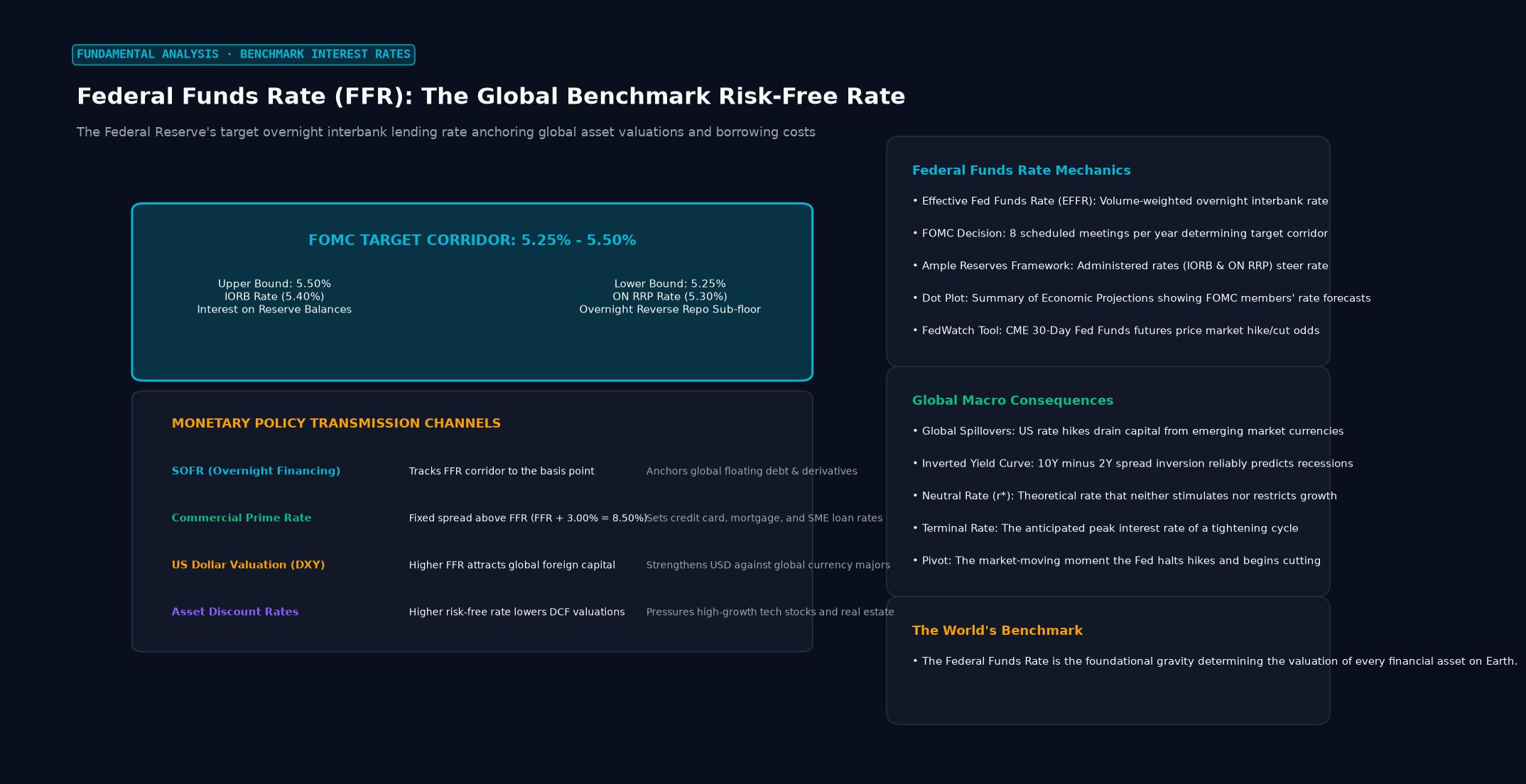 Figure: The Federal Reserve’s target overnight interbank lending rate anchoring global asset valuations and borrowing costs
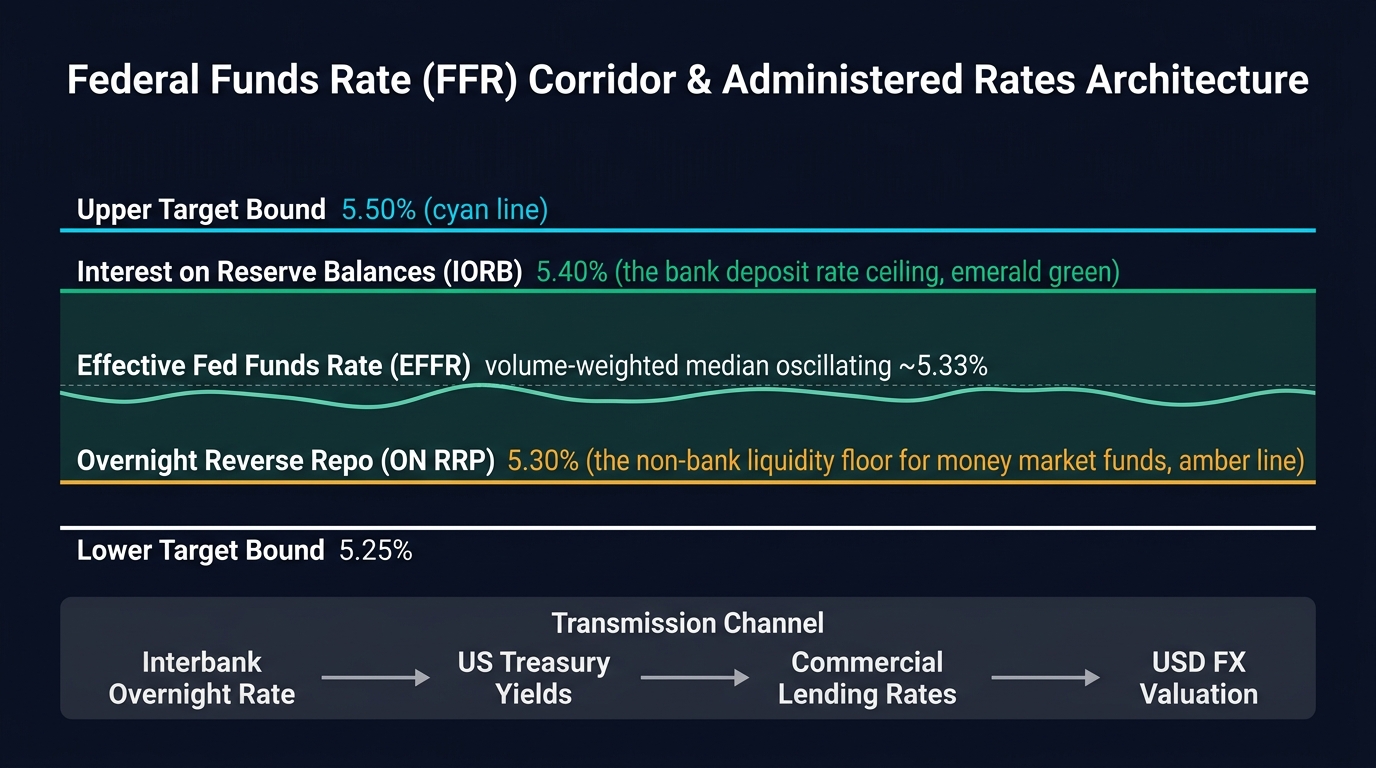
- Interest on Reserve Balances (IORB): The interest rate the Federal Reserve pays directly to commercial banks on funds deposited in their Fed reserve accounts. No bank will lend reserves to another private commercial bank at a rate lower than what it can earn completely risk-free from the Fed.
- Overnight Reverse Repurchase (ON RRP) Facility: Because non-bank financial institutions—such as money market mutual funds and government-sponsored enterprises—cannot hold Fed deposit accounts, the Fed allows them to park cash overnight in exchange for Treasury collateral. This facility establishes a rigid floor, preventing non-bank institutions from undercutting the target range.
The Economic Transmission Mechanism
Although the Federal Funds Rate applies directly only to overnight loans between banks, its changes propagate through the entire economic system via the monetary transmission mechanism:
- The Prime Rate: The interest rate commercial banks charge their most creditworthy corporate borrowers. In the United States, the Prime Rate is pegged mechanically to the upper bound of the Federal Funds Rate plus a fixed 3.00% markup ($\text{Prime Rate} = \text{FFR Upper Bound} + 3.00%$).
- Consumer Borrowing Costs: Variable-rate credit cards, adjustable-rate mortgages (ARMs), auto loans, and small business credit lines adjust in lockstep with the Prime Rate. When the Fed hikes the FFR, borrowing becomes instantly more expensive for households.
- US Treasury Yields: Short-term sovereign debt (1-month, 3-month, and 2-year Treasury bills) tracks the expected path of the Federal Funds Rate over the duration of the debt.
How the Federal Funds Rate Drives Foreign Exchange
In the foreign exchange market, international capital is constantly seeking the highest risk-adjusted yield. Shifts in the Federal Funds Rate alter the interest rate differential between the United States and other sovereign currency blocs, serving as the dominant catalyst for currency trends:
1. Widening Differential (US Dollar Appreciation)
If the Federal Reserve maintains a Federal Funds Rate of 5.50% while the European Central Bank holds rates at 3.75% and the Bank of Japan holds rates at 0.10%:
- Global asset managers, sovereign wealth funds, and corporate treasuries earn an extra 1.75% to 5.40% in annual yield by holding US Dollar deposits and Treasuries.
- International investors sell Euros and Yen to buy US Dollars, generating massive structural upward momentum across USD/JPY and depressing EUR/USD.
2. Narrowing Differential (US Dollar Depreciation)
When the Fed begins an aggressive rate-cutting campaign while foreign central banks hold rates steady:
- The dollar’s yield advantage evaporates.
- Investors rotate capital out of dollar assets and allocate into emerging market debt, European equities, and high-beta commodity currencies (AUD, NZD, CAD), causing the US Dollar to decline globally.
3. Carry Trade Dynamics
A high Federal Funds Rate eliminates the US Dollar as a borrowing currency, transforming it into a high-yielding target currency. Hedge funds execute the carry trade by borrowing Japanese Yen or Swiss Francs at near-zero rates and investing the proceeds into short-term US Dollar instruments, collecting the overnight interest spread daily.
Key Takeaways
- The Federal Funds Rate is the interest rate charged between US commercial banks for overnight, unsecured loans of central bank reserves.
- The FOMC establishes a 25-basis-point target range; the New York Fed calculates the actual transacted Effective Federal Funds Rate (EFFR) daily.
- Under the modern ample reserves framework, the rate is steered through IORB (the ceiling) and the ON RRP facility (the floor).
- Changes in the FFR dictate the Prime Rate, consumer credit card interest, mortgage financing, and Treasury bond yields.
- Cross-border interest rate differentials driven by the FFR represent the primary macroeconomic catalyst for global foreign exchange trends.
FAQ
Can the Federal Funds Rate go below zero? In theory, foreign central banks (like the ECB, Bank of Japan, and Swiss National Bank) have operated negative interest rate policies. However, the Federal Reserve has repeatedly stated that US financial, legal, and money market architectures are unsuited for negative nominal rates, utilizing the 0.00%–0.25% range as the operational lower bound.
What is the difference between the Federal Funds Rate and the Discount Rate? The Federal Funds Rate is an interbank market rate where private commercial banks lend reserves to one another. The Discount Rate is the direct interest rate charged by the Federal Reserve itself when a commercial bank borrows emergency funds directly from the Fed’s Discount Window.
How does the Fed Funds Rate affect my forex rollover swap? Forex rollover fees (swaps) credited or debited to your retail account at 5:00 PM EST reflect the interest rate differential between the two currencies in the pair. When you hold a long position in a currency with a high Federal Funds Rate against a low-interest currency, you typically earn positive daily swap income.
Ready to trade forex?
Open a free demo account with a regulated broker. Practice with virtual funds before risking real money.