Disinflation
Disinflation is a slowdown in the rate of price inflation across an economy over time. Unlike deflation, where prices outright decline and inflation turns negative, disinflation occurs when consumer prices continue to rise, but at a decelerating pace.
What Is Disinflation?
Disinflation describes a macroeconomic scenario in which the general rate of inflation slows down over a measurable period. It represents a deceleration in the growth rate of consumer prices rather than a drop in absolute price levels. For instance, if an economy’s Consumer Price Index (CPI) increases by 8.5% year-over-year in January, 6.2% in June, and 3.4% by December, the economy is undergoing disinflation. Prices are still higher than they were twelve months prior, but they are expanding at a much gentler trajectory.
Retail market participants frequently confuse disinflation with deflation. Deflation represents negative inflation—an absolute contraction in the price level (e.g., inflation falling to -1.5%), which often accompanies severe economic depressions, credit contraction, and rising unemployment. In contrast, healthy disinflation is often the primary objective of central bank monetary tightening campaigns designed to restore price stability without crashing economic growth.
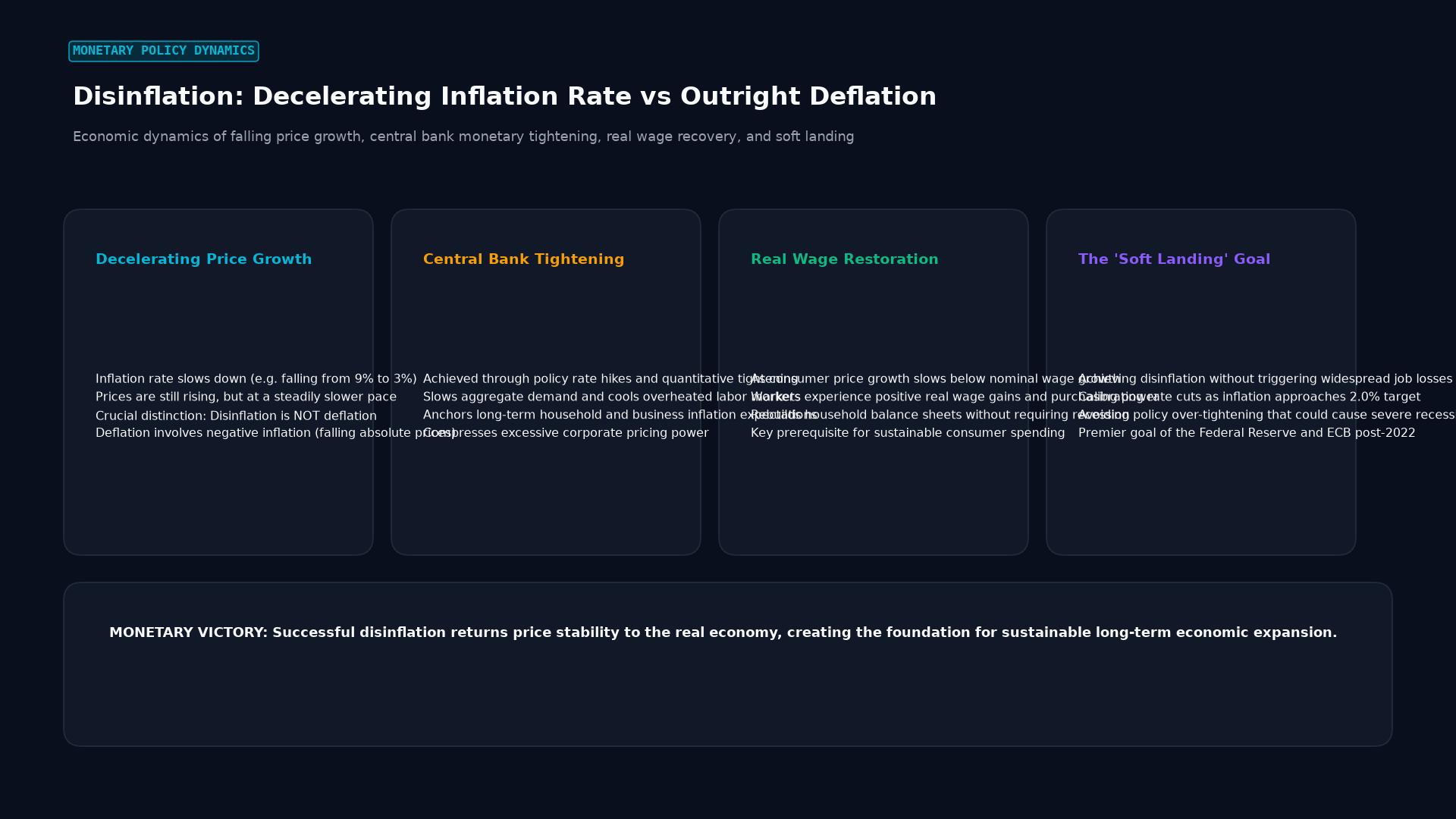 Figure: Economic dynamics of falling price growth, central bank monetary tightening, real wage recovery, and soft landing
Disinflation vs. Deflation vs. Inflation
To evaluate macroeconomic reports and central bank communications accurately, currency traders must distinguish between these three distinct inflationary states:
| Metric | Inflation | Disinflation | Deflation |
|---|---|---|---|
| Price Trajectory | Accelerating upward | Rising at a decelerating rate | Outright decline |
| CPI Rate Example | Moving from 3% to 9% | Moving from 9% to 3% | Falling below 0% (-1.2%) |
| Purchasing Power | Erodes rapidly | Continues eroding, but slowly | Increases |
| Central Bank Policy | Aggressive rate hikes (tightening) | Halting rate hikes / pausing | Aggressive rate cuts / QE |
| Economic Growth | Often overheating | Normalizing (“Soft Landing”) | Severe contraction / recession |
Primary Drivers of Disinflation
Disinflation does not occur spontaneously. It is typically catalyzed by deliberate monetary interventions and structural supply-side adjustments:
1. Central Bank Interest Rate Hikes
When central banks such as the Federal Reserve, the European Central Bank (ECB), or the Bank of England raise benchmark interest rates, commercial borrowing costs rise. Mortgages, business expansion loans, and consumer credit cards become more expensive. This dampens aggregate consumer spending and corporate capital expenditure, forcing merchants to moderate price increases to sustain demand.
2. Supply Chain Normalization
Global price spikes often stem from supply-side bottlenecks, such as maritime shipping backlogs, semiconductor shortages, or geopolitical energy embargoes. As production lines reopen and logistics networks clear, goods availability increases, causing commodity and retail prices to settle.
3. Energy and Raw Material Price Moderation
Crude oil, natural gas, and agricultural commodities feed into virtually every sector of the modern economy through transportation, manufacturing, and heating costs. When energy prices retreat from historical peaks, input costs drop across consumer industries, driving broad headline disinflation.
4. Labor Market and Wage Growth Cooling
When wage growth significantly outpaces labor productivity, companies pass higher labor costs onto consumers, generating a wage-price spiral. As job openings normalize and wage growth stabilizes closer to historical benchmarks (typically 3% to 3.5%), service-sector disinflation takes hold.
Case Study: The Post-Pandemic Disinflation Cycle (2022–2024)
The economic aftermath of the COVID-19 pandemic provided one of the most dramatic disinflation case studies in modern economic history.
In the United States, headline CPI surged to a four-decade high of 9.1% in June 2022, propelled by global supply chain gridlocks, massive fiscal stimulus checks, and the outbreak of the Russia-Ukraine war. Between March 2022 and July 2023, the Federal Reserve embarked on its most aggressive tightening cycle in forty years, hiking the Federal Funds Rate from near-zero (0.00%–0.25%) to a target range of 5.25%–5.50%.
US CPI (%)
10.0 +        /\  June 2022: 9.1% Peak
 8.0 +       /  \
 6.0 +      /    \  <--- DISINFLATION PHASE
 4.0 +     /      \-------/\
 2.0 +----+                 \---- 2024: ~2.9% - 3.2%
 0.0 +--------------------------------------------------
      2021       2022       2023       2024
Over the subsequent 24 months, headline inflation decelerated steadily toward 3.0%. Remarkably, the US labor market retained low unemployment and positive real GDP growth, achieving what financial media and central bankers termed a rare macroeconomic “soft landing.”
Foreign Exchange Implications of Disinflation
For forex traders, disinflation is an indispensable macro catalyst that drives major cross-currency trends:
- Repricing Central Bank Terminal Rates: When disinflation accelerates faster than forecasted in a major economy, market consensus concludes that the central bank has concluded its rate-hiking cycle. Bond yields decline, and the domestic currency frequently weakens against peers whose central banks remain hawkish.
- Shift Toward Rate Cut Cycles: Sustained disinflation allows central banks to shift guidance from inflation containment to economic growth defense. Currencies with accelerating disinflation tend to underperform currencies with “sticky” services inflation where rates must remain elevated for longer.
- Risk-On Sentiment in Asset Classes: Predictable disinflation removes interest rate uncertainty from global markets. Equities, high-yield emerging market currencies, and carry trade strategies typically rally during disinflationary soft-landing phases as global financial conditions loosen.
Key Takeaways
- Disinflation is a slowing in the rate of inflation; prices continue to climb, but at a visibly slower pace.
- Disinflation is distinctly different from deflation, which represents an absolute contraction of prices below zero.
- The primary drivers of disinflation include central bank monetary tightening, lower energy prices, and supply chain normalization.
- In foreign exchange markets, rapid disinflation often weakens the domestic currency as bond markets price in anticipated interest rate cuts.
- Disinflation coupled with stable employment is considered the ideal “soft landing” scenario for central banks.
Frequently Asked Questions
Is disinflation good or bad for the economy?
Disinflation is generally highly favorable when an economy is emerging from an inflationary spiral. It restores household purchasing power stability and lowers borrowing cost expectations without causing widespread job destruction or business bankruptcies.
How does disinflation differ from deflation?
Under disinflation, the inflation rate remains positive (e.g., inflation drops from 7% to 2.5%), meaning things are still getting more expensive, just at a slower rate. Under deflation, the inflation rate is negative (e.g., -1.5%), meaning prices across the economy are actively dropping.
How do currency markets react when US inflation prints lower than expected?
When US CPI prints below consensus expectations (indicating faster disinflation), traders typically sell the US Dollar. Lower inflation reduces the likelihood of further Federal Reserve rate hikes and accelerates market timelines for interest rate cuts, narrowing US yield advantages against foreign currencies.
Ready to trade forex?
Open a free demo account with a regulated broker. Practice with virtual funds before risking real money.