Diversified Carry Basket
A diversified carry basket is an institutional currency portfolio strategy that distributes carry trades across multiple funding and investment currencies to maximize interest yield while minimizing idiosyncratic drawdown risk.
What Is a Diversified Carry Basket?
A diversified carry basket is an advanced quantitative foreign exchange strategy that scales the classic carry trade across a diversified portfolio of multiple sovereign currencies. Rather than concentrating capital into a single bilateral currency pair (such as Long USD/JPY or Long AUD/JPY), a diversified carry basket systematically borrows across multiple low-yielding funding currencies to invest in a balanced matrix of high-yielding target currencies.
In a standalone carry trade, a trader is severely exposed to idiosyncratic sovereign shocks—such as a surprise interest rate cut, a sudden central bank market intervention, or an unexpected election crisis in that single nation. By constructing a diversified basket, institutional fund managers harness the mathematical benefits of portfolio theory: aggregate daily interest rollover credits (carry) compound steadily, while the negative impacts of unexpected devaluations in any single currency are absorbed and neutralized by the broader portfolio.
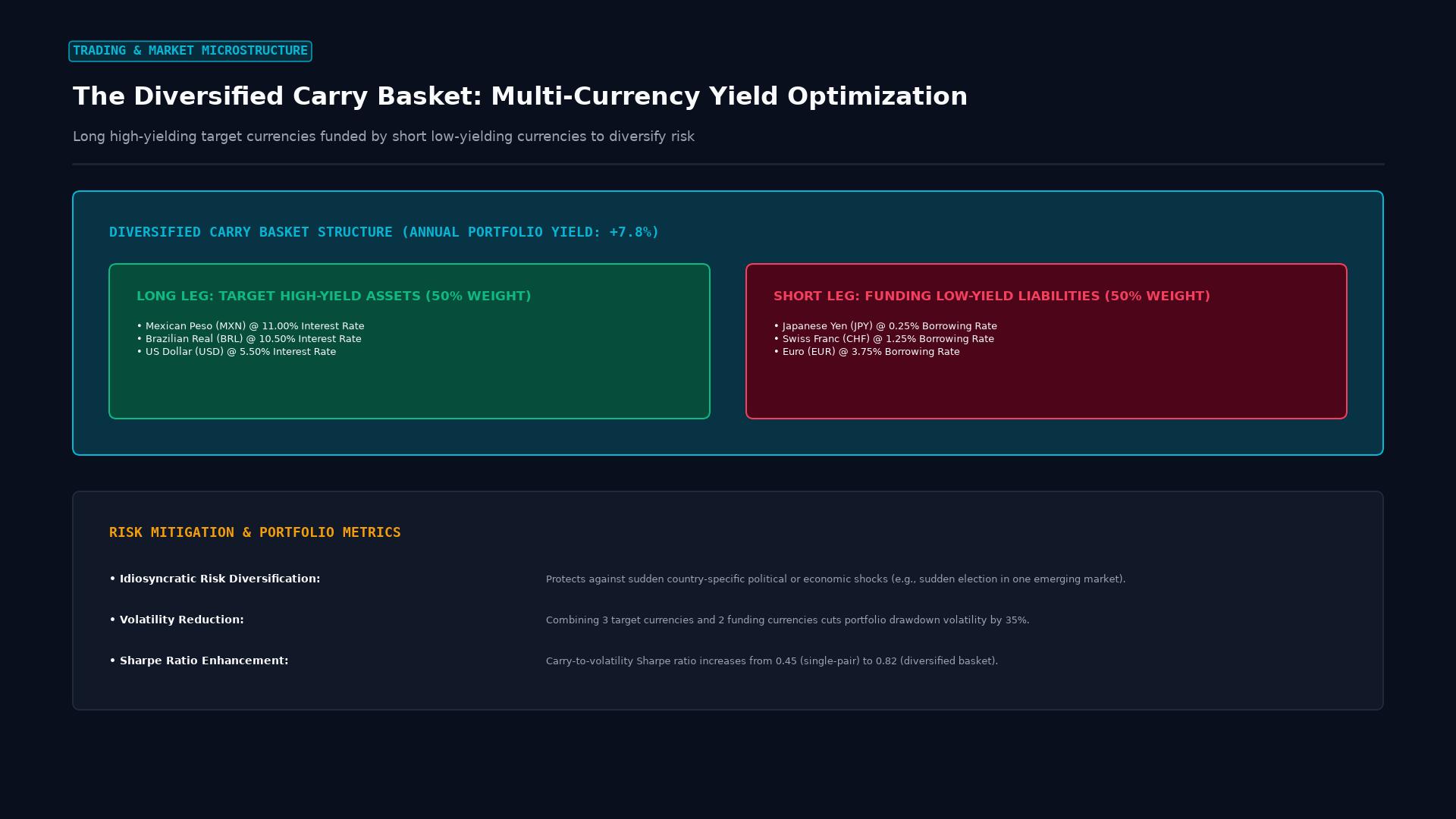 Figure: Systematic portfolio construction: long positions across high-yield target currencies funded by short positions across low-yield currencies to diversify country risk and boost Sharpe ratio.
Key Takeaways
- Mitigating the “Carry Crash”: The fatal flaw of carry trading is that currencies tend to “go up by the stairs and down by the elevator.” Diversified baskets prevent a single flash crash from wiping out an entire account.
- Multiple Funding Currencies: Rather than relying solely on the Japanese Yen, modern baskets blend funding across the Japanese Yen (JPY), Swiss Franc (CHF), and Euro (EUR), reducing vulnerability to single-nation monetary interventions.
- Inverse Volatility Weighting: Institutional desks do not allocate equal dollar amounts across currencies; they weight positions by inverse volatility to ensure high-volatility emerging currencies (like BRL or ZAR) do not dominate portfolio risk.
- Macro Volatility Filters: Professional managers dynamically de-risk or liquidate the carry basket whenever global financial stress indicators (such as the VIX or High-Yield credit spreads) breach critical danger thresholds.
Portfolio Construction: Inverse Volatility Weighting
A common mistake among retail traders is allocating equal notional sizes (e.g., $100,000 each) across diverse carry currencies. Because the South African Rand (ZAR) is three times more volatile than the Australian Dollar (AUD), an equal-dollar portfolio is effectively a high-risk bet on South Africa.
Institutional desks utilize Risk Parity (Inverse Volatility Weighting):
$$w_i = \frac{1 / \sigma_i}{\sum_{j=1}^{n} (1 / \sigma_j)}$$
Where:
- $w_i$ = Target percentage capital weight for Currency $i$
- $\sigma_i$ = Annualized historical volatility (standard deviation) of Currency $i$
Allocation Example Across a Target Basket:
| Target Currency | Benchmark Policy Yield | Annualized Volatility ($\sigma$) | Inverse Volatility ($1/\sigma$) | Portfolio Risk Weight ($w_i$) |
|---|---|---|---|---|
| Mexican Peso (MXN) | 11.00% | 10.5% | 0.0952 | 25.8% |
| Brazilian Real (BRL) | 10.50% | 16.0% | 0.0625 | 17.0% |
| South African Rand (ZAR) | 8.25% | 15.5% | 0.0645 | 17.5% |
| Australian Dollar (AUD) | 4.35% | 8.5% | 0.1176 | 31.9% |
| Hungarian Forint (HUF) | 6.75% | 14.0% | 0.0714 | 19.4% |
Strategic Result: The low-volatility Australian Dollar receives a larger capital allocation, while volatile emerging currencies receive smaller allocations, ensuring that each asset contributes an equal share of risk to the overall carry portfolio.
The Asymmetric Hazard: How Carry Trades Unwind
Carry trades exhibit structural negative skewness: they generate steady, smooth positive returns for months, followed by sudden, violent drawdowns.
                 The "Carry Unwind" Liquidity Cascade:
Global Volatility Shock (VIX Spikes) ──► Macro Hedge Funds Hit VaR Limits
                                                    │
                                                    ▼
Emergency Deleveraging ◄── Liquidity Evaporates ◄── Fire-Sale Long Carry Holdings
                                                    │
                                                    ▼
Borrowers Repay Funding Loans ──► Japanese Yen & Swiss Franc Surge Violently
During a global liquidity panic (such as the 2008 Lehman collapse, the March 2020 pandemic onset, or the August 2024 Yen carry unwind):
- Speculators are forced to rapidly liquidate their high-yielding emerging market positions.
- Simultaneously, they must purchase massive quantities of the low-yielding funding currencies (JPY and CHF) to repay their original borrowed loans.
- This creates a vicious feedback loop: the funding currencies surge parabolic, while the carry currencies collapse, inflicting massive losses on unhedged carry trades.
Modern Risk Management: The Volatility Regime Switch
To protect diversified carry baskets against catastrophic unwinds, quantitative managers deploy automated volatility kill-switches:
$$\text{Position Sizing Multiplier} = \min\left(1.0, , \frac{\text{Target Volatility}}{\text{Current Market Realized Volatility}}\right)$$
- VIX Threshold Filter: If the Cboe Volatility Index (VIX) crosses above 25.0, the trading model automatically cuts total basket exposure by 50%. If the VIX breaches 35.0, the entire carry basket is liquidated into cash immediately.
- FX Volatility Overlay (JPMorgan VXY Index): Monitors global G7 and emerging market currency implied volatilities. When FX volatility breaks above its 6-month moving average, position sizes are automatically scaled back.
- Systematic Tail-Risk Hedging: Allocating 10% to 15% of the earned carry yield to purchase cheap, deep Out-of-the-Money (OTM) Put options on the target currencies, providing a catastrophic insurance floor.
Real-World Case Study: Surviving the August 2024 Yen Carry Unwind
In early August 2024, the Bank of Japan unexpectedly raised interest rates to 0.25%, while U.S. employment data signaled a sharp economic slowdown.
The Divergence in Outcomes:
- Trader A (Undiversified Single Carry): Held 100% of their capital in a single USD/JPY Long position to collect positive interest swap. When the BoJ hiked, USD/JPY plunged by over 1,200 pips in five trading sessions. Trader A’s account suffered a 60% drawdown and triggered a complete margin liquidation.
- Trader B (Diversified Carry Basket): Held an institutional basket funded across JPY, EUR, and CHF, invested across MXN, BRL, AUD, and ZAR with an automated volatility filter.
- When the Yen began its rapid ascent, the model’s volatility filter triggered, cutting net portfolio exposure by 60% within the first 48 hours.
- While JPY-funded legs suffered losses, the EUR-funded legs held steady as European rates were stable.
- Trader B’s total basket drawdown was contained to just -4.2%, preserving their capital to re-enter the carry trade at superior valuations once volatility normalized.
Frequently Asked Questions
Which currencies currently serve as the best funding currencies?
Historically, the Japanese Yen (JPY) and Swiss Franc (CHF) have been the premier funding currencies due to their decades-long structural low-inflation regimes and zero-to-negative central bank policy rates. During periods of European Central Bank easing, the Euro (EUR) also functions as a major global funding currency.
How do retail traders implement a diversified carry basket?
Retail traders on platforms like MetaTrader can implement a carry basket by opening fractional micro-lot positions (0.01 to 0.05 lots) across 4 to 6 diverse cross pairs (e.g., Long MXN/JPY, Long AUD/CHF, Long ZAR/JPY) rather than taking a large position in a single pair.
What is the difference between a carry basket and a carry grid?
A carry basket focuses on cross-sectional diversification across multiple sovereign currencies at a single point in time. A carry grid focuses on temporal price laddering within a single currency pair, layering buy and sell limit orders above and below the market to capture range-bound volatility alongside interest swaps.
Ready to trade forex?
Open a free demo account with a regulated broker. Practice with virtual funds before risking real money.