E-Commerce (Electronic Commerce)
E-commerce (electronic commerce) is the commercial production, distribution, marketing, and electronic purchase of goods and services over computer networks and the internet, encompassing B2B, B2C, C2C, and cross-border digital trade.
What Is E-Commerce?
E-commerce (short for electronic commerce) encompasses the end-to-end commercial lifecycle—including production, marketing, sale, digital invoicing, payment transmission, and delivery coordination—of physical products, software, and services conducted across telecommunication networks and the internet.
From a macroeconomic and market microstructure perspective, e-commerce represents the fundamental structural transition from decentralized, geographically constrained physical marketplaces to centralized, algorithmic digital exchange networks. E-commerce radically lowers menu costs (the cost of altering prices), enhances market price transparency, eliminates traditional wholesale distributor markups, and integrates domestic retail consumers directly into multi-currency global supply chains.
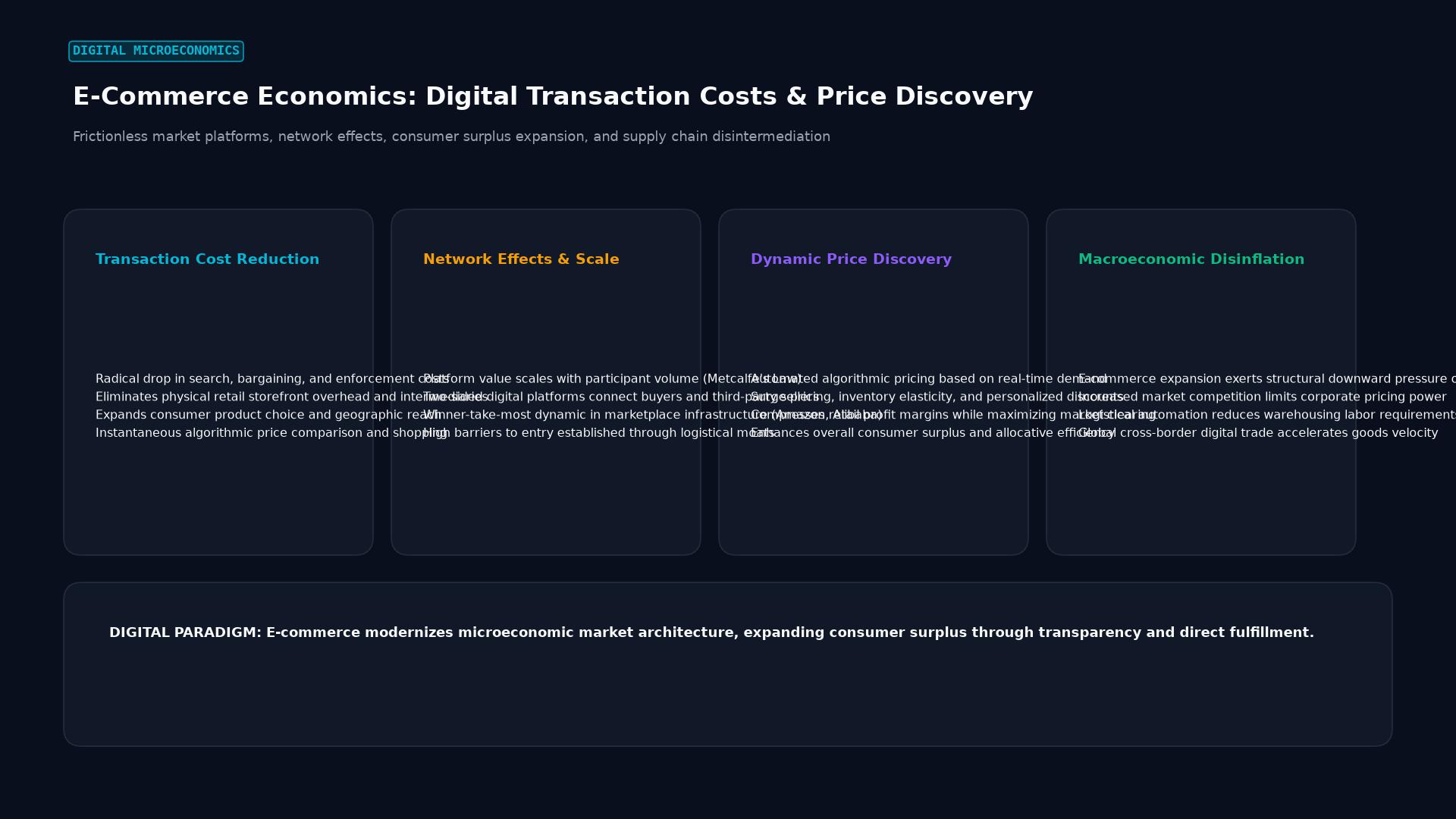 Figure: Frictionless market platforms, network effects, consumer surplus expansion, and supply chain disintermediation
Technical Mechanics & Transaction Cost Architecture
In digital commerce, every electronic checkout undergoes multi-party automated clearing. For an online merchant, gross merchandise value (GMV) is eroded by the multi-layered fee stack:
Merchant Net Settlement Equation
$$\text{Net Merchant Proceeds} = \text{GMV} - \left( \text{Interchange Fee} + \text{Card Scheme Fee} + \text{Acquiring Markup} + \text{FX Spread Fee} \right)$$
Where:
- Interchange Fee: Assessed by the card-issuing bank (capped at 0.20%–0.30% in the EU under Interchange Fee Regulation, but reaching 1.50%–2.50% in the US).
- Scheme Fee: Paid directly to the payment network (Visa, Mastercard, American Express).
- Payment Gateway / Acquiring Fee: Retained by the payment processor (e.g., Stripe, Adyen).
- FX Spread Fee: Currency conversion margin levied on cross-border transactions (typically 1.0% to 3.0% above the wholesale interbank spot rate).
Macroeconomic Impact: The “Amazon Effect” on Inflation
In monetary economics, the Amazon Effect describes the persistent structural downward pressure exerted on core consumer inflation by e-commerce:
$$\Delta P_{\text{retail}} = f\left( \text{Search Costs} \downarrow, \text{Price Dispersion} \downarrow, \text{Supply Chain Disintermediation} \uparrow \right)$$
Algorithmic price crawlers continuously monitor competitor prices across the web, forcing online and brick-and-mortar retailers alike to compress profit margins and rapidly pass cost reductions to consumers, flattening the traditional Phillips curve.
Comparative Matrix: Commercial Business Frameworks
| Model Type | Participant Structure | Primary Platforms | Payment & Settlement Rails | Key Operational Metric |
|---|---|---|---|---|
| B2B (Business-to-Business) | Enterprise $\to$ Enterprise | Alibaba, Amazon Business | Wire Transfer, ACH, Commercial Invoices | Days Sales Outstanding (DSO) |
| B2C (Business-to-Consumer) | Enterprise $\to$ Consumer | Amazon, Walmart.com | Credit/Debit Cards, Digital Wallets | Customer Acquisition Cost (CAC) |
| D2C (Direct-to-Consumer) | Manufacturer $\to$ Consumer | Shopify, Brand Webstores | Stripe, Apple Pay, Buy Now Pay Later (BNPL) | Lifetime Value (LTV) / CAC Ratio |
| C2C (Consumer-to-Consumer) | Consumer $\to$ Consumer | eBay, Etsy, Poshmark | Peer-to-Peer Escrow, PayPal | Gross Merchandise Value (GMV) |
Real-World Case Study: The 2020 Pandemic E-Commerce Inflection Point
The ultimate structural test of global e-commerce infrastructure occurred in March 2020, when worldwide COVID-19 pandemic lockdowns shuttered physical retail stores across continents.
Anatomy of an Accelerated Economic Shift:
1. The Acceleration: US e-commerce retail penetration jumped from 11.8% of total retail sales in Q1 2020 to 16.1% in Q2 2020—compressing a decade of projected digital adoption into approximately 90 days.
2. The Infrastructure Strain: Cloud computing providers (Amazon Web Services, Microsoft Azure) and digital payments processors (Adyen, Stripe) processed unprecedented transaction volumes without systemic outages.
3. Logistics Re-Engineering: Traditional retailers without robust e-commerce logistics collapsed into Chapter 11 bankruptcy (e.g., J.Crew, Neiman Marcus, JCPenney), while agile omnichannel giants capable of Buy-Online-Pick-Up-In-Store (BOPIS) captured historic market share.
The episode proved that e-commerce is not merely a supplementary sales channel, but the critical operating infrastructure of modern national economies.
Frequently Asked Questions (FAQ)
What is Dynamic Currency Conversion (DCC) in cross-border e-commerce?
Dynamic Currency Conversion (DCC) is an electronic point-of-sale service that gives international online shoppers the choice to pay in their local home currency rather than the merchant’s domestic currency. While DCC provides immediate price transparency to the consumer, it is frequently criticized by consumer advocates because the payment processor or merchant acquirer applies an aggressive foreign exchange markup (often 3% to 5% above interbank mid-market rates), making the transaction substantially more expensive than letting the consumer’s home bank handle the currency conversion.
What is the difference between a Payment Gateway and a Merchant Acquirer?
A payment gateway is the software bridge and security layer (such as Stripe API or Authorize.net) that captures the customer’s payment credentials at online checkout, encrypts the sensitive data, and routes the transaction token securely to the payment networks. A merchant acquirer (clearing bank) is the financial institution that actually settles the funds: it receives the money from the issuing bank via card networks and deposits the net cash into the merchant’s commercial bank account.
How does “Buy Now, Pay Later” (BNPL) function within e-commerce?
Buy Now, Pay Later (BNPL) services (such as Klarna, Affirm, and Afterpay) provide point-of-sale micro-financing that allows consumers to split the purchase price into interest-free installments (typically four payments across eight weeks). The BNPL fintech provider assumes the customer credit default risk and pays the online merchant the full purchase amount immediately upfront, minus a high merchant processing fee (typically 3% to 6%, substantially higher than standard 2% credit card processing fees).
Ready to trade forex?
Open a free demo account with a regulated broker. Practice with virtual funds before risking real money.