Early Settlement
Early settlement is the execution and clearing of a financial transaction, trade, or debt obligation prior to the standard contractual settlement date (such as T+0 cash settlement instead of T+1), or the prepayment of a consumer or commercial loan before contractual maturity.
What Is Early Settlement?
In financial market trading and commercial credit, early settlement refers to the completion and final discharge of a financial transaction, trade, or debt agreement prior to its formally scheduled settlement or maturity date.
The term encompasses two fundamental market applications:
- Securities & Foreign Exchange Trading: The accelerated clearing and transfer of cash and securities ahead of standard settlement conventions—such as executing a T+0 (same-day cash settlement) transaction rather than waiting for the standard T+1 interbank clearing cycle. This mechanism is frequently used by institutional trading desks to capture dividend record dates, secure proxy voting rights, or neutralize margin exposure prior to corporate reporting deadlines.
- Lending & Debt Facilities: The complete payoff and retirement of a mortgage, term loan, or commercial credit line prior to its contractual maturity date, commonly referred to as prepayment.
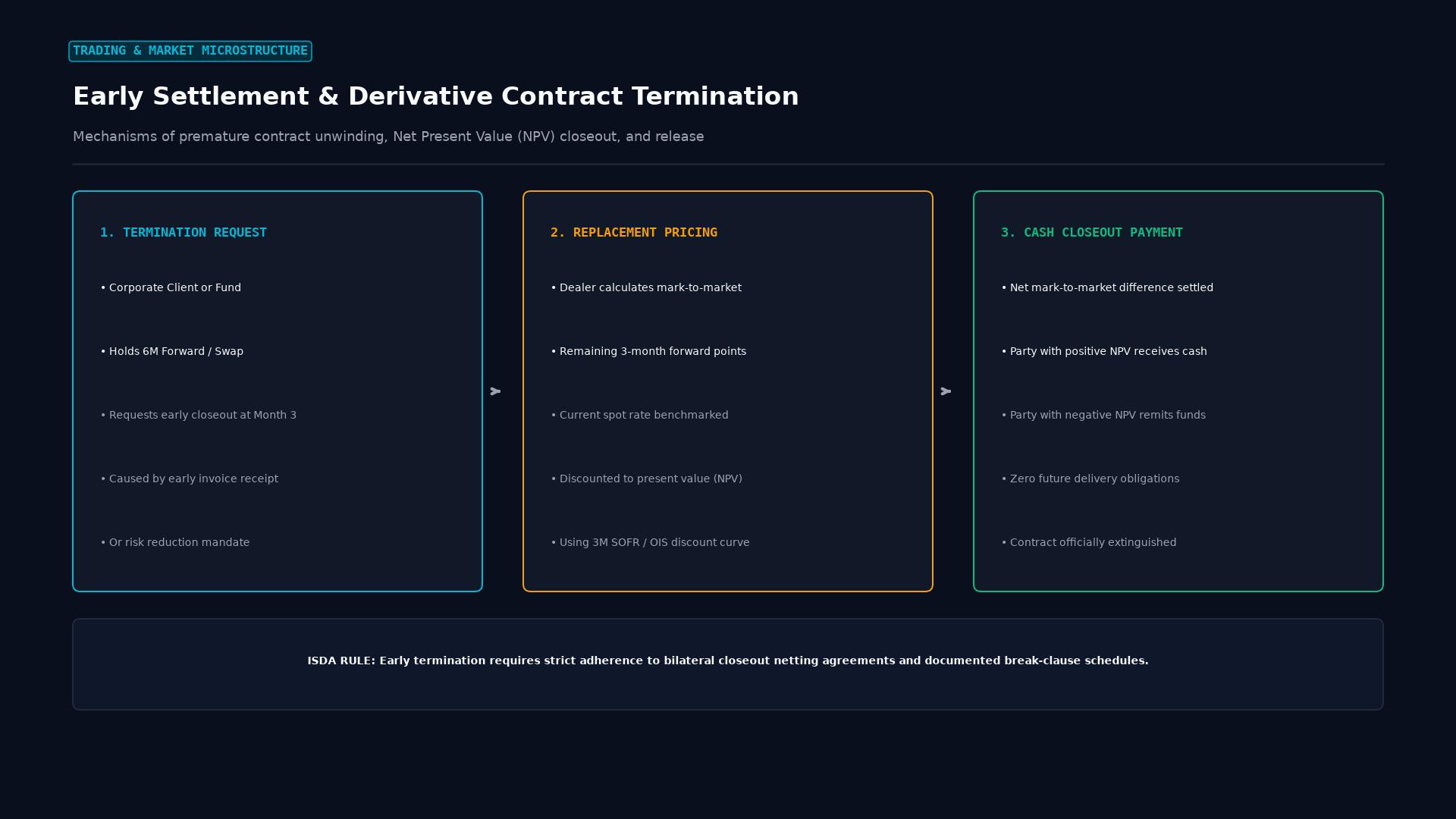 Figure: Premature unwinding of forward and swap contracts: mark-to-market Net Present Value (NPV) calculation, bilateral cash closeout, and mutual release of future obligations.
Technical Mechanics & Prepayment Mathematical Modeling
In commercial banking and consumer debt contracts, early settlement involves calculating the remaining outstanding principal while netting unearned interest and applicable early termination fees:
The Actuarial Prepayment Formulation
Under modern actuarial payoff calculations, the total payoff amount ($P_{\text{settle}}$) required to discharge a loan early at month $k$ is:
$$P_{\text{settle}} = B_k + \text{Accrued Interest} + \text{Prepayment Penalty} - \text{Unearned Rebate}$$
Where the remaining unamortized principal balance ($B_k$) for a loan with monthly payment $PMT$, monthly interest rate $r$, and original term $n$ is:
$$B_k = PMT \times \left[ \frac{1 - (1 + r)^{-(n - k)}}{r} \right]$$
The Archaic “Rule of 78” Trap
Historically, subprime auto lenders utilized the predatory Rule of 78 (sum-of-the-digits method) to calculate early settlement interest rebates:
$$\text{Rebate Fraction} = \frac{(n - k)(n - k + 1)}{n(n + 1)}$$
Because the Rule of 78 front-loads interest payments into the initial months of the loan, a borrower who executes an early settlement within the first year pays significantly more interest than under standard actuarial compounding, prompting regulatory bans across many jurisdictions.
Early Settlement in Foreign Exchange: Flexible Forwards
In corporate foreign exchange risk management, multinational importers and exporters routinely utilize Flexible Forward Contracts (Window Forwards) that permit early settlement:
$$\text{Forward Drawdown Window} = [T_{\text{start}}, T_{\text{maturity}}]$$
If an importer purchases a 6-month EUR/USD forward contract maturing on December 31, but their European supplier delivers raw materials in October, the importer executes an early settlement drawdown, taking delivery of the Euros at the pre-agreed forward exchange rate plus or minus pro-rated forward swap points.
Comparative Matrix: Settlement Speed Conventions
| Settlement Type | Notation | Transfer Timing | Operational Premium Paid | Primary Use Case |
|---|---|---|---|---|
| Early Settlement (Same-Day) | T+0 (Cash) | Same business day (Within hours) | High execution markup | Dividend capture, emergency margin calls |
| Next-Day Settlement | T+1 (Regular Way) | Next business day | Standard broker rates | Standard US/Canadian equities, Treasuries |
| Two-Day Settlement | T+2 | Two business days later | Standard broker rates | European equities, G10 spot forex |
| Extended / Delayed Settlement | T+3 to T+30 | Stated future date | Forward financing fee | Complex institutional block syndicates |
Real-World Case Study: The Microsoft $32 Billion Special Dividend Arbitrage (2004)
The strategic deployment of same-day early settlement occurred in November 2004, when Microsoft issued a record-setting $3.00 per share special cash dividend ($32 billion total payout).
Anatomy of an Early Settlement Arbitrage:
1. The Setup: The Record Date was set for November 17, 2004.
2. The Problem: Under the prevailing T+3 settlement rules of 2004, purchasing shares on November 15, 16, or 17 would not settle in time to appear on the official shareholder registry.
3. The Early Settlement Solution: Institutional arbitrage desks approached clearing brokers to execute "Cash Trade Early Settlements" (T+0) on November 17.
4. The Execution: Arbitrageurs purchased millions of shares at 11:00 AM for same-day delivery via the Depository Trust Company (DTC), paying a $0.05 per-share execution premium.
5. The Payoff: By 04:00 PM on November 17, the trades formally settled; the arbitrageurs were officially registered on Microsoft's books and collected the full $3.00 dividend cash distribution.
Frequently Asked Questions (FAQ)
Why would an institutional trader pay extra for same-day early settlement?
Traders utilize same-day cash settlement (T+0) primarily for time-sensitive corporate actions. If a company announces a massive special dividend or an imminent shareholder proxy vote with a looming Record Date, purchasing shares under regular settlement rules might miss the cutoff. By executing an early cash settlement, the buyer secures legal ownership on the company’s transfer books that afternoon, capturing the corporate distribution.
What is a prepayment penalty in early loan settlement?
A prepayment penalty is a contractual fee charged by a mortgage lender or commercial bank if the borrower pays off the loan balance prior to a specified timeframe (e.g., within the first 3 to 5 years). Lenders impose prepayment penalties to recoup unamortized loan origination costs and compensate for the unexpected loss of future interest cash flows when borrowers refinance during periods of falling interest rates.
How does early settlement work in credit card accounts?
In credit card management, early settlement occurs when a cardholder pays off their statement balance before the official grace period due date. Settling early eliminates any revolving interest charges, instantly resets the cardholder’s available credit line, and lowers the credit utilization ratio reported to credit rating bureaus, boosting the borrower’s credit score.
Ready to trade forex?
Open a free demo account with a regulated broker. Practice with virtual funds before risking real money.