Early Withdrawal
An early withdrawal is the premature liquidation and removal of funds from a fixed-term deposit (CD) or tax-advantaged retirement vehicle (401(k), IRA) prior to its agreed maturity date or statutory age milestone, typically incurring contractual interest forfeiture or tax penalties.
What Is an Early Withdrawal?
An early withdrawal is the act of liquidating and pulling capital out of a locked financial instrument or tax-sheltered investment vehicle before the contractually agreed maturity date or statutory age threshold has been reached.
The term operates across two primary domains in wealth management and commercial banking:
- Bank Time Deposits (Certificates of Deposit - CDs): Liquidating a fixed-term savings deposit prior to its stated maturity (such as breaking a 5-year CD in Year 2), resulting in the forfeiture of several months of accrued interest as a contractual bank penalty.
- Tax-Advantaged Retirement Vehicles (401(k), Traditional IRA): Withdrawing pre-tax retirement savings prior to reaching the statutory age threshold of 59½, which legally triggers both ordinary federal and state income taxation alongside an immediate 10.0% statutory IRS tax penalty.
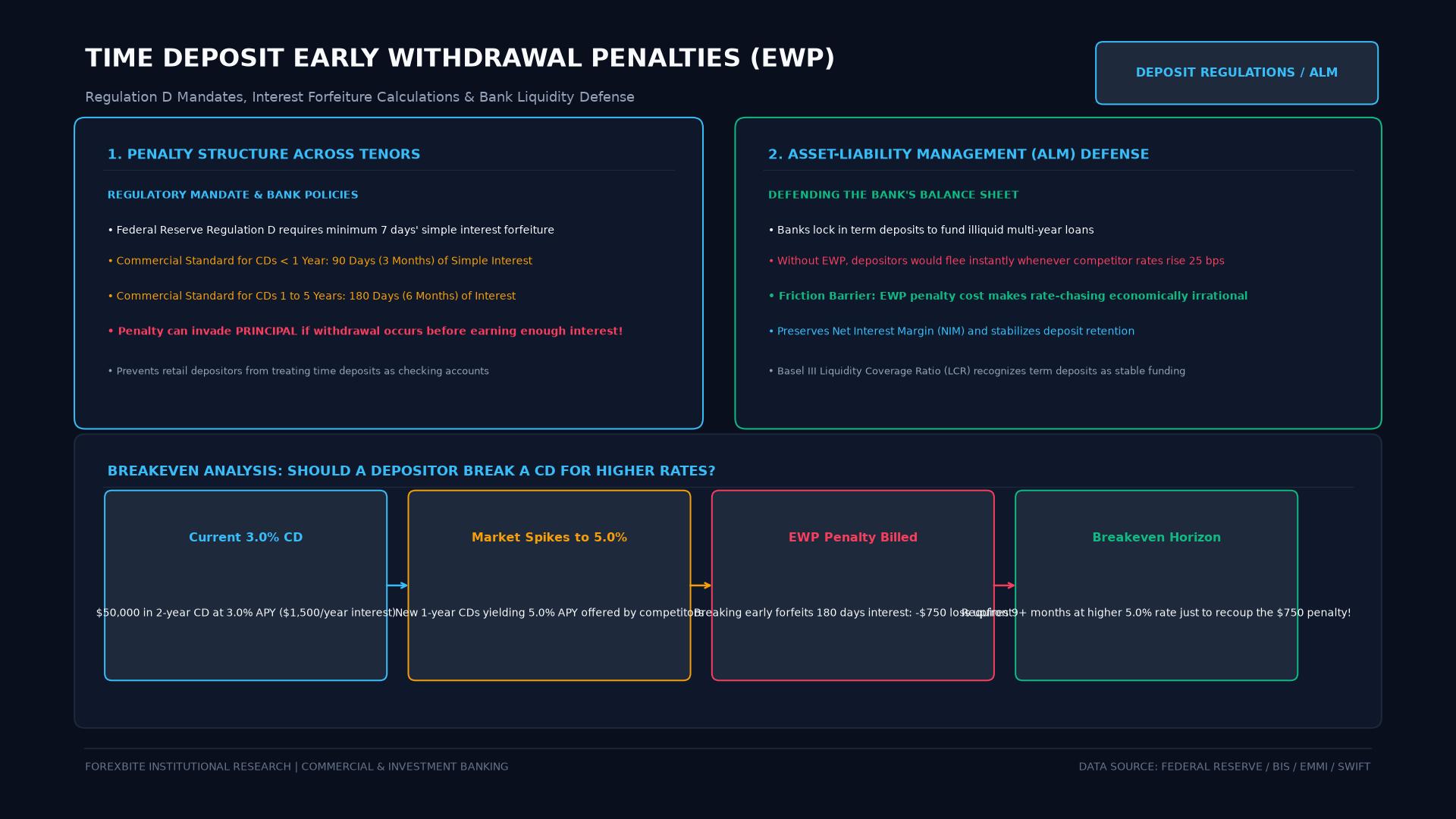 Figure: Depository contract breakage mechanics: accrued interest forfeit, principal invasion risk, and statutory interest rate adjustments.
Technical Mechanics & Penalty Formulations
The financial penalty assessed depends entirely on whether the account is a commercial bank time deposit or a government tax-deferred retirement structure:
1. Certificate of Deposit (CD) Early Withdrawal Penalty (EWP)
Commercial banks calculate early withdrawal penalties based on a predetermined forfeiture of daily accrued interest ($I_{\text{daily}}$):
$$\text{EWP} = \text{Withdrawal Amount} \times \left( \frac{\text{Annual Percentage Yield (APY)}}{365} \right) \times N_{\text{penalty days}}$$
$$\text{Net Payout} = \text{Principal} + \text{Accrued Interest} - \text{EWP}$$
Where typical statutory forfeiture periods ($N$) are:
- Short-Term CDs ($\le 12$ Months): 90 days of interest.
- Medium-Term CDs (1 to 3 Years): 180 days of interest.
- Long-Term CDs ($> 3$ Years): 270 to 365 days of interest. (Note: If a depositor breaks a CD early in its term before sufficient interest has accumulated, the bank deducts the remaining penalty directly from the principal deposit).
2. Qualified Retirement Accounts (IRC §72(t))
Under Section 72(t) of the US Internal Revenue Code, non-qualified distributions taken prior to age 59½ are subject to an inescapable tax formula:
$$\text{Net Proceeds} = W \times \left( 1 - t_{\text{fed}} - t_{\text{state}} - 0.10 \right)$$
Where $W$ is the gross withdrawal amount, $t_{\text{fed}}$ is the marginal federal income tax rate, and $t_{\text{state}}$ is the state tax rate. For high-income earners in states like California or New York, total early withdrawal erosion frequently reaches 48% to 53%.
Statutory Exemptions to the 10% IRS Penalty
The Internal Revenue Code provides explicit exceptions where the 10% penalty is waived (though ordinary income tax still applies):
| Statutory Exception | Account Type Eligible | Maximum Cap / Requirement | Primary Objective |
|---|---|---|---|
| First-Time Homebuyer | Traditional & Roth IRA | $10,000 lifetime limit | Assisting primary home down payments |
| Higher Education Expenses | Traditional & Roth IRA | Uncapped (Qualified tuition/fees) | Funding post-secondary education |
| Unreimbursed Medical Costs | IRA and 401(k) | Expenses exceeding 7.5% of AGI | Preventing healthcare bankruptcies |
| Permanent Disability | IRA and 401(k) | Total and permanent disability proof | Providing permanent disability support |
| Rule of 55 | 401(k) Only (Not IRAs) | Left employer in year turning 55+ | Bridging early corporate retirement |
| SEPP (Rule 72(t)) | IRA and 401(k) | Annual fixed schedule for $\ge 5$ years | Early retirement income streams |
Real-World Case Study: The CARES Act Retirement Relief (2020)
During the economic dislocations of the COVID-19 pandemic, the US Congress enacted the Coronavirus Aid, Relief, and Economic Security (CARES) Act of 2020, temporarily suspending traditional early withdrawal rules.
Anatomy of an Emergency Retirement Safe Harbor:
1. The Mandate: Individuals impacted by COVID-19 could take Coronavirus-Related Distributions (CRDs) of up to $100,000 from 401(k)s and IRAs between January 1 and December 30, 2020.
2. The Penalty Waiver: The mandatory 10.0% early withdrawal penalty under Section 72(t) was completely waived for all qualifying participants under age 59½.
3. The Tax Smoothing Option: Income taxes on the distributions could be spread ratably over three years (2020, 2021, and 2022).
4. The Repayment Provision: Account holders were granted three years to re-contribute the funds back into their retirement accounts, completely refunding any paid income taxes and restoring their tax-deferred retirement balances.
Frequently Asked Questions (FAQ)
What is the difference between an early withdrawal from a Traditional IRA vs. a Roth IRA?
In a Traditional IRA, contributions were made with pre-tax dollars; therefore, an early withdrawal before age 59½ triggers both ordinary income taxes and the 10% penalty on the entire distributed amount. In a Roth IRA, contributions were made with after-tax money. Under Roth ordering rules, an investor can withdraw their original contributions at any time, at any age, 100% tax-free and penalty-free. Only if the investor withdraws investment earnings before age 59½ and before the account meets the 5-year seasoning rule do taxes and the 10% penalty apply.
Can an investor take a loan from their 401(k) to avoid an early withdrawal penalty?
Yes. Many employer-sponsored 401(k) plans permit 401(k) loans, allowing participants to borrow up to 50% of their vested balance or $50,000 (whichever is lower). Because a 401(k) loan is repaid over five years with interest through automated payroll deductions, it does not trigger income taxes or the 10% early withdrawal penalty. However, if the employee leaves or is terminated by the company, the remaining loan balance must typically be repaid quickly or it defaults into a deemed taxable early distribution.
How does an early withdrawal from a Certificate of Deposit impact earned interest?
When an investor breaks a Certificate of Deposit (CD) early, the bank calculates a penalty based on a set number of months of interest (such as 3, 6, or 12 months of interest). If the CD is closed very early in its term (for example, breaking a 1-year CD after only one month), the penalty will exceed the interest earned to date. The bank legally deducts the shortfall directly from the depositor’s original principal deposit, resulting in a net cash payout smaller than the initial deposit.
Ready to trade forex?
Open a free demo account with a regulated broker. Practice with virtual funds before risking real money.