Earned Surplus (Retained Earnings)
Earned surplus (the historical statutory accounting term for retained earnings) represents the cumulative net income generated by a corporation since inception that has been retained and reinvested in business operations rather than distributed to shareholders as dividends.
What Is Earned Surplus?
Earned surplus is the traditional, statutory legal term for what modern accounting frameworks (such as US GAAP and IFRS) designate as retained earnings. It represents the cumulative, unappropriated net profits that a corporation has generated across its entire operating history that have not been distributed to shareholders in the form of cash dividends, stock dividends, or share repurchases.
In corporate balance sheet hierarchy, earned surplus resides within the Shareholders’ Equity section. It embodies the internal capital accumulated by an enterprise to self-fund long-term expansion, finance capital expenditures (CapEx), acquire competitors, retire existing corporate debt, or build liquid cash buffers against macroeconomic recessions.
If cumulative lifetime corporate losses exceed cumulative lifetime profits, the earned surplus account becomes negative, designated on the balance sheet as an Accumulated Deficit.
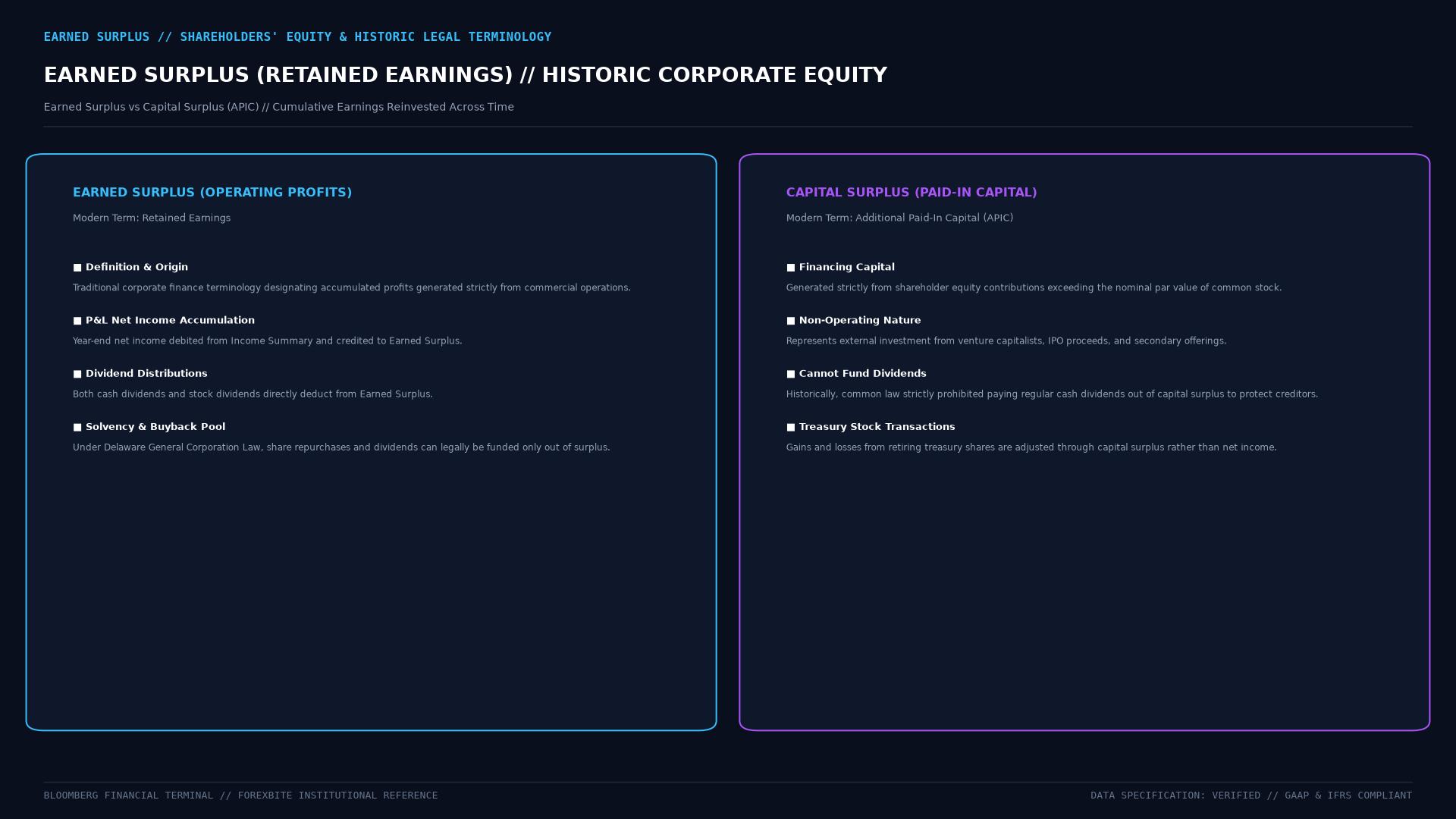 Figure: Capital formation waterfall of Earned Surplus (Retained Earnings) from cumulative net income to dividend disbursements, share repurchases, and capital reinvestment in operational expansion.
Technical Mechanics & Balance Sheet Formulations
Under modern financial accounting, the change in earned surplus across a fiscal period ($t$) is modeled as:
The Retained Earnings Roll-Forward Equation
$$\text{Earned Surplus}t = \text{Earned Surplus}{t-1} + \text{Net Income}_t - \text{Dividends Declared}_t - \text{Share Repurchases}_t$$
Where:
- $\text{Earned Surplus}_{t-1}$: Retained earnings brought forward from the prior fiscal year.
- $\text{Net Income}_t$: After-tax accounting profit reported on the income statement.
- $\text{Dividends Declared}_t$: Both common and preferred dividends formally declared by the board of directors (even if not yet paid).
Warren Buffett’s $1 Retained Earnings Test
In fundamental equity analysis, retaining earnings is only justifiable if corporate management allocates those funds at rates of return superior to what shareholders could achieve independently. Warren Buffett codified this as the One-Dollar Rule:
$$\text{Value Creation Ratio} = \frac{\Delta \text{Market Capitalization}}{\sum_{k=1}^{n} \text{Earned Surplus Retained}_k} \ge 1.0$$
Over any rolling five-to-ten-year period, every $1.00 of net income retained by the company must create at least $1.00 of incremental market value for equity shareholders. If the ratio drops below $1.0$, management is destroying shareholder wealth and should distribute earnings as dividends.
Comparative Matrix: Corporate Equity Components
| Equity Account | Source of Capital | Impact of Net Income | Subject to Dividend Distribution? |
|---|---|---|---|
| Earned Surplus (Retained Earnings) | Internal operational profits | Directly expanded by Net Income | Yes (Primary source of legal dividends) |
| Capital Surplus (APIC) | External investors paying above par | No impact | Severely restricted by state corporate law |
| Stated Capital (Common Stock) | Legal par value of issued shares | No impact | Cannot be impaired by dividends |
| Treasury Stock | Shares repurchased from market | No impact | Contra-equity account (Deduction from equity) |
Real-World Case Study: Apple Inc.’s Capital Allocation Pivot (2012)
The accumulation of staggering earned surplus was exemplified by Apple Inc. during the post-iPhone economic explosion.
Anatomy of an Earned Surplus Transformation:
1. The Steve Jobs Era: Under Steve Jobs, Apple hoarded 100% of its operating profits, accumulating over $140 billion in cash and earned surplus, refusing to pay a single penny in dividends or execute share buybacks to ensure existential survival.
2. The Investor Rebellion (2012): Activist investors (including Carl Icahn and David Einhorn) criticized Apple for hoarding surplus capital earning sub-1% yields in Treasury bills, arguing that management was violating the One-Dollar Rule.
3. The Capital Return Program: In April 2012, CEO Tim Cook initiated the largest capital return program in Wall Street history.
4. The Execution: Between 2012 and 2024, Apple deployed over $650 billion toward share repurchases and cash dividends.
5. Accounting Impact: Because annual share buybacks and dividends routinely exceeded annual net income, Apple's balance-sheet Retained Earnings contracted sharply, successfully optimizing corporate Return on Equity (ROE).
Frequently Asked Questions (FAQ)
Why did corporate accounting transition from “earned surplus” to “retained earnings”?
In the early 20th century, corporate balance sheets used the word “surplus” loosely (e.g., Earned Surplus, Paid-In Surplus, Appraisal Surplus). The term “surplus” confused non-accountant investors, who mistakenly believed it represented idle, unneeded cash sitting in a bank account. In reality, earned surplus is an equity accounting claim, not cash; the actual funds are typically tied up in factories, inventory, and technology. To clarify that these funds represent historical profits reinvested into business operations, the American Institute of Certified Public Accountants (AICPA) formally replaced “earned surplus” with retained earnings.
Can a company legally distribute dividends if it has zero earned surplus?
Under the corporate laws of most US states (such as Delaware DGCL §170), corporations can pay dividends only out of surplus (earned surplus plus capital surplus) under the Balance Sheet Test. If a company has an accumulated deficit (negative earned surplus), it generally cannot distribute dividends, with one notable exception: the Nimble Dividend Rule, which permits a company to pay dividends out of its current fiscal year’s net profits even if its cumulative historical balance remains negative.
Does a stock split affect a corporation’s earned surplus?
A standard stock split (such as a 2-for-1 split) has zero impact on earned surplus. It merely doubles the number of shares outstanding while halving the par value per share; total shareholders’ equity remains unchanged. In contrast, a stock dividend (issuing new shares to existing owners) requires a formal accounting transfer: the market value of the distributed shares is debited (deducted) from earned surplus and credited to common stock and additional paid-in capital accounts.
Ready to trade forex?
Open a free demo account with a regulated broker. Practice with virtual funds before risking real money.