Earner
In macroeconomic demographic analysis and household finance, an earner is an individual, commercial entity, or revenue-generating asset that actively produces gross income or economic value within a national labor force or financial structure.
What Is an Earner?
In macroeconomic labor analysis, demographic modeling, and household economics, an earner is any individual, business unit, or economic agent whose active participation in commercial activity generates cash compensation, operating revenue, or capital income.
At the microeconomic household level, an earner is conventionally classified as either a primary earner (the household member providing the largest proportion of total household income) or a secondary earner (contributing supplementary wages).
At the macroeconomic level, national statistical agencies—such as the US Bureau of Labor Statistics (BLS) and Eurostat—aggregate earner data to evaluate labor productivity, household disposable income trends, income inequality (Gini coefficients), and the critical Age-Dependency Ratio, which dictates whether a nation’s active workforce can sustainably support its non-working retired population.
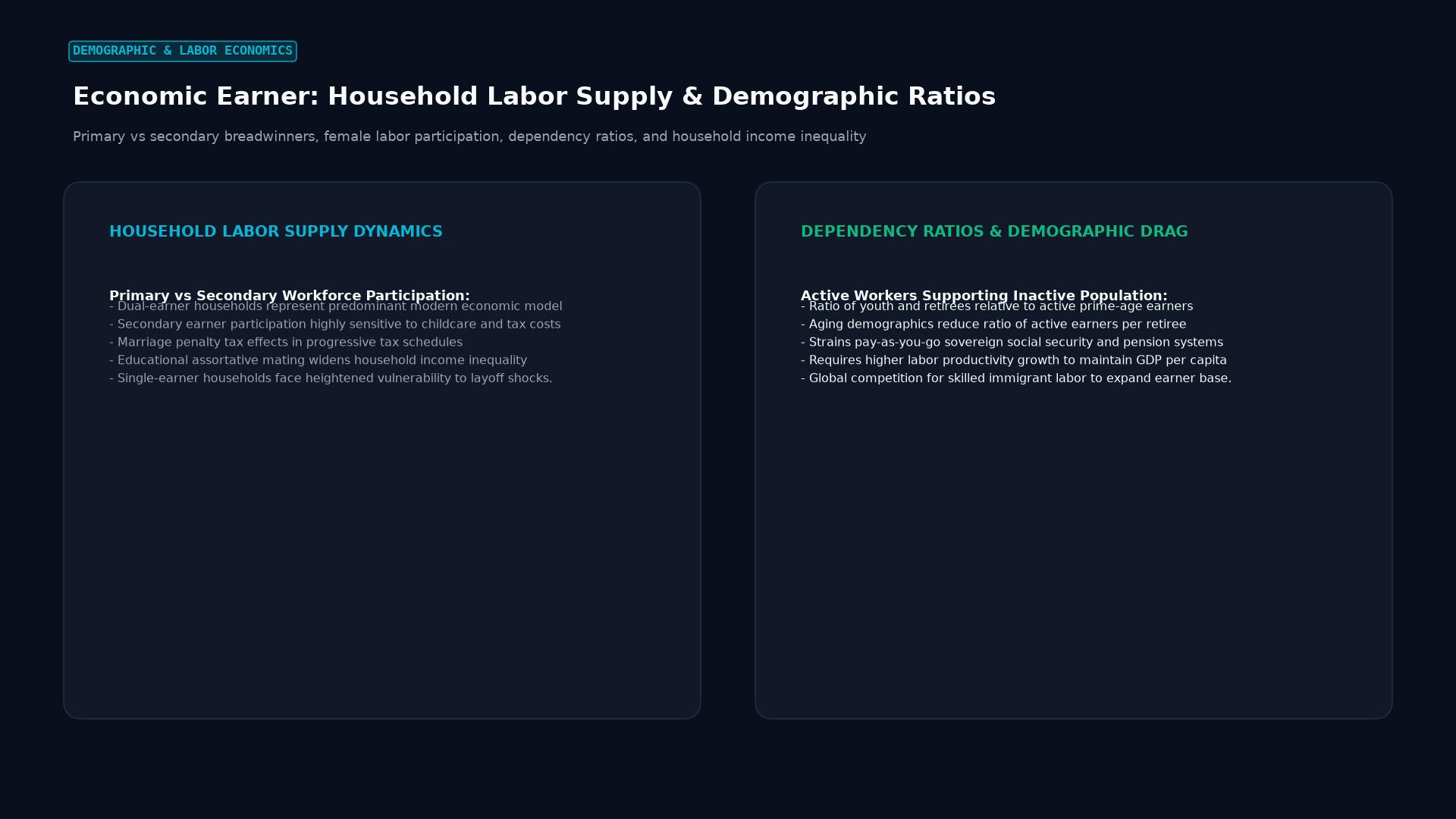 Figure: Primary vs secondary breadwinners, female labor participation, dependency ratios, and household income inequality
Technical Mechanics & The Demographic Dependency Equation
Economists measure a nation’s structural labor health using the Total Dependency Ratio (TDR), which tracks the mathematical relationship between the non-earner dependent population and the active earner base:
The Dependency Ratio Formulation
$$\text{Total Dependency Ratio} = \left( \frac{\text{Population}{0-14} + \text{Population}{65+}}{\text{Working-Age Earner Population}_{15-64}} \right) \times 100$$
Where:
- Child Dependency Ratio: Proportion of dependent children per 100 active earners.
- Old-Age Dependency Ratio: Proportion of dependent retirees per 100 active earners: $$\text{Old-Age Ratio} = \left( \frac{\text{Population}{65+}}{\text{Population}{15-64}} \right) \times 100$$
When the Old-Age Dependency Ratio rises from 20 to over 50 (as seen in nations like Japan, Italy, and South Korea), the tax burden per active worker must increase exponentially to maintain existing state healthcare and pension systems without massive government deficit borrowing.
Household Economics: The Dual-Earner Paradigm
In corporate consumer goods analysis and real estate underwriting, tracking household earner dynamics is paramount:
The Dual-Earner Elasticity Shock
$$\text{Household Purchasing Power} = Y_{\text{primary}} + Y_{\text{secondary}} - T - \text{Childcare Costs}$$
Over the past fifty years, advanced economies experienced a structural transition from single-earner households to dual-earner households. While this transition doubled household gross income potential, it introduced structural economic rigidities: fixed costs (such as two commuting automobiles, professional daycare, and urban housing near dual employment hubs) surged, reducing household discretionary savings rates during macroeconomic recessions.
Comparative Matrix: Economic Earner Classifications
| Earner Category | Primary Income Channel | Marginal Propensity to Consume (MPC) | Tax Structure Applied |
|---|---|---|---|
| High Earner (HENRY) | Six-figure executive salary / bonuses | Low (0.20 to 0.40) | Top federal/state marginal tax rates |
| Middle-Income Earner | Standard salaried wages (W-2 / PAYE) | Moderate (0.60 to 0.75) | Standard graduated tax brackets |
| Low-Wage Earner | Hourly wages, tips, gig contracts | High (0.85 to 1.00) | Subsidized by EITC / Child Tax Credits |
| Asset / Capital Earner | Dividend distributions, bond yields | Low | Preferential capital gains rates |
(Note: “HENRY” is a recognized institutional wealth management acronym for “High Earner, Not Rich Yet”—young professionals with high earned wages but low accumulated balance-sheet wealth).
Real-World Case Study: The Japanese Demographic “Earner Deficit” (1990–Present)
The macroeconomic consequences of a shrinking earner base are most visible in the multi-decade economic trajectory of Japan.
Anatomy of an Earner Demographic Squeeze:
1. The Baseline: In 1970, Japan had roughly 8.5 active working-age earners supporting every 1 retired senior citizen.
2. The Inversion: By 2023, decades of ultra-low fertility rates (below 1.3 births per woman) compressed the ratio: roughly 2.0 active earners support every 1 senior citizen.
3. The Economic Consequences:
   * Domestic consumer demand stagnated, causing decades of persistent deflationary and disinflationary pressures.
   * Japan's sovereign debt-to-GDP ratio exploded past 260% as the government borrowed trillions of Yen to fund healthcare for a non-earner aging majority.
   * Corporate investment shifted abroad as domestic consumer market growth evaporated.
Frequently Asked Questions (FAQ)
What is the economic difference between a “high earner” and a “wealthy individual”?
A high earner possesses a large recurring flow of gross labor compensation (e.g., an orthopedic surgeon earning $600,000 annually), which is heavily taxed at top ordinary income brackets. A wealthy individual (High-Net-Worth Individual - HNWI) possesses a large stock of accumulated assets on their balance sheet (e.g., $20 million in real estate, equities, and private equity). A high earner who spends 95% of their paycheck on luxury consumption can easily carry a net worth near zero, making them highly vulnerable to economic shocks.
How do central banks track earner wage growth during inflationary cycles?
Central banks (such as the Federal Reserve and Bank of England) monitor earner wage indices—including the Employment Cost Index (ECI) and Average Hourly Earnings—to detect wage-price spirals. If worker wages (earner income) rise faster than worker productivity, corporations raise retail prices to protect profit margins, forcing workers to demand even higher wages and cementing persistent core inflation.
What is a “breadwinner” in modern macroeconomic terms?
In modern labor economics, a breadwinner (or primary earner) is the individual whose earnings account for more than 50% of the household’s total financial support. In the 1960s, over 80% of US married-couple breadwinners were male; by the 2020s, demographic shifts and higher female educational attainment resulted in women serving as the primary or sole breadwinner in nearly 30% to 40% of married American households.
Ready to trade forex?
Open a free demo account with a regulated broker. Practice with virtual funds before risking real money.