Earnings Adequacy Ratio
The earnings adequacy ratio is an institutional risk-adjusted credit metric developed by credit rating agencies (such as Standard & Poor's) to evaluate whether a financial enterprise's pre-tax operating earnings are sufficient to absorb potential credit losses, capital impairments, and ongoing operational costs.
What Is the Earnings Adequacy Ratio?
The earnings adequacy ratio is a specialized, risk-adjusted financial performance metric utilized by global credit rating agencies—most notably S&P Global Ratings (Standard & Poor’s)—to evaluate the earnings quality, capital resilience, and debt-servicing capacity of commercial banks, insurance companies, and diversified financial institutions.
While traditional accounting profitability metrics (such as Return on Assets - ROA or Return on Equity - ROE) measure historical accounting profit relative to historical balance sheet size, they ignore the underlying volatility and credit risk of the assets being deployed.
The earnings adequacy ratio explicitly adjusts an institution’s earnings against its risk-weighted asset profile. It answers a fundamental question for bondholders and credit rating committees: Are the institution’s core, recurring pre-tax operating earnings sufficiently robust to absorb unexpected credit write-downs, loan default spikes, and catastrophic market downturns without depleting its core regulatory capital reserves?
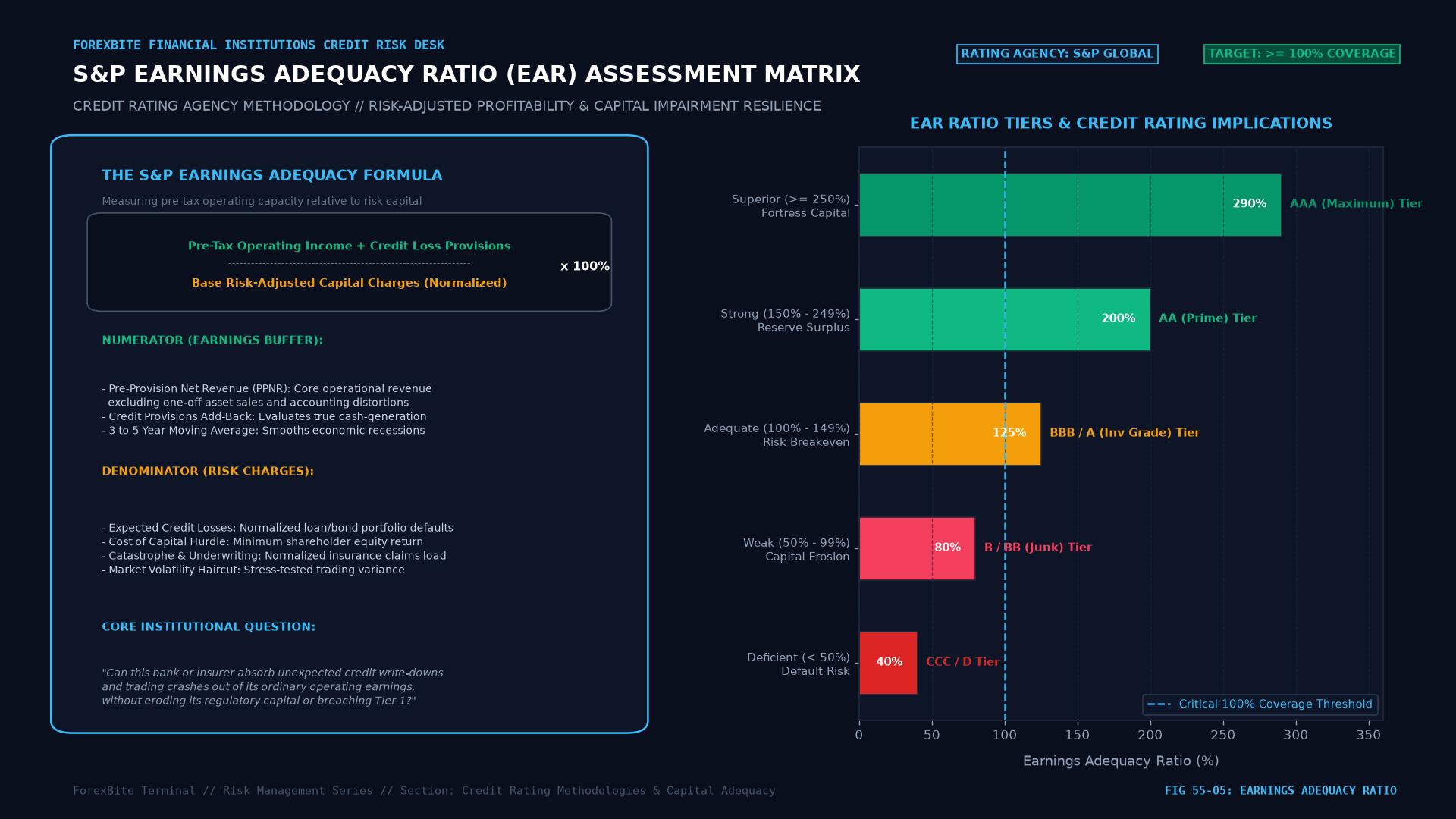 Figure: S&P Global Ratings earnings adequacy ratio (EAR) methodology decomposing pre-tax operating earnings against normalized risk-adjusted capital charges.
Technical Mechanics & Credit Agency Formulations
Under Standard & Poor’s financial institution rating criteria, the Earnings Adequacy Ratio (EAR) evaluates core operating performance against normalized risk requirements over a multi-year economic cycle:
The S&P Earnings Adequacy Formulation
$$\text{EAR} = \left( \frac{\text{Pre-Tax Operating Income} + \text{Credit Provisions}}{\text{Base Risk-Adjusted Capital Charges}} \right) \times 100$$
Where:
- $\text{Pre-Tax Operating Income}$: Core recurring earnings generated from ongoing business operations, strictly stripping out volatile, one-off gains (such as the sale of real estate, litigation settlements, or temporary mark-to-market trading windfalls).
- $\text{Credit Provisions}$: Addition of pre-tax provisions set aside for anticipated loan or insurance losses.
- $\text{Base Risk-Adjusted Capital Charges}$: The theoretical minimum operating income an institution must generate to cover its baseline risk-weighted asset defaults and maintain a target capital adequacy buffer.
The CAMELS Supervisory Interplay
The earnings adequacy ratio aligns directly with the “E” (Earnings) component of the international CAMELS supervisory framework deployed by banking regulators (FDIC, Federal Reserve, OCC):
- Level 1 (Strong): Earnings provide more than sufficient capital accretion to fund business growth and absorb severe economic stress.
- Level 3 (Average): Earnings are adequate to meet current capital requirements, but vulnerable to unexpected economic deterioration.
- Level 5 (Critically Deficient): Chronic operating losses threaten the immediate viability of the institution, requiring regulatory takeover or recapitalization.
Comparative Matrix: Institutional Solvency & Profitability Metrics
| Metric | Measuring Agency / Standard | Incorporates Asset Risk? | Focus Area | Benchmark Threshold |
|---|---|---|---|---|
| Earnings Adequacy Ratio | S&P Global Ratings | Yes (Risk-adjusted charges) | Earnings safety margin | $> 125%$ (Healthy) |
| Capital Adequacy Ratio (CAR) | Basel III / Central Banks | Yes (Risk-weighted assets) | Core balance-sheet equity | $\ge 8.0%$ to $10.5%$ |
| Interest Coverage Ratio | General Corporate Finance | No | Ability to service debt interest | $> 3.0\times$ (Investment Grade) |
| Return on Equity (ROE) | Accounting Standard (GAAP) | No | Shareholder accounting yield | $10%$ to $15%$ |
Real-World Case Study: European Banking Authority (EBA) Stress Testing
The real-world application of earnings adequacy under extreme macroeconomic stress was demonstrated during the European Banking Authority (EBA) EU-wide bank stress tests.
Anatomy of an Earnings Adequacy Stress Evaluation:
1. The Scenario: The EBA subjected 70 European commercial banks to a simulated 3-year severe macroeconomic crisis, modeling a 3.4% cumulative drop in EU Gross Domestic Product (GDP), a 21% collapse in real estate prices, and surging sovereign bond yields.
2. The Test: Evaluating whether banks' pre-provision operating earnings could absorb projected credit impairments without breaching statutory Tier 1 Common Equity (CET1) thresholds.
3. The Finding:
   * Nordic and German commercial banks demonstrated high Earnings Adequacy Ratios (>180%), as diversified corporate fee income and low non-performing loans absorbed stress without impairing capital.
   * Conversely, several Southern European peripheral lenders exhibited deficient earnings adequacy: projected loan loss provisions completely wiped out operating earnings, resulting in negative capital accretion and requiring mandatory equity capital injections.
Frequently Asked Questions (FAQ)
How does S&P use the earnings adequacy ratio to assign credit ratings?
Standard & Poor’s utilizes the earnings adequacy ratio as a foundational sub-factor within its Financial Institutions Rating Methodology. A bank with an exceptionally high earnings adequacy ratio (exceeding 150% across a full 5-year cycle) receives an upward rating adjustment (often lifting the credit rating into AA or AAA territory), because the institution demonstrates an ability to generate massive internal organic capital even during economic recessions, insulating senior bondholders from default.
What is the primary difference between Earnings Adequacy and Capital Adequacy?
Capital Adequacy is a stock metric: it measures the total existing buffer of permanent equity capital sitting on the balance sheet at a single point in time relative to risk-weighted assets (e.g., Common Equity Tier 1 - CET1 ratio). Earnings Adequacy is a flow metric: it measures the ongoing annual flow of pre-tax profits generated by business operations that can absorb fresh loan losses before the bank is forced to dip into and deplete its permanent balance-sheet capital.
Why do rating agencies strip out one-off investment gains when calculating earnings adequacy?
Rating agencies explicitly exclude non-recurring items—such as profits from selling a corporate subsidiary, tax refunds, or unexpected trading spikes during a market panic—because these cash flows are temporary and non-repeatable. If a bank appears profitable only because it sold its corporate headquarters building, its core commercial lending operations may still be deeply unprofitable. Rating agencies require proof that core, repeatable operating revenue is adequate to cover systemic risks.
Ready to trade forex?
Open a free demo account with a regulated broker. Practice with virtual funds before risking real money.