Earnings Announcement
An earnings announcement is the formal quarterly or annual public disclosure by a publicly traded corporation of its financial performance, net income, revenue, and forward management guidance, communicated via a press release, SEC Form 10-Q/10-K filing, and an interactive executive conference call.
What Is an Earnings Announcement?
An earnings announcement (formally designated as a quarterly earnings release) is the official public disclosure issued by an exchange-listed corporation detailing its operational results, gross revenues, and net income performance over the preceding three-month fiscal period (or full fiscal year).
Occurring four times annually during a cyclical market window known as Earnings Season, the earnings announcement represents the primary event catalyst in modern equity markets. The disclosure package typically unfolds across three distinct media:
- The Official Press Release: Published over corporate newswires (such as PR Newswire or Business Wire) containing the condensed balance sheet, income statement, and headline Earnings Per Share (EPS).
- Regulatory Statutory Filings: The concurrent submission of Form 10-Q (quarterly filing) or Form 10-K (audited annual filing) to the Securities and Exchange Commission (SEC).
- The Executive Conference Call: An interactive live audio webcast where the Chief Executive Officer (CEO) and Chief Financial Officer (CFO) discuss business catalysts, issue forward guidance, and answer unscripted questions from Wall Street sell-side equity analysts.
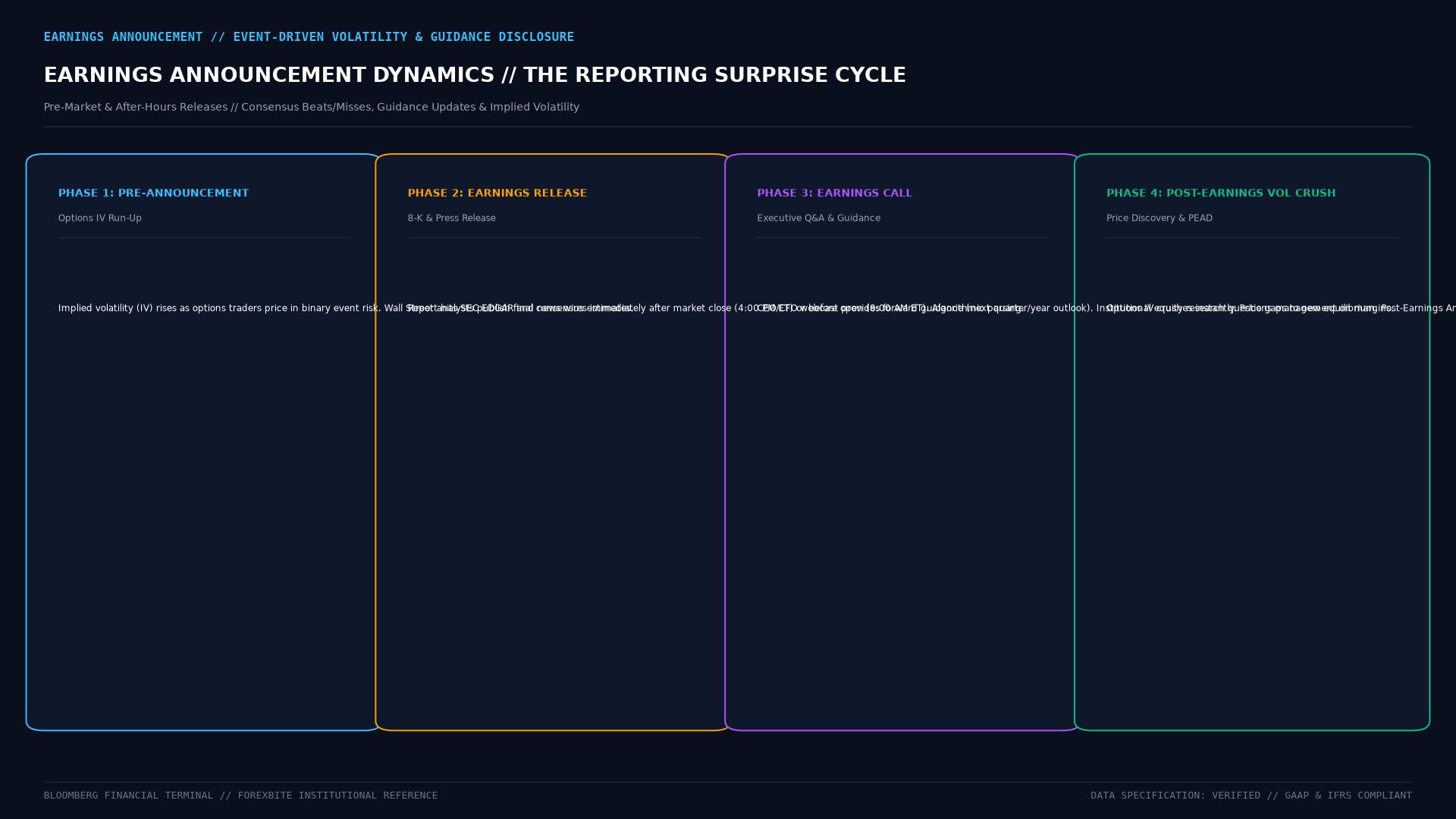 Figure: Institutional Earnings Announcement lifecycle from consensus estimate formation and the quiet period to earnings release, conference call guidance, and post-earnings announcement drift (PEAD).
Technical Mechanics & The PEAD Market Anomaly
In quantitative equity trading, the market’s immediate and multi-month reaction to an earnings announcement is modeled using the concept of Standardized Unexpected Earnings (SUE):
The SUE Metric Formulation
$$\text{SUE}_t = \frac{\text{Actual EPS}_t - \text{Consensus Estimated EPS}t}{\sigma{\text{forecast error}}}$$
Where:
- $\text{Actual EPS}_t$: The official diluted earnings per share reported by the corporation.
- $\text{Consensus Estimated EPS}_t$: The mean consensus forecast aggregated by financial data providers (e.g., Bloomberg, FactSet, IBES).
- $\sigma_{\text{forecast error}}$: The standard deviation of analysts’ forecast estimates over the 30 days prior to the release.
Post-Earnings Announcement Drift (PEAD)
Classical Efficient Market Hypothesis (EMH) predicts that stock prices should adjust instantaneously to new earnings data. However, decades of empirical financial research document the Post-Earnings Announcement Drift (PEAD):
- Stocks reporting extreme positive SUE scores not only gap up on Day 0, but experience sustained, positive price momentum drifting upward for 60 to 90 trading days.
- This drift occurs because large institutional asset managers (pension funds, mutual funds) managing tens of billions of dollars cannot purchase their full multi-million-share target positions in a single morning without creating catastrophic market impact, spreading their algorithmic accumulation over several months.
Options Trading: The Implied Volatility Crush (IV Crush)
In derivatives markets, holding options through an earnings announcement exposes traders to severe Implied Volatility (IV) Crush:
$$\Delta \text{Option Value} \approx \Delta \text{Spot} \cdot \Delta_{\text{Greek}} - \Delta \sigma_{\text{IV}} \cdot \nu_{\text{Vega}}$$
Prior to the announcement, the market uncertainty surrounding the release drives implied volatility to astronomical levels (often exceeding 100% to 150% annualized). The moment the press release crosses the wire, the binary uncertainty resolves to zero. Implied volatility immediately collapses back to historical baselines (e.g., plunging from 120% to 35% in minutes). Even if a trader accurately predicts that the stock will rally, the catastrophic collapse in Vega ($\nu$) extrinsic value can cause long call options to lose money.
Comparative Matrix: Components of an Earnings Release
| Release Component | Dissemination Channel | Legal Liability Level | Key Market Information Delivered |
|---|---|---|---|
| Headline Press Release | Wire Services (Business Wire) | High (SEC Reg FD) | Headline EPS, Gross Revenue, Operating Margin |
| SEC Form 10-Q / 10-K | SEC EDGAR Database | Strict Federal Liability (SOX) | Audited segment data, footnotes, risk factors |
| Executive Earnings Call | Live Audio Webcast | High (Reg FD safe harbor) | Executive tone, nuanced forward outlook |
| Management Guidance | Press Release / Call | Forward-looking safe harbor | Next quarter & full-year revenue/profit targets |
Real-World Case Study: Meta Platforms’ $232 Billion Wipeout (February 2022)
The most destructive single-day market cap collapse triggered by an earnings announcement occurred on February 3, 2022, when Meta Platforms (formerly Facebook) announced its Q4 2021 financial results.
Anatomy of an Earnings Catastrophe:
1. The Headline Print: Meta reported Q4 EPS of $3.67 (missing Wall Street consensus of $3.84).
2. The KPI Shock: Daily Active Users (DAUs) declined for the first time in corporate history (dropping from 1.930 billion to 1.929 billion).
3. The Guidance Bomb: CFO David Wehner issued disastrous Q1 2022 revenue guidance, projecting $27B-$29B (well below the $30.15B expected), citing a $10 billion advertising revenue headwind caused by Apple's iOS privacy tracking changes.
4. The Market Reaction:
   * At the 16:00 EST market close: Meta stock traded at $323.00.
   * Post-announcement: The stock collapsed 26.4% in after-hours and regular trading, opening the next morning at $237.76.
   * Total Market Cap Destruction: $232 billion vanished in a single trading session—the largest one-day market value wipeout for any public company in world history.
Frequently Asked Questions (FAQ)
Why do corporations schedule earnings announcements Before Market Open (BMO) or After Market Close (AMC)?
Public corporations deliberately release earnings outside of regular stock market trading hours (either between 06:30 and 08:30 AM EST for BMO, or between 16:05 and 17:00 PM EST for AMC) to promote fair, orderly market price discovery. Releasing complex 50-page financial statements during active trading hours would cause chaotic, fragmented trading halts. Publishing outside regular hours allows institutional analysts, algorithms, and retail investors time to digest footnotes and participate in the executive conference call before the broader market opens.
What is the difference between an earnings beat and a guidance cut?
An earnings beat means the company’s past quarterly performance exceeded consensus Wall Street estimates (e.g., earning $2.10 vs $2.00 expected). A guidance cut means management lowered its financial forecasts for upcoming future quarters. In modern financial markets, forward guidance always trumps historical results: if a company beats past earnings but lowers future guidance (“beat and lower”), the stock almost always sells off aggressively.
What is Regulation FD and how does it govern earnings announcements?
Adopted by the US Securities and Exchange Commission in August 2000, Regulation Fair Disclosure (Reg FD) legally prohibits publicly traded corporations from disclosing material, non-public information to select institutional investors, hedge funds, or equity analysts before making it available to the general public. Under Reg FD, all material earnings disclosures, guidance updates, and conference calls must be disseminated simultaneously to all market participants worldwide.
Ready to trade forex?
Open a free demo account with a regulated broker. Practice with virtual funds before risking real money.