Whisper Number
A whisper number is the unofficial, unpublished consensus forecast of corporate earnings or macroeconomic data circulating among institutional traders and hedge funds prior to official release, often diverging from published consensus estimates.
What Is a Whisper Number?
In financial markets, a whisper number represents the unofficial, unreleased expectation of a company’s upcoming quarterly earnings per share (EPS), revenue, or a key macroeconomic indicator (such as US Non-Farm Payrolls or CPI).
While major financial data providers like Bloomberg, Refinitiv, and FactSet compile and publish official consensus estimates based on formal sell-side analyst research notes, institutional buy-side participants (hedge funds, proprietary trading desks, and mutual funds) frequently arrive at different conclusions. Through private channel checks, alternative data sets (credit card transactions, satellite imagery, web scraping), and informal dealer communications, these traders form an informal consensus—the “whisper”—that reflects where the market is actually positioned.
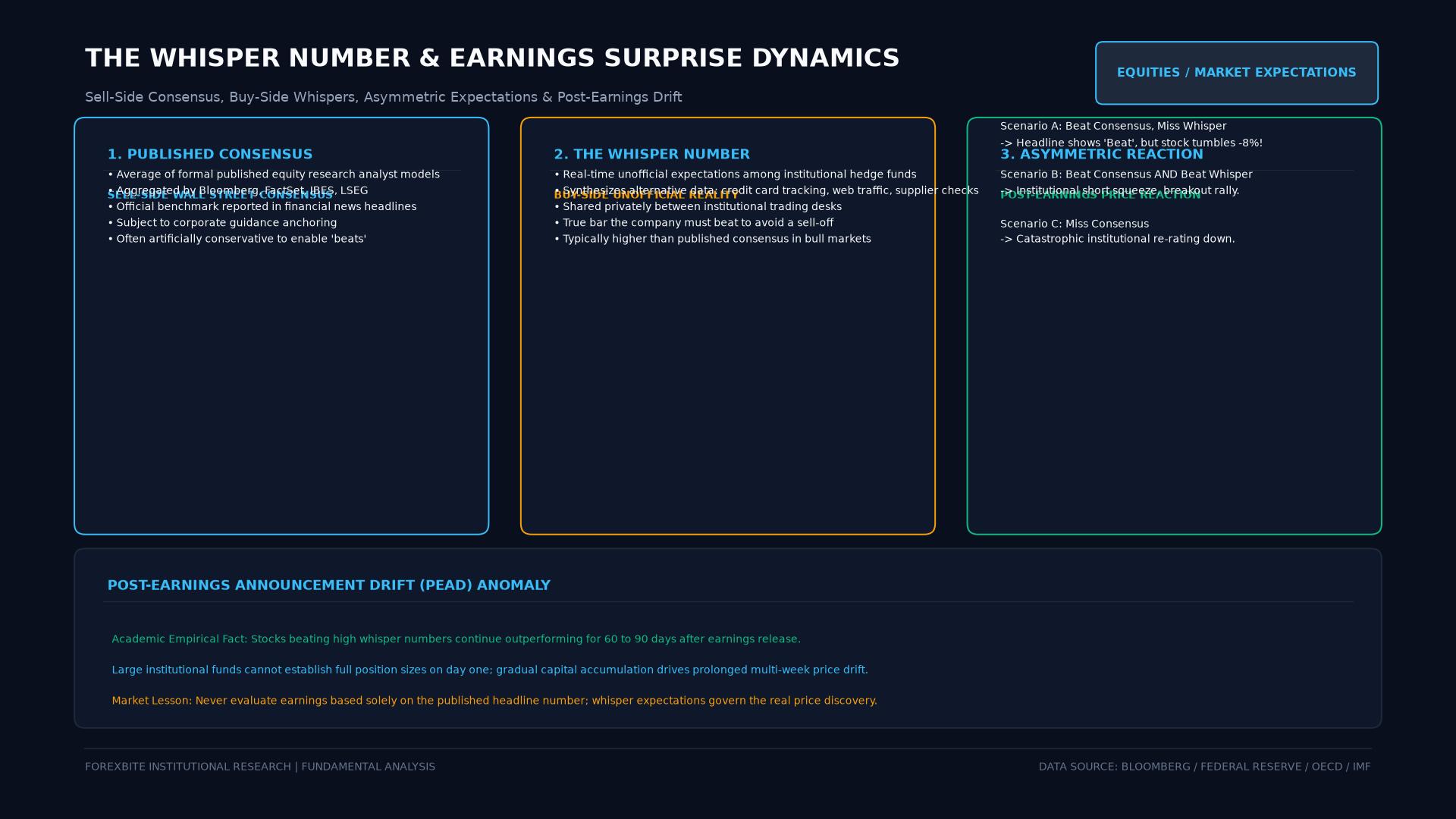 Figure: The institutional whisper number lifecycle in corporate earnings season, comparing published sell-side consensus estimates against unofficial buy-side whisper expectations and Post-Earnings Announcement Drift (PEAD).
Quantitative Mechanics: Measuring the Expectation Gap
Market price action around high-profile data releases is driven by the divergence between the actual reported figure and the effective market expectation.
The Surprise Metrics
-
Official Consensus Surprise ($S_{\text{official}}$): $$S_{\text{official}} = \frac{\text{Actual} - \text{Consensus}{\text{official}}}{|\text{Consensus}{\text{official}}|} \times 100$$
-
Whisper Surprise ($S_{\text{whisper}}$): $$S_{\text{whisper}} = \frac{\text{Actual} - \text{Expectation}{\text{whisper}}}{|\text{Expectation}{\text{whisper}}|} \times 100$$
Post-Earnings Announcement Drift (PEAD) Dynamics
Empirical market microstructure shows that when an asset’s price has run up aggressively into an announcement, the market is pricing in the whisper number ($E_{\text{whisper}} > E_{\text{consensus}}$). If the actual metric arrives at $A$:
$$\text{If } E_{\text{consensus}} < A < E_{\text{whisper}} \implies \Delta P < 0$$
Despite delivering a positive headline surprise relative to financial media headlines, the asset experiences sharp selling as short-term institutional traders liquidate long positions, realizing that growth was fully discounted.
Comparative Structure: Forecast Information Layers
| Metric Tier | Source | Transparency | Rigor & Methodology | Market Impact Mechanism |
|---|---|---|---|---|
| Official Consensus | Sell-side broker analysts | Fully public; published on financial terminals | Fundamental DCF, quarterly corporate guidance | Media headlines, algorithmic headline scrapers |
| Whisper Number | Buy-side funds, floor desks, alternative data | Semi-private; informal trader chats, specialized aggregators | Credit card scraping, supply chain telemetry | True pre-release price positioning and options skew |
| “Bogeys” (Buy-Side Hurdles) | Internal hedge fund risk models | Confidential | Proprietary quantitative alpha models | Institutional stop-loss triggers and portfolio liquidation |
Real-World Case Study: Macroeconomic Whisper Numbers in Forex (US NFP 2023)
Whisper numbers exert massive influence not only in corporate equities but also across G10 foreign exchange markets during the release of the US Non-Farm Payrolls (NFP) report.
NFP Release Dynamics (October 2023):
- Published Consensus: Bloomberg survey predicted +170,000 new jobs.
- The Whisper: High-frequency alternative data (ADP private payrolls, initial jobless claims, and proprietary Goldman Sachs desk surveys) pushed the institutional whisper to +240,000.
- Spot Positioning: Institutional desks aggressively accumulated USD/JPY long positions, driving the pair higher by 65 pips in the 2 hours prior to the 08:30 EST release.
- Actual Release: +336,000 jobs (surpassing both consensus and whisper).
- Market Reaction: USD surged over 110 pips across G10 pairs within 3 minutes as both retail and institutional algorithms triggered full-volume momentum buying.
Conversely, when an NFP report beats published consensus but falls 30,000 jobs short of a high whisper number, the US Dollar frequently experiences an immediate sharp knee-jerk reversal lower.
Frequently Asked Questions (FAQ)
Where do modern whisper numbers originate?
In the early days of electronic trading, whisper numbers originated primarily through word of mouth among institutional sales traders and specialized websites like WhisperNumber.com. Today, modern whisper numbers are driven by sophisticated quantitative alternative data: hedge funds analyze credit and debit card transaction databases (e.g., Bloomberg Second Measure), real-time supply chain import receipts, cell phone geolocation foot traffic outside retail stores, and natural language processing (NLP) analysis of corporate supplier calls.
How do algorithmic trading desks trade around whisper numbers?
Algorithmic execution models monitor order book depth and options implied volatility skews in the hours leading up to an event. If call options skew sharply higher relative to puts despite flat published consensus, algorithms infer that smart money expects a positive whisper surprise. Automated news-reading bots are then programmed with conditional multi-tier execution thresholds, checking whether the incoming headline beats both the published consensus and the higher implied hurdle rate.
Does trading on a whisper number violate insider trading regulations?
No, provided the whisper number is compiled through independent research, publicly observable alternative data, and legitimate economic modeling. It is legal for market participants to conduct channel checks, evaluate consumer foot traffic, or aggregate broker commentary. However, if a whisper number is derived from a material non-public leak directly from a corporate insider or government official prior to formal embargo release, trading on that information constitutes illegal insider trading under SEC and CFTC regulations.
Ready to trade forex?
Open a free demo account with a regulated broker. Practice with virtual funds before risking real money.