Earnings Before Interest After Taxes (EBIAT)
Earnings Before Interest After Taxes (EBIAT)—also recognized in corporate valuation as Net Operating Profit After Tax (NOPAT)—is a financial metric measuring a corporation's operating profitability after accounting for corporate income taxes while strictly ignoring capital structure and debt financing costs.
What Is EBIAT?
Earnings Before Interest After Taxes (EBIAT)—widely recognized across investment banking and corporate valuation under the synonymous term Net Operating Profit After Tax (NOPAT)—is an essential financial metric that measures a corporation’s core operating profitability after deducting corporate income taxes, while completely neutralizing the effects of debt leverage and capital structure.
In standard corporate financial reporting, traditional Net Income is heavily distorted by how a company chooses to finance its balance sheet: a company with $10 billion in debt will report significantly lower net income than an otherwise identical company with zero debt due to massive interest expense deductions.
EBIAT removes this distortion. By evaluating the firm as if it were 100% unleveraged (all-equity financed), EBIAT isolates the true economic productivity of the business operations, serving as the foundational building block for Free Cash Flow to Firm (FCFF) models and Return on Invested Capital (ROIC) calculations.
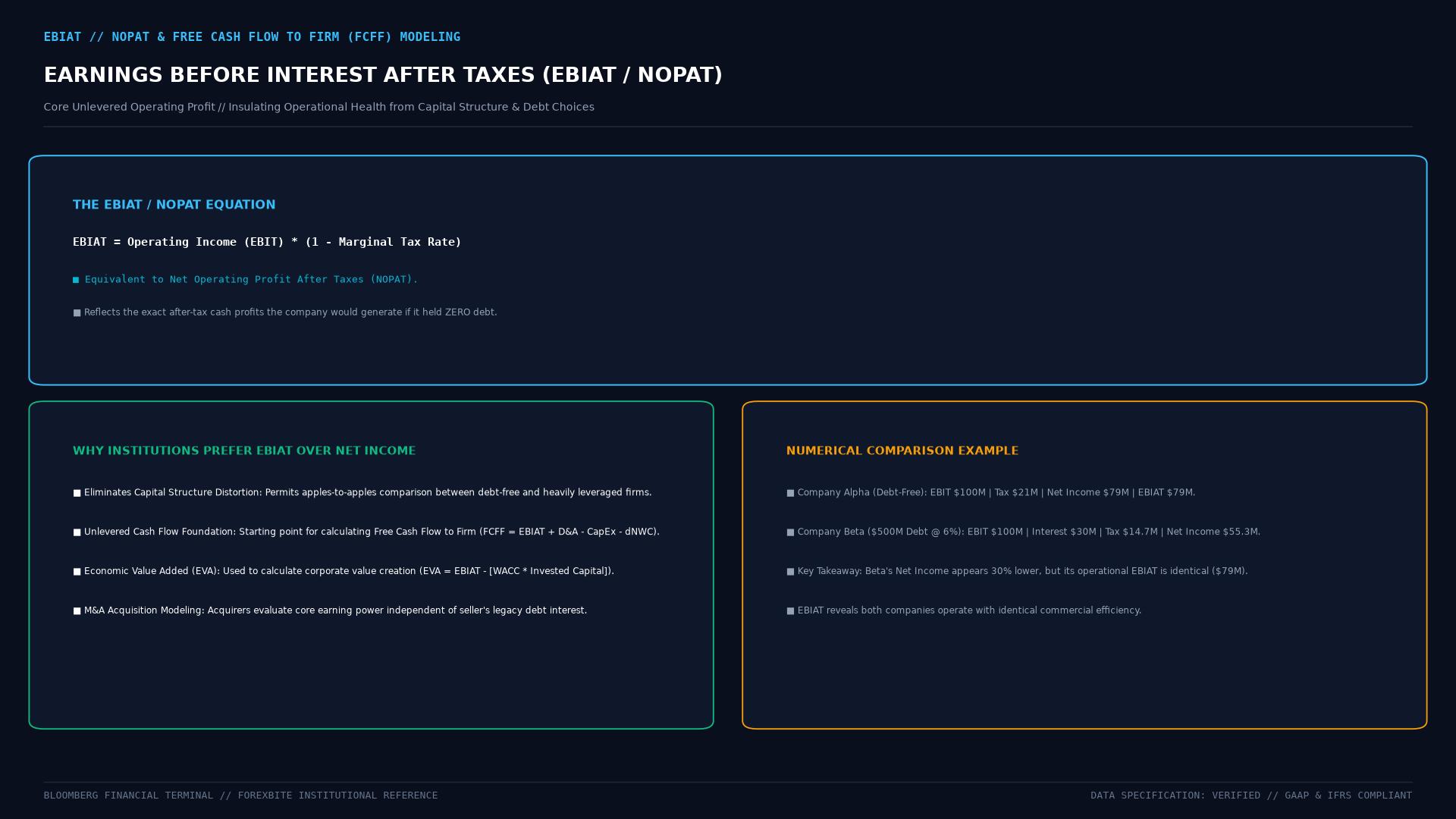 Figure: Mathematical and financial derivation of EBIAT ($EBIT \times (1 - t)$), contrasting unlevered operational earnings against net income, and illustrating its central role in Free Cash Flow to Firm (FCFF) modeling.
Technical Mechanics & Mathematical Formulations
EBIAT can be derived through two primary accounting calculations: the top-down operating approach and the bottom-up net income reconciliation:
1. Top-Down Operating Formulation
Starting from Operating Profit (EBIT - Earnings Before Interest and Taxes):
$$\text{EBIAT} = \text{EBIT} \times (1 - t_{\text{effective}})$$
Where $t_{\text{effective}}$ represents the normalized corporate income tax rate:
$$t_{\text{effective}} = \frac{\text{Total Corporate Income Taxes}}{\text{Earnings Before Taxes (EBT)}}$$
2. Bottom-Up Net Income Reconciliation
Starting from reported bottom-line Net Income, EBIAT reverses the after-tax interest expense:
$$\text{EBIAT} = \text{Net Income} + \left[ \text{Net Interest Expense} \times (1 - t_{\text{effective}}) \right]$$
Because debt interest provides a statutory corporate tax deduction (the interest tax shield), only the after-tax interest expense is added back to neutralize the financing effect.
Role in Enterprise DCF & ROIC Frameworks
EBIAT is not merely an alternative accounting snapshot; it is the mathematical engine of institutional M&A valuation:
1. Free Cash Flow to Firm (FCFF / Unlevered Free Cash Flow)
In Discounted Cash Flow (DCF) enterprise valuation models, cash flows must be projected independent of debt leverage:
$$\text{FCFF} = \text{EBIAT} + \text{Depreciation & Amortization} - \text{Capital Expenditures (CapEx)} - \Delta \text{Net Working Capital}$$
These unlevered cash flows are discounted using the company’s Weighted Average Cost of Capital (WACC) to determine Enterprise Value.
2. Return on Invested Capital (ROIC)
ROIC measures how efficiently management allocates shareholder and bondholder capital to generate returns:
$$\text{ROIC} = \frac{\text{EBIAT}}{\text{Total Invested Capital}}$$
$$\text{Total Invested Capital} = \text{Total Debt} + \text{Total Equity} - \text{Excess Cash}$$
If a company’s ROIC exceeds its WACC ($\text{ROIC} > \text{WACC}$), the company is creating genuine economic shareholder value.
Comparative Matrix: Corporate Profitability Metrics
| Metric | Incorporates Debt Interest? | Incorporates Taxes? | Capital Structure Dependent? | Primary Valuation Role |
|---|---|---|---|---|
| EBIAT / NOPAT | No (Interest ignored) | Yes (After-tax) | No (Capital Neutral) | FCFF, DCF models, ROIC |
| EBIT | No | No (Pre-tax) | No | Top-of-funnel operating comparison |
| EBITDA | No | No | No | Leverage capacity, debt covenants |
| Net Income | Yes (Deducted) | Yes (Deducted) | Yes (Highly Leveraged) | Trailing P/E multiples, Dividend coverage |
Real-World Case Study: Private Equity LBO Valuation Modeling
The analytical supremacy of EBIAT over Net Income is demonstrated during private equity leveraged buyout (LBO) evaluations.
Comparing Two Competitors in the Packaging Industry:
- Company Alpha (All-Equity Financed):
  * Operating Income (EBIT): $100 Million.
  * Interest Expense: $0.
  * Taxes (25% rate): $25 Million.
  * Reported Net Income: $75 Million.
- Company Beta (Debt-Financed - $600M Debt at 8%):
  * Operating Income (EBIT): $100 Million.
  * Interest Expense: $48 Million.
  * Pre-Tax Income (EBT): $52 Million.
  * Taxes (25% rate): $13 Million.
  * Reported Net Income: $39 Million.
- The Analyst Dilemma: Looking strictly at Net Income, Company Alpha appears nearly twice as profitable as Company Beta ($75M vs. $39M).
- The EBIAT Solution:
  $$\text{EBIAT}_{\text{Alpha}} = \$100\text{M} \times (1 - 0.25) = \$75\text{ Million}$$
  $$\text{EBIAT}_{\text{Beta}} = \$100\text{M} \times (1 - 0.25) = \$75\text{ Million}$$
By calculating EBIAT, the private equity sponsor recognizes that both businesses operate with identical operational efficiency. The sponsor can acquire Company Beta, restructure its expensive debt, and capture the same core cash flows as Company Alpha.
Frequently Asked Questions (FAQ)
What is the exact difference between EBIAT and NOPAT?
In mainstream corporate finance and investment banking, EBIAT (Earnings Before Interest After Taxes) and NOPAT (Net Operating Profit After Tax) are virtually interchangeable and represent the exact same core concept: Operating Profit multiplied by $(1 - \text{Tax Rate})$. However, in specialized financial frameworks (such as Stern Stewart’s Economic Value Added - EVA model), NOPAT involves detailed balance sheet adjustments, such as capitalizing R&D expenses and operating leases, whereas EBIAT typically reflects unadjusted income statement figures.
Why do analysts add back after-tax interest instead of gross interest to Net Income?
Under corporate tax laws across most jurisdictions, interest paid on corporate debt is a tax-deductible business expense. If an analyst simply added back gross interest to Net Income, they would overstate the company’s operating earnings by ignoring the fact that removing debt also eliminates the tax deductions associated with that interest. Adding back $\text{Interest} \times (1 - t)$ accurately reflects the net cash reality.
Can a company have positive EBIAT but negative Net Income?
Yes. If a corporation has a highly profitable core business generating strong operating income (EBIT), but carries an enormous debt load with astronomical interest expenses that exceed its operating profit, the company will report negative Net Income (a net accounting loss) while simultaneously reporting a robust, positive EBIAT.
Ready to trade forex?
Open a free demo account with a regulated broker. Practice with virtual funds before risking real money.