Easing
Easing is a dovish monetary policy intervention by a central bank aimed at stimulating economic activity, lowering borrowing costs, and increasing money supply through policy interest rate cuts and unconventional balance-sheet asset purchases.
What Is Easing?
In macroeconomic policy and foreign exchange trading, easing (or monetary easing) refers to actions taken by a sovereign central bank to reduce the cost of credit, expand liquidity across the commercial banking system, and stimulate aggregate demand within an underperforming or recessionary economy. Easing represents the classic dovish stance of monetary policy, contrasted with monetary tightening (hawkish policies such as interest rate hikes designed to curb inflation).
Easing operates through two primary frameworks:
- Conventional Monetary Easing: The central bank cuts its headline policy target rate (e.g., the Federal Reserve’s Federal Funds Target Rate or the European Central Bank’s Deposit Facility Rate). Lower benchmark rates lower the prime lending rates charged by commercial banks, reducing mortgage rates, corporate bond yields, and commercial credit spreads.
- Unconventional Monetary Easing (Quantitative Easing - QE): When short-term policy interest rates reach the Zero Lower Bound (ZLB) or negative territory, central banks expand their balance sheets by electronically creating central bank reserves to purchase long-dated government sovereign bonds and mortgage-backed securities from private banks. This depresses long-term yields and flattens the yield curve.
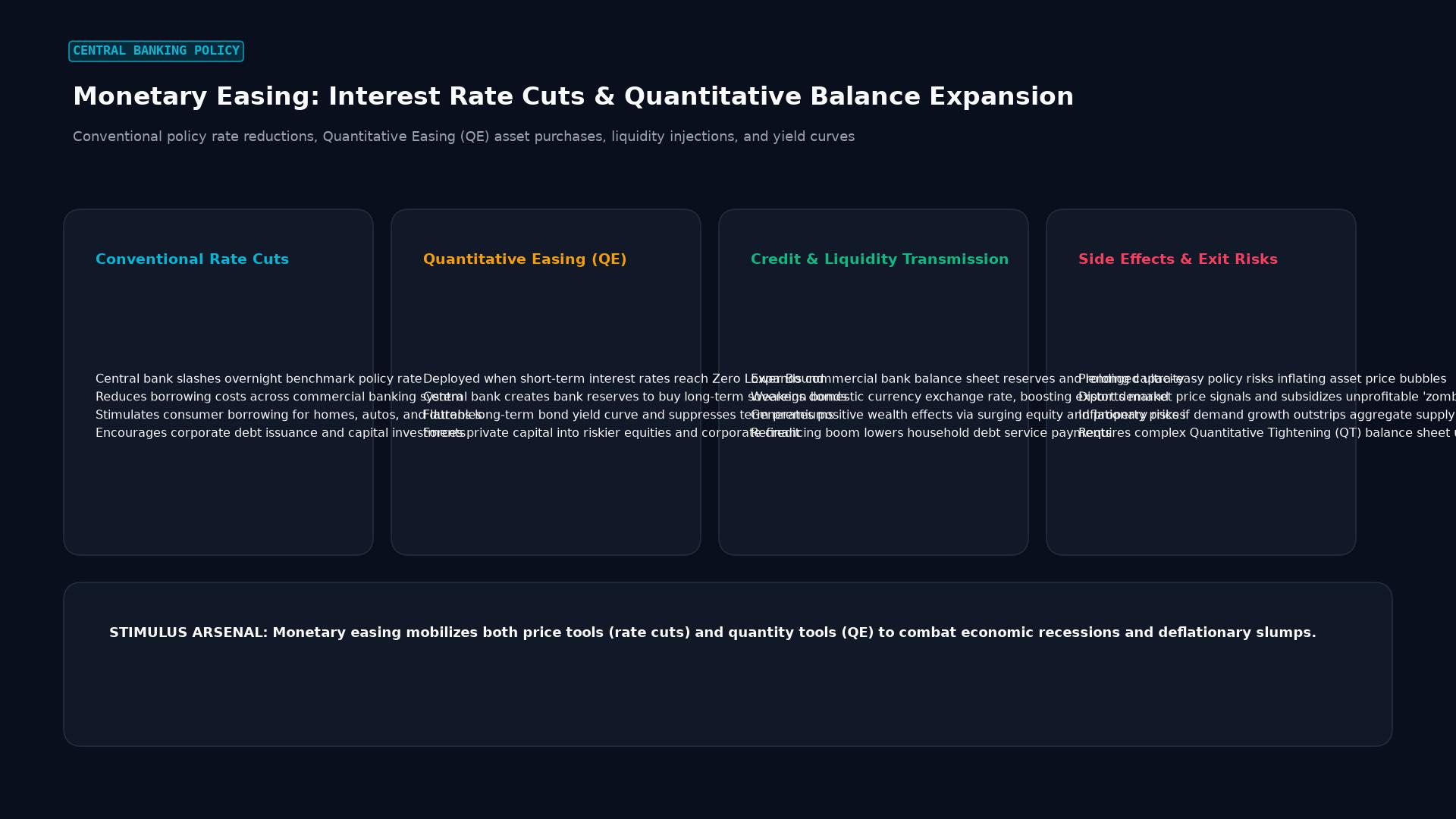 Figure: Conventional policy rate reductions, Quantitative Easing (QE) asset purchases, liquidity injections, and yield curves
Key Takeaways
- Dovish Policy Objective: Easing is implemented when an economy faces decelerating GDP growth, widening output gaps, rising unemployment, or disinflation/deflation threats.
- Negative Currency Pressure: Under standard macroeconomic conditions, monetary easing triggers currency depreciation as global investors shift capital out of low-yielding domestic sovereign debt toward higher-yielding foreign assets.
- Funding Currency Status: Prolonged ultra-loose easing (such as the Bank of Japan’s multi-decade zero-interest-rate policy) transforms the domestic currency into a premier funding currency for international carry trades.
- Inflationary Side Effects: While easing prevents liquidity freezes during systemic panics, excessive or sustained easing risks generating cost-push inflation and asset price bubbles.
Mechanics: Conventional vs. Unconventional Easing
| Dimension | Conventional Easing | Quantitative Easing (QE) |
|---|---|---|
| Primary Tool | Policy benchmark rate cuts (overnight lending rate) | Open-market electronic asset purchases (Sovereign & MBS bonds) |
| Operational Target | Short-term interbank money market rates | Long-term sovereign yields, term premiums, and yield curve slope |
| Balance Sheet Impact | Minor balance sheet fluctuation; changes price of reserves | Massive expansion and duration extension of central bank balance sheet |
| Economic Boundary | Limited when policy rate approaches the Zero Lower Bound (0%) | Effective even when short rates are at or below 0% |
| FX Market Reaction | Rapid repricing of forward swap points and front-end FX forwards | Sustained portfolio rebalancing capital outflows, driving multi-month trends |
The Yield Differential Mechanism in Foreign Exchange
Exchange rates in the global currency market are heavily driven by real interest rate differentials between paired economies:
$$\text{Real Yield} = \text{Nominal Sovereign Yield} - \text{Expected Inflation Rate}$$
When Central Bank A initiates an aggressive easing cycle while Central Bank B remains on hold:
- Bond Yield Compression: Nominal returns on sovereign fixed-income securities denominated in Currency A fall relative to Currency B.
- Institutional Capital Reallocation: Sovereign wealth funds, global asset managers, and corporate treasuries divest from Currency A debt instruments to buy higher-yielding Currency B bonds, exchanging Currency A for Currency B in the spot FX market.
- Downward Trend Formation: This steady institutional selling creates multi-month downtrends in currency pairs where Currency A is the base currency (e.g., EUR/USD falling when the ECB cuts rates faster than the Federal Reserve).
Historical Case Studies
1. The Federal Reserve’s Great Financial Crisis Intervention (2008–2014)
In response to the subprime mortgage collapse in late 2008, the Federal Reserve cut the target Federal Funds Rate to 0.00%–0.25% and launched three successive rounds of Quantitative Easing (QE1, QE2, and QE3). The Fed purchased trillions in U.S. Treasuries and agency mortgage-backed securities, expanding its balance sheet from under $900 billion in 2007 to over $4.5 trillion by 2014. The U.S. Dollar Index (DXY) experienced prolonged cyclical weakness as global capital sought yield in emerging markets and commodity-linked currencies.
2. Bank of Japan’s Qualitative and Quantitative Easing (QQE)
Under Governor Haruhiko Kuroda in 2013, the Bank of Japan launched aggressive QQE combined with Yield Curve Control (YCC) to escape deflation. By pinning the 10-year Japanese Government Bond (JGB) yield near 0.00% while major central banks eventually hiked rates in 2022–2023, the Japanese Yen depreciated dramatically from ~115 USD/JPY to over 160 USD/JPY, demonstrating the immense power of divergent monetary easing.
Frequently Asked Questions
What is the difference between easing and tapering?
Easing is the active loosening of monetary conditions via rate cuts or expanding asset purchases. Tapering is the gradual reduction in the monthly pace of new asset purchases under an ongoing Quantitative Easing program. Tapering is not monetary tightening (rates are not being raised and the balance sheet is still expanding), but it signals that the easing cycle is drawing to a close.
How does Quantitative Easing differ from “printing money”?
Technically, central banks do not print physical banknotes to conduct QE. Instead, they credit commercial banks with newly created electronic central bank reserves in exchange for high-grade bonds. These reserves sit on commercial bank balance sheets at the central bank and enter the broader economy only if commercial banks expand lending to businesses and households.
Can monetary easing cause a currency crisis?
Yes. If an emerging market central bank eases aggressively despite elevated domestic inflation or heavy foreign-currency-denominated debt, domestic and foreign investors will rapidly convert local currency holdings into foreign reserves (e.g., USD or EUR). This triggers a currency run, severe depreciation, imported hyperinflation, and a depletion of official foreign exchange reserves.
Ready to trade forex?
Open a free demo account with a regulated broker. Practice with virtual funds before risking real money.