Effective Exchange Rate
An effective exchange rate is a trade-weighted index that measures the international purchasing power and overall external valuation of a sovereign currency against a diversified basket of its primary trading partners' currencies.
What Is an Effective Exchange Rate?
In international macroeconomics and currency analysis, an effective exchange rate (EER) is a multilateral summary index that reflects the comprehensive external value of a country’s currency. While bilateral exchange rates (such as EUR/USD or GBP/JPY) track the relative price between only two sovereign currencies, an effective exchange rate calculates a trade-weighted average against an entire basket of foreign currencies representing a nation’s major export and import partners.
Central banks, international organizations like the Bank for International Settlements (BIS) and the International Monetary Fund (IMF), and sovereign finance ministries use effective exchange rates to determine whether a nation’s currency is genuinely appreciating or depreciating on a global scale, and to assess the competitive standing of domestic industries in global commerce.
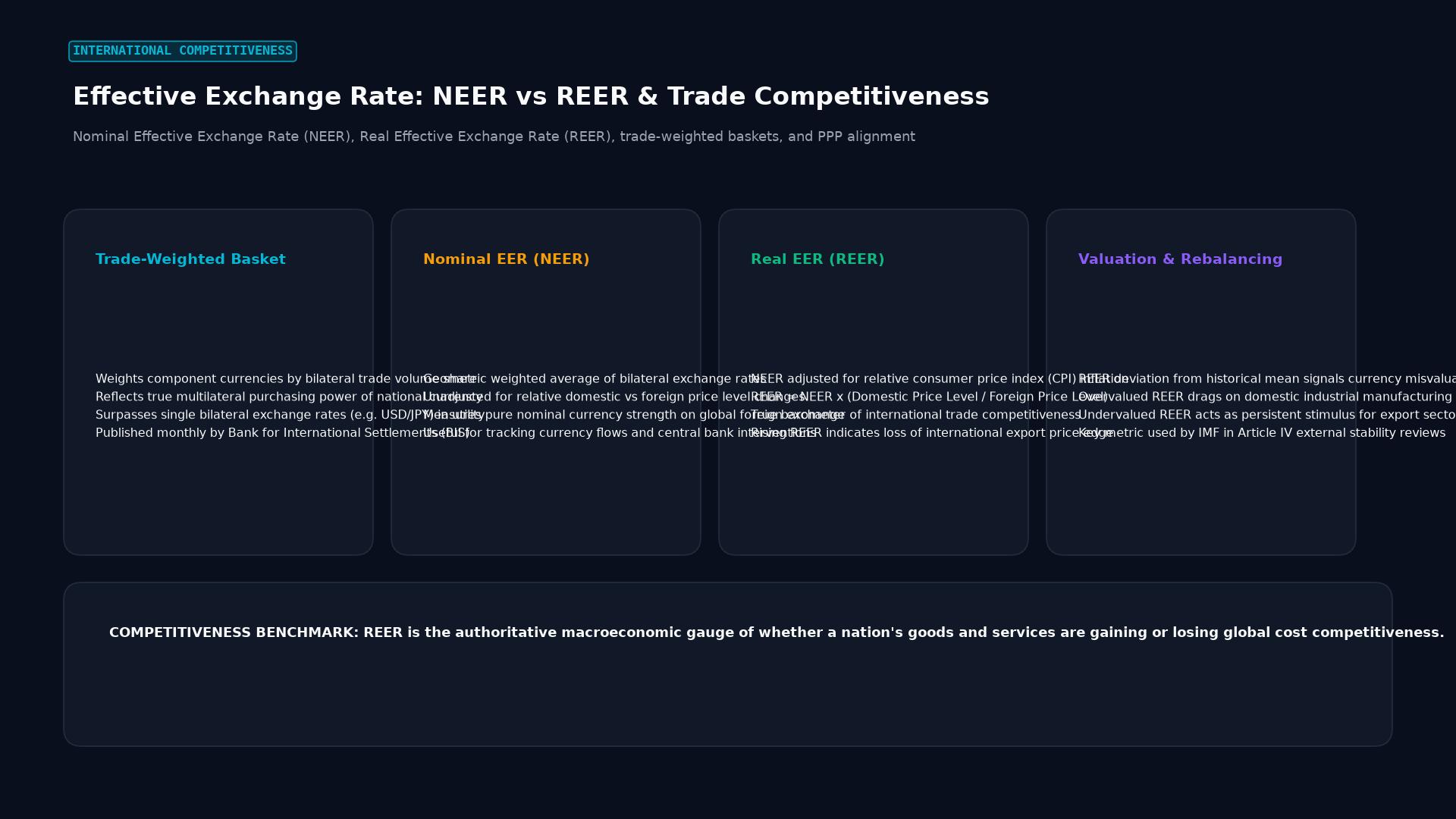 Figure: Nominal Effective Exchange Rate (NEER), Real Effective Exchange Rate (REER), trade-weighted baskets, and PPP alignment
Key Takeaways
- Multilateral Index: Unlike a standard currency pair quote, the EER is an index (typically set to a base year value of 100) reflecting a currency’s average price against an entire trading network.
- NEER vs. REER: The Nominal Effective Exchange Rate (NEER) measures unadjusted trade-weighted exchange rates, while the Real Effective Exchange Rate (REER) adjusts the NEER for relative inflation differentials (CPI or producer price indices) between countries.
- Competitiveness Benchmark: A rising REER indicates that a country’s manufactured goods and exports are becoming more expensive relative to foreign competitors, potentially dampening trade surplus momentum.
- Central Bank Anchor: Some central banks—most notably the Monetary Authority of Singapore (MAS)—conduct national monetary policy explicitly by managing an effective exchange rate band (the S$NEER) rather than setting domestic benchmark interest rates.
Mathematical Formulation: NEER and REER
The Bank for International Settlements and the IMF compute the Nominal Effective Exchange Rate (NEER) using a geometric weighted average of bilateral exchange rate indices:
$$\text{NEER} = \prod_{i=1}^{N} \left( \frac{S_i}{S_{i,0}} \right)^{w_i}$$
Where:
- $N$ is the number of partner countries in the trade basket.
- $S_i$ is the index of the bilateral exchange rate of the home currency against partner $i$.
- $S_{i,0}$ is the bilateral exchange rate during the base period.
- $w_i$ is the normalized trade weight assigned to partner country $i$ ($\sum w_i = 1$), calculated from bilateral export and import shares.
To calculate the Real Effective Exchange Rate (REER), the index is deflated by relative consumer price indices ($P$ and $P_i^*$):
$$\text{REER} = \text{NEER} \times \prod_{i=1}^{N} \left( \frac{P}{P_i^} \right)^{w_i} = \prod_{i=1}^{N} \left( \frac{S_i \cdot P}{S_{i,0} \cdot P_i^} \right)^{w_i}$$
Where:
- $P$ is the domestic price index (e.g., domestic CPI).
- $P_i^*$ is the foreign price index of partner $i$.
NEER vs. REER: The Inflation Divergence
| Metric | Nominal Effective Exchange Rate (NEER) | Real Effective Exchange Rate (REER) |
|---|---|---|
| Adjustment | None (pure nominal market exchange rates) | Adjusted for domestic vs. foreign consumer or producer price inflation |
| Unit | Index points relative to base year (e.g., 100) | Index points relative to base year (e.g., 100) |
| Analytical Use | Tracks pure foreign exchange market supply and demand trends | Measures true international trade competitiveness and purchasing power parity |
| High-Inflation Distortion | Can artificially surge if nominal rates rise, masking hyperinflation | Accurately reveals whether goods are becoming uncompetitive despite nominal currency moves |
| Policy Application | Short-term liquidity and currency intervention surveillance | Long-term macro equilibrium modeling (FEER, BEER, and PPP) |
Practical Application: The Monetary Authority of Singapore (MAS)
Because Singapore is a hyper-open, trade-dependent city-state whose gross imports and exports exceed 300% of national GDP, domestic monetary policy cannot rely effectively on traditional interest rate adjustments. Instead, the Monetary Authority of Singapore (MAS) uses the S$NEER as its primary monetary policy instrument:
- Policy Band: The MAS establishes an undisclosed policy band around the S$NEER index with three manageable parameters: the slope (rate of appreciation/depreciation), the midpoint, and the width.
- Fighting Imported Inflation: When global commodity and import prices surge, the MAS steepens the upward slope of the S$NEER band, orchestrating an appreciation of the Singapore Dollar against its trading partners to insulate domestic consumers from imported inflation.
- Market Intervention: If speculative flows push the Singapore Dollar outside the band limits, the MAS intervenes directly in the spot FX market, buying or selling foreign currency reserves.
Frequently Asked Questions
What does it mean if a country’s REER is significantly above 100?
If a nation’s REER index is substantially above 100 (relative to a historically balanced base period), it signifies that the sovereign currency is overvalued in real terms. Domestic wages and prices have risen faster than those of trading partners without a compensating nominal currency depreciation, making domestic exports uncompetitive and often causing the trade balance to deteriorate.
Why can a currency depreciate nominally while its REER appreciates?
This occurs during periods of severe domestic inflation. For example, if a country’s nominal exchange rate depreciates by 10% against its trading partners, but its domestic inflation rate is 30% while partner inflation is only 2%, the net real price of domestic goods has increased by roughly 18%. In this scenario, the NEER drops, but the REER rises, degrading trade competitiveness.
Where can traders find reliable daily and monthly EER data?
Authoritative, standardized Effective Exchange Rate indices are published monthly and daily by the Bank for International Settlements (BIS), the Federal Reserve Board (which publishes the Broad Trade-Weighted U.S. Dollar Index), the European Central Bank (ECB) (for the Euro harmonized EER), and the Bank of England.
Ready to trade forex?
Open a free demo account with a regulated broker. Practice with virtual funds before risking real money.