Equilibrium
Equilibrium is the theoretical state of economic and financial balance where the aggregate supply of a currency equals aggregate demand at a market-clearing exchange rate, or where exchange rates align with fundamental parity models like Purchasing Power Parity.
What Is Equilibrium?
In economics and financial markets, equilibrium is a state of balance in which opposing economic forces—principally supply and demand—are equalized, leaving no inherent market pressure for prices or exchange rates to change in the absence of new external shocks. In foreign exchange, equilibrium is analyzed across two distinct analytical dimensions:
- Microstructure Market Equilibrium (Short-Term): The continuous market-clearing spot price at which the volume of currency sellers matches the volume of currency buyers on interbank matching engines (such as EBS or Refinitiv Dealing). At this instantaneous clearing price, order flow is matched without excess bid or ask queues.
- Macroeconomic Fundamental Equilibrium (Long-Term): The theoretical exchange rate that harmonizes a nation’s internal economic balance (full employment and stable low inflation) with its external economic balance (a sustainable current account position over the medium-to-long term).
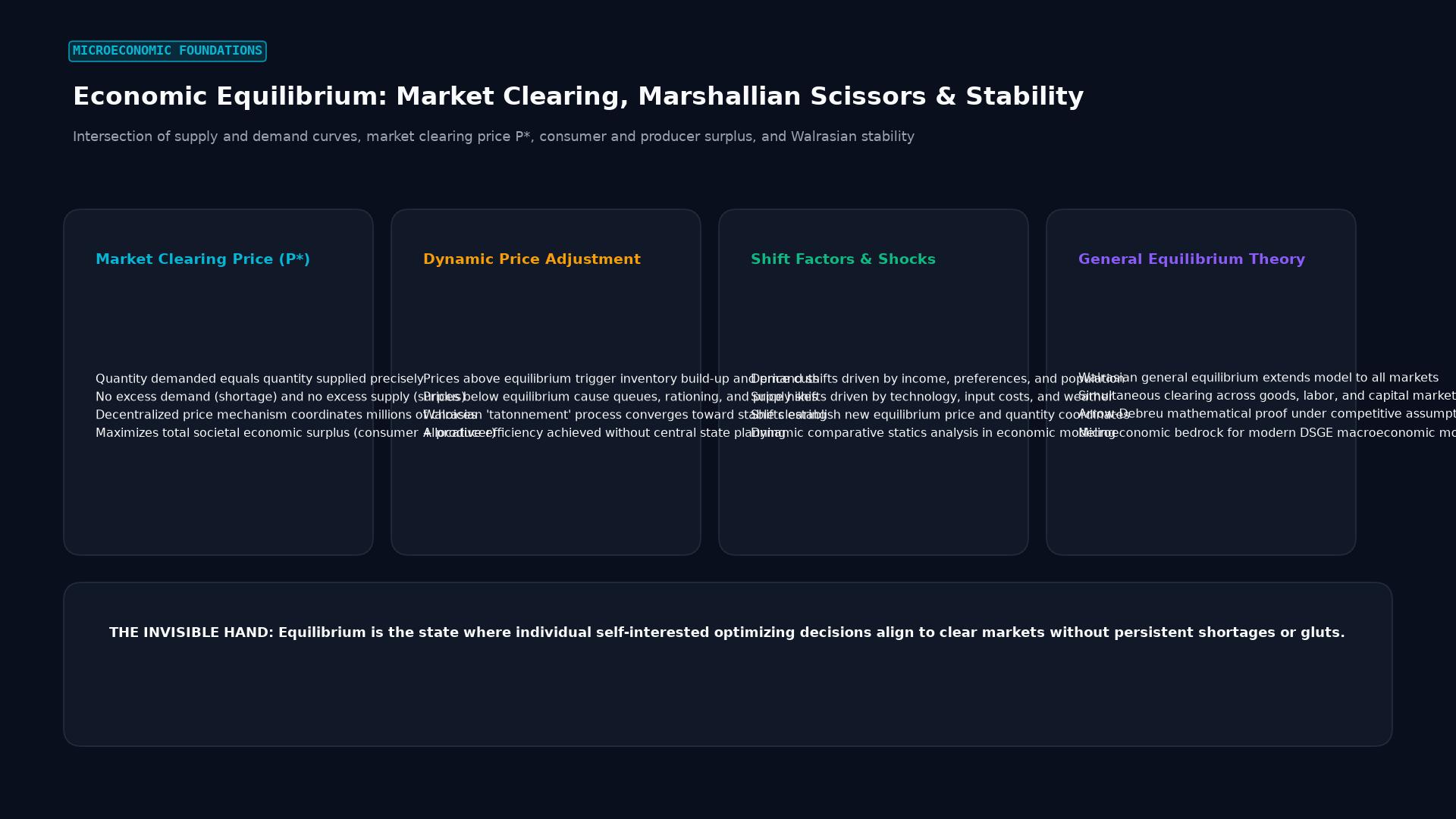 Figure: Intersection of supply and demand curves, market clearing price P, consumer and producer surplus, and Walrasian stability*
Key Takeaways
- Dynamic, Never Static: Financial market equilibrium is not a fixed resting place; it is a continuously moving target that recalculates with every new economic release, central bank statement, and geopolitical development.
- Short-Term vs. Long-Term Divergence: In the short run, currency exchange rates frequently diverge by 10% to 30% from their long-term fundamental equilibrium values due to capital flows, speculative positioning, and interest rate differentials.
- Overshooting Mechanism: According to the renowned Dornbusch Overshooting Model, exchange rates must temporarily overcompensate and overshoot their long-term equilibrium following monetary shocks because goods prices adjust sluggishly while asset markets adjust instantaneously.
- Arbitrage as the Restoring Force: Whenever market prices deviate substantially from equilibrium, financial arbitrageurs enter the market, buying undervalued assets and selling overvalued ones until equilibrium is restored.
Major Macroeconomic Equilibrium Models
Economists and central bank research departments rely on several formal models to calculate where a currency “should” trade in fair-value equilibrium:
1. Purchasing Power Parity (PPP)
The law of one price asserts that identical baskets of tradable goods and services should cost the same across two countries when converted into a common currency:
$$S_{\text{PPP}} = \frac{P_{\text{Domestic}}}{P_{\text{Foreign}}}$$
Where $P$ represents the national price levels. If EUR/USD trades at 1.0800 in the spot market while PPP fair value calculates at 1.2200, the Euro is considered fundamentally undervalued against the U.S. Dollar.
2. Fundamental Equilibrium Exchange Rate (FEER)
Pioneered by John Williamson at the Peterson Institute for International Economics (PIIE), FEER calculates the real effective exchange rate that simultaneously achieves internal balance (full employment and price stability) and external balance (a current account deficit or surplus that can be comfortably financed by sustainable capital inflows).
3. Behavioral Equilibrium Exchange Rate (BEER)
Unlike FEER, which relies on normative policy targets, BEER utilizes econometrics to link real exchange rates to observable economic fundamentals, such as terms of trade, net foreign asset positions, relative government debt, and productivity differentials (the Balassa-Samuelson effect).
The Dornbusch Overshooting Model
Formulated by MIT economist Rudiger Dornbusch in 1976, the Overshooting Model explains why floating exchange rates experience violent volatility far exceeding underlying macroeconomic shifts:
Dornbusch Monetary Shock Timeline:
1. Central Bank unexpectedly cuts policy interest rates (Monetary Easing).
2. Goods and wage prices in the physical economy are "sticky" (slow to adjust).
3. Bond yields and money markets adjust instantaneously.
4. Capital immediately flees the currency to find higher yield abroad.
5. SPOT RATE OVERSHOOTS: Currency plunges far below its long-term PPP equilibrium.
6. Over months/years, domestic goods prices gradually rise; the currency slowly
   appreciates back toward its new long-term equilibrium level.
Summary Comparison: Short-Term vs. Fundamental Equilibrium
| Dimension | Short-Term Market Equilibrium | Long-Term Macro Equilibrium |
|---|---|---|
| Determination Mechanism | Order book matching (bid-ask spread clearing) | Relative productivity, trade balance, inflation parity |
| Time Horizon | Milliseconds to Days | 3 to 10 Years |
| Key Influences | News surprises, central bank tone, algorithmic order flow | Purchasing power parity, terms of trade, demographic trends |
| Market Volatility | High; subject to whip-saws, flash crashes, and noise | Very low; slow structural drift |
| Primary Trading Utility | Day trading, scalping, immediate order execution | Long-term sovereign wealth investing, corporate CAPEX hedging |
Frequently Asked Questions
Can a currency remain away from fundamental equilibrium indefinitely?
Currencies can remain disconnected from fundamental equilibrium models like PPP for years—a phenomenon known in academic finance as the “PPP puzzle.” Structural deviations persist due to transportation costs, non-tradable goods and services (e.g., local rent and haircuts), tariffs and trade barriers, and multi-year institutional carry trades where capital stays parked in high-yielding currencies regardless of inflation rates.
What role do central banks play in market equilibrium?
Central banks often intervene when market exchange rates deviate so severely from macroeconomic equilibrium that they threaten the domestic economy. For instance, when the Japanese Yen plummeted to historic multi-decade lows against the U.S. Dollar in 2024, the Bank of Japan and Ministry of Finance conducted multi-billion-dollar spot interventions to halt speculative overshoot and nudge the exchange rate closer to economic fundamentals.
How do algorithmic market makers maintain micro-equilibrium?
Electronic market makers continuously post two-sided limit orders (bids and offers). When order flow becomes imbalanced (e.g., aggressive buyers absorb all available offers), market makers immediately raise their ask prices and widen spreads, restoring micro-equilibrium at a higher price tier to protect themselves from adverse selection.
Ready to trade forex?
Open a free demo account with a regulated broker. Practice with virtual funds before risking real money.