Efficient Market Theory
Efficient Market Theory (or the Efficient Market Hypothesis) asserts that financial asset prices fully and instantaneously incorporate all relevant information, making it impossible to consistently generate risk-adjusted excess returns (alpha) through technical or fundamental analysis.
What Is Efficient Market Theory?
Efficient Market Theory—widely known as the Efficient Market Hypothesis (EMH)—is a foundational concept in neoclassical financial economics developed by University of Chicago economist and Nobel laureate Eugene Fama in the late 1960s. The theory posits that in an active, liquid financial market with rational profit-seeking participants, asset prices always fully reflect all available information.
Under pure EMH, price movements behave as a random walk: because current prices already discount everything known today, future price shifts can only occur in response to genuinely unpredictable future news arrivals. Consequently, no market participant can systematically beat the market on a risk-adjusted basis through historical chart pattern recognition (technical analysis) or macroeconomic valuation models (fundamental analysis).
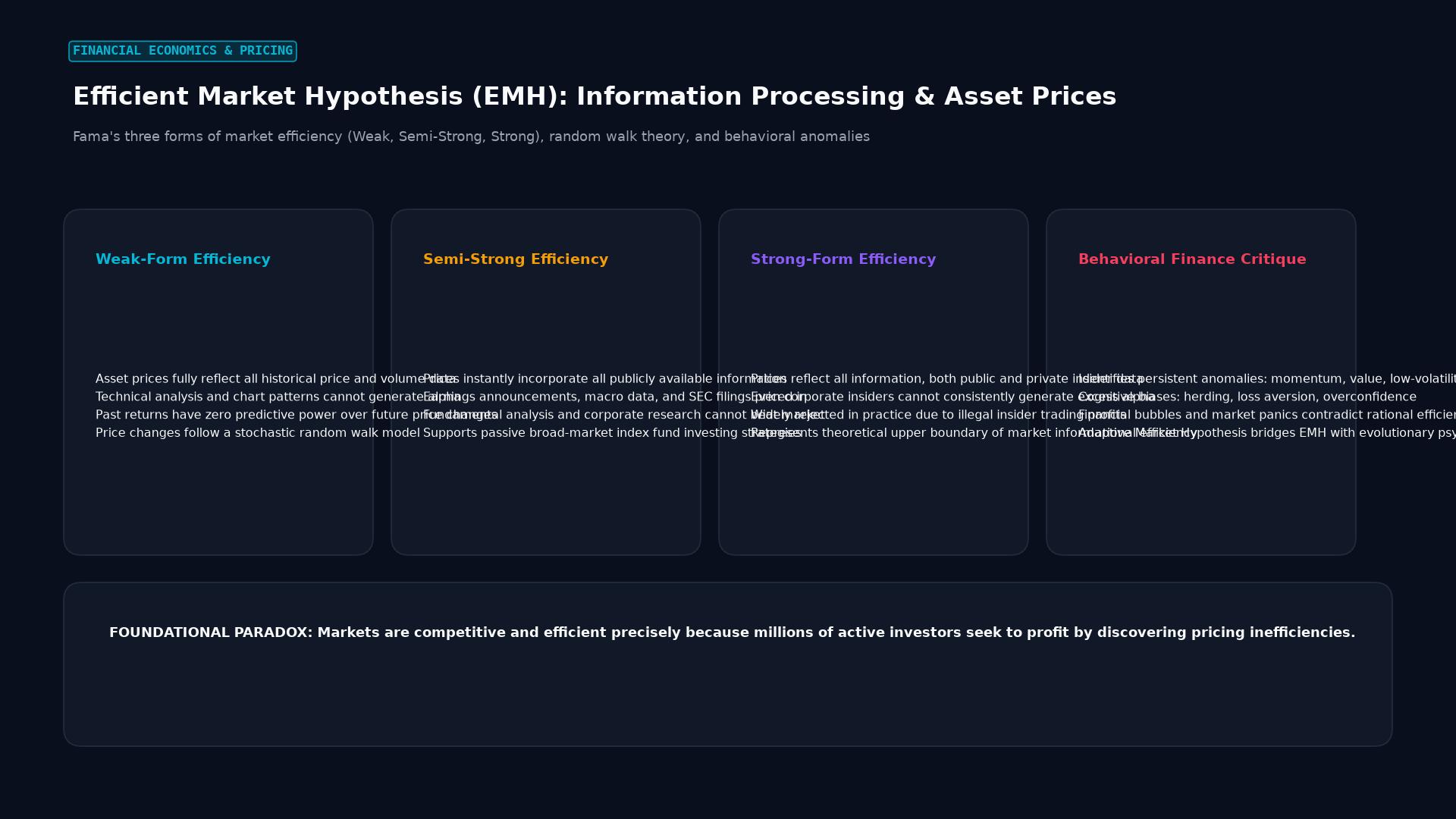 Figure: Fama’s three forms of market efficiency (Weak, Semi-Strong, Strong), random walk theory, and behavioral anomalies
Key Takeaways
- Three Information Tiers: EMH categorizes efficiency into Weak, Semi-Strong, and Strong forms based on the subset of information already priced in.
- The Alpha Impossibility: If markets are fully efficient, any trading strategy generating excess returns above benchmark risk is merely taking uncompensated tail risk or experiencing temporary statistical luck.
- Foreign Exchange Deviations: The global FX market exhibits notable structural deviations from pure EMH due to the presence of non-profit participants (central banks) and commercial corporate hedgers who do not trade to maximize speculative return.
- The Adaptive Alternative: Modern quant finance increasingly adopts the Adaptive Markets Hypothesis (AMH), viewing market efficiency not as a static binary state, but as a dynamic biological ecosystem where inefficiencies emerge and decay based on competition.
The Three Forms of Market Efficiency
1. Weak-Form Efficiency
Weak-form efficiency asserts that current exchange rates fully reflect all historical trading data, including historical price paths, volume, and open interest.
- Implication: Past price trends contain zero predictive information regarding future returns.
- Trading Impact: Classical technical analysis—such as Moving Average crossovers, Head and Shoulders patterns, or RSI oscillators—cannot generate systematic excess returns after deducting execution commissions and slippage.
2. Semi-Strong Form Efficiency
Semi-strong efficiency posits that asset prices adjust virtually instantaneously to all publicly available information, including macroeconomic data releases (e.g., GDP, CPI, NFP), central bank policy statements, and geopolitical developments.
- Implication: By the time a trader reads a headline on a financial news feed or terminal, algorithmic high-frequency trading (HFT) engines have already repriced the currency pair to its new fair value.
- Trading Impact: Discretionary fundamental analysis cannot generate abnormal alpha.
3. Strong-Form Efficiency
Strong-form efficiency claims that prices incorporate all information, both public and private (insider knowledge).
- Implication: Even central bank officials, corporate executives, or institutional dealing desk heads with non-public order flow intelligence cannot achieve abnormal risk-adjusted returns over time.
Comparative Breakdown: EMH Forms and Market Realities
| EMH Form | Information Reflected | Ineffective Strategy | Market Reality in Foreign Exchange |
|---|---|---|---|
| Weak Form | Historical prices, volumes, tick data | Technical analysis, chart geometry, indicator oscillators | Contested: Trend-following CTAs and quantitative momentum funds have generated persistent multi-decade alpha in currency futures. |
| Semi-Strong Form | All public data, balance sheets, news releases | Fundamental macro analysis, economic calendar trading | Generally Supported: Algorithmic news engines reprice spot rates within milliseconds; retail latency arbitrage is virtually impossible. |
| Strong Form | All public AND private/insider information | Private order flow intelligence, insider positioning | Rejected: Institutional market makers with visibility into massive sovereign wealth order books consistently extract spread profits. |
Why Foreign Exchange Deviates from Pure EMH
Unlike equity markets where participants share a common objective (maximizing financial return on capital), the $7.5+ trillion daily foreign exchange market contains massive institutional players operating with non-profit motivations:
- Central Bank Interventions: Central banks intervene in spot and forward FX markets to stabilize trade competitiveness, defend currency pegs, or control domestic inflation—often absorbing billions in accounting losses regardless of asset pricing efficiency.
- Corporate Commercial Hedging: Multinational corporations (such as Apple, Toyota, or Shell) exchange billions in foreign currencies to settle payroll, pay supplier invoices, and hedge balance sheet exposure. They execute currency transactions for liquidity, not speculative alpha.
- The Forward Premium Anomaly (Carry Trade): According to EMH and Uncovered Interest Rate Parity (UIP), high-yielding currencies should depreciate by the exact interest rate differential to eliminate excess returns. In reality, high-yielding currencies frequently appreciate or stay stable for years, allowing carry traders to harvest persistent excess risk premia.
Frequently Asked Questions
If EMH is true, why do hedge funds and algorithmic traders make profits?
Proponents of EMH argue that apparent profits are simply compensation for bearing hidden tail risk (e.g., liquidity risk or crash risk during black-swan events like the 2015 Swiss Franc unpegging). Furthermore, market efficiency is a moving target: the very process of quantitative hedge funds hunting and exploiting pricing discrepancies is what drives prices back toward efficiency.
What is the Adaptive Markets Hypothesis?
Formulated by MIT economist Andrew Lo, the Adaptive Markets Hypothesis (AMH) reconciles EMH with behavioral finance. It argues that market efficiency fluctuates based on market conditions, participant density, and competitive ecology. When market conditions shift rapidly, behavioral biases (such as fear and panic selling) create exploitable inefficiencies until new market participants arbitrage them away.
Does EMH apply equally to major and exotic currency pairs?
No. Highly liquid G10 currency pairs (such as EUR/USD and USD/JPY) exhibit near-instantaneous price discovery and operate close to semi-strong efficiency. In contrast, exotic currency pairs (such as USD/ZAR or USD/TRY) experience wider bid-ask spreads, fragmented liquidity, and heavy state controls, resulting in frequent structural pricing inefficiencies.
Ready to trade forex?
Open a free demo account with a regulated broker. Practice with virtual funds before risking real money.