EFT
An Electronic Funds Transfer (EFT) is the digital movement of money between institutional or retail bank accounts through interconnected interbank computer networks without manual paper-based check processing or physical cash.
What Is an Electronic Funds Transfer (EFT)?
An Electronic Funds Transfer (EFT) is an umbrella term encompassing any transfer of financial funds initiated through an electronic terminal, computer, mobile device, or magnetic tape that instructs a depository financial institution (such as a commercial bank, credit union, or central bank) to debit or credit an account. EFT replaces physical cash, paper checks, and manual ledger reconciliations with automated, cryptographic interbank accounting messages.
In foreign exchange trading and international brokerage operations, EFT forms the foundational infrastructure that allows retail traders, institutional asset managers, and corporate hedgers to fund trading accounts, withdraw capital, settle spot currency obligations, and manage liquidity across global financial hubs.
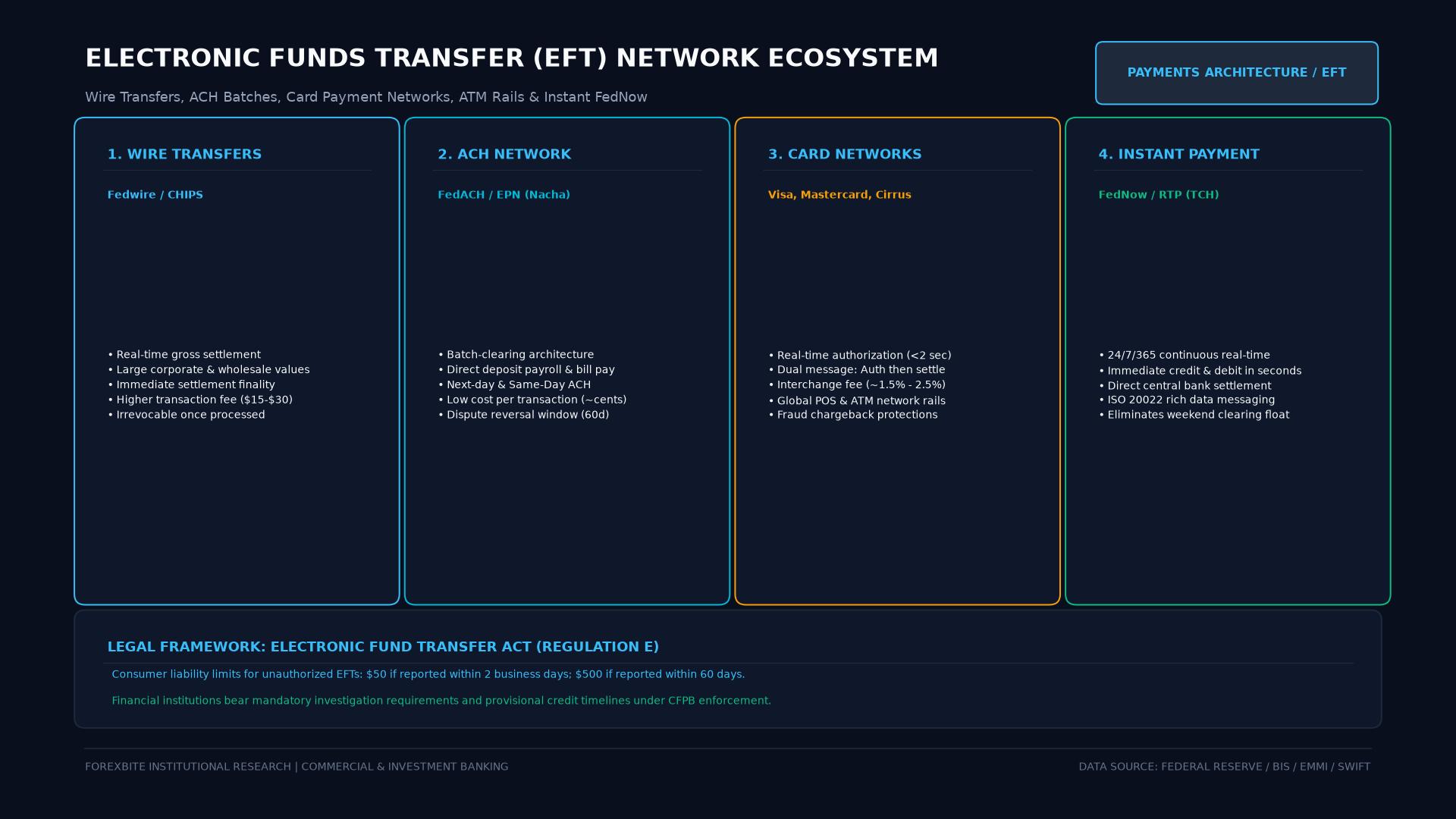 Figure: Omni-channel electronic payments ecosystem: wire transfers, ACH clearing, debit POS networks, and ATM switching network architectures.
Key Takeaways
- Broad Classification: EFT encompasses a wide spectrum of digital payment mechanisms, including Automated Clearing House (ACH) transfers, domestic and international wire transfers, point-of-sale (POS) debit card transactions, and real-time instant payment rails.
- Forex Broker Funding Rail: Retail and institutional FX brokers rely on EFT channels to deposit margins and disburse profits to and from segregated client trust accounts.
- Strict Anti-Money Laundering (AML) Rules: To prevent international money laundering and terrorist financing, regulatory bodies strictly prohibit third-party EFTs—the name on the originating bank account must identically match the registered name on the trading account.
- ISO 20022 Modernization: Global EFT rails are rapidly transitioning to the rich-data ISO 20022 XML messaging standard, improving cross-border tracking and drastically reducing trade settlement breaks.
Primary Types of Electronic Funds Transfers
1. Automated Clearing House (ACH) & Direct Debit
ACH is a batch-oriented electronic funds transfer system widely used for domestic transactions in the United States. Batches of payments are accumulated throughout the business day and settled at scheduled intervals.
- Settlement Timeframe: Typically 1 to 3 business days (or Same-Day ACH for urgent payments).
- Cost: Inexpensive (often free for consumers, pennies per transaction for corporations).
- Reversibility: Transactions can be recalled or disputed within 60 days under specific unauthorized transaction conditions.
2. Real-Time Gross Settlement (RTGS) Wire Transfers
Wires—such as those processed over Fedwire and CHIPS in the United States, TARGET2 in the Eurozone, or CHAPS in the United Kingdom—settle high-value transactions individually and immediately on the books of the central bank.
- Settlement Timeframe: Near real-time (minutes to a few hours).
- Cost: Higher flat fees ($15 to $50 per transfer).
- Finality: Irrevocable and final upon execution, making it the preferred method for institutional FX prime brokers and large commercial transactions.
3. Modern Instant Payment Rails
Next-generation retail payment networks—such as the Eurozone’s SEPA Instant Credit Transfer, the U.S. Federal Reserve’s FedNow, and India’s Unified Payments Interface (UPI)—process transactions 24/7/365 with immediate funds availability in less than 10 seconds.
Comparison of Common Broker EFT Payment Rails
| Rail System | Typical Settlement Speed | Reversibility Risk | Relative Transaction Fee | Common Forex Usage |
|---|---|---|---|---|
| Domestic ACH | 1 to 3 Business Days | Moderate (60-day dispute window) | Very Low ($0.20 – $1.00) | Retail account deposits and scheduled regular withdrawals |
| RTGS Bank Wire | 30 to 120 Minutes | None (Irrevocable and final) | High ($20 – $50) | Large deposits (>$10,000), institutional prime broker margin |
| Instant Rails (SEPA / FedNow) | Under 10 Seconds | Very Low | Low ($0.10 – $1.50) | Instant trading capital top-ups during high-volatility sessions |
| Debit Card (EFT-POS) | Instant credit (clearing T+1) | Moderate (Chargeback risk) | Moderate (1.5% – 3.0% merchant fee) | Convenience retail account onboarding and initial deposits |
Regulatory Compliance & Anti-Money Laundering (AML) in FX EFTs
Because foreign exchange transactions facilitate rapid cross-border movement of liquid capital, brokerages and payment processors are subject to intense scrutiny under the Financial Action Task Force (FATF) guidelines, FinCEN regulations in the U.S., and the EU Anti-Money Laundering Directives (AMLD):
- Third-Party Payment Ban: Brokers categorically reject EFT transfers coming from bank accounts, credit cards, or e-wallets that do not match the trader’s verified legal identity. Attempting a third-party transfer results in transaction rejection and account freezing.
- The “Return to Source” Withdrawal Rule: Brokers enforce a rule requiring that withdrawal funds be returned via the identical EFT method and to the same originating financial institution from which the initial deposit arrived, up to the deposited amount.
- The Travel Rule: For wire transfers above statutory thresholds (e.g., $3,000 in the U.S. or €1,000 in the EU), originating financial institutions are legally mandated to transmit the originator’s full legal name, account number, physical address, and national identity data alongside the transaction message.
Frequently Asked Questions
What happens if an EFT deposit fails or bounces due to insufficient funds?
If an ACH or EFT deposit fails after a broker has granted provisional trading credit, the broker will immediately reverse the credit. If the trader opened positions with that margin and suffered trading losses, the account will enter negative balance or margin call, and the broker may liquidate open trades and initiate debt collection.
Is an EFT the same as a SWIFT transfer?
SWIFT itself is not a fund-transfer settlement rail; rather, it is a secure financial messaging network over which international EFT instructions (such as MT103 customer transfers) are transmitted between correspondent banks across borders.
How are client EFT deposits protected if a forex broker becomes insolvent?
Under regulatory frameworks established by top-tier authorities (such as the UK FCA, Australian ASIC, or U.S. CFTC/NFA), client deposits arriving via EFT must be immediately deposited into segregated client trust accounts maintained at reputable Tier-1 banks, legally isolated from the broker’s operational funds.
Ready to trade forex?
Open a free demo account with a regulated broker. Practice with virtual funds before risking real money.