Escrow Account
An escrow account is a legally segregated trust account held by an independent third party to safeguard funds, assets, or documents on behalf of transacting parties until contractual conditions are verified and executed.
What Is an Escrow Account?
An escrow account is a fiduciary financial arrangement in which a neutral, independent third party (the escrow agent, custodian bank, or legal trust) holds financial assets, securities, or funds on behalf of two transacting parties who are in the process of completing a commercial deal. The assets remain locked in the escrow account until specified contractual milestones, documentation verifications, or legal conditions precedent are satisfied.
In the retail and institutional foreign exchange industry, the principles of escrow are fundamental to client fund segregation and cross-border settlement. Rather than allowing a brokerage firm or OTC counterparty to commingle customer trading margins with its own daily operating capital, regulatory frameworks mandate the ring-fencing of client capital into dedicated, bankruptcy-remote trust and escrow facilities at regulated Tier-1 commercial banks.
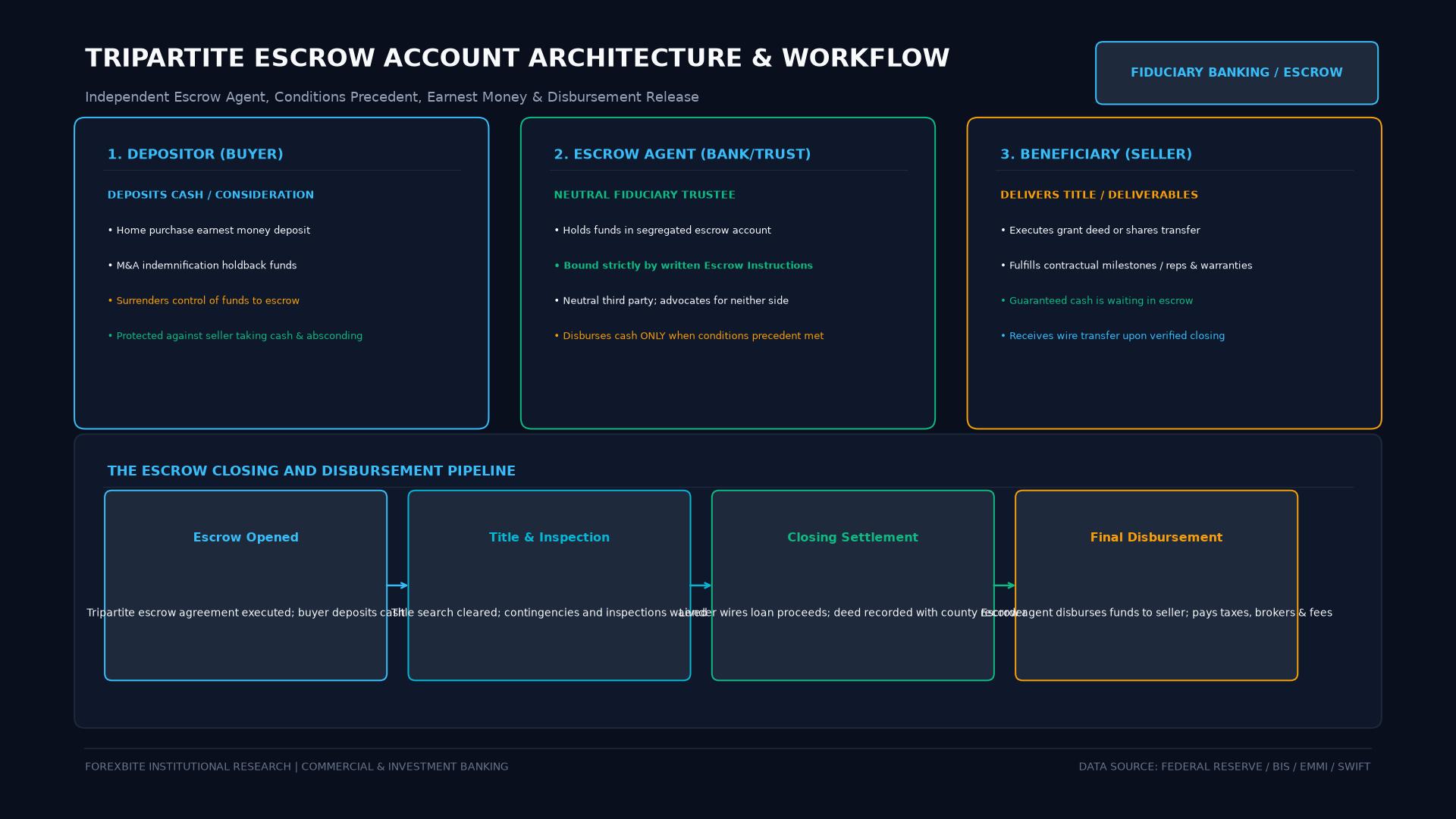 Figure: Tri-party escrow legal structure: independent escrow agent, fiduciary deposit safekeeping, verified milestone conditions, and conditional release.
Key Takeaways
- Risk Mitigation: Escrow arrangements eliminate counterparty delivery risk by ensuring that neither party can abscond with funds or fail to deliver agreed assets without financial recourse.
- Forex Client Fund Segregation: Tier-1 regulatory regimes (such as the UK FCA, Australian ASIC, and U.S. CFTC) legally require brokers to deposit customer margins into segregated client bank accounts that operate under escrow-like fiduciary trust status.
- Bankruptcy-Remote Protection: If a brokerage firm or corporate trading partner files for insolvency, assets held within a properly structured escrow or statutory trust account cannot be seized by the bankrupt entity’s general creditors.
- Cross-Border Trade Settlement: Escrow mechanisms are central to international trade finance, backing documentary collection, letters of credit (LCs), and cross-border corporate mergers.
Primary Applications in Foreign Exchange and Finance
1. Brokerage Segregated Client Trust Accounts
When a trader transfers capital to a regulated retail forex broker, the capital must be placed in a segregated trust account rather than the broker’s corporate operational account.
- Under the UK Financial Conduct Authority’s Client Assets Sourcebook (CASS) rules, client funds are held under statutory trust. The broker cannot use client deposits to cover corporate overhead, pay employee salaries, or fund proprietary hedging operations.
- If the brokerage enters administration, an independent insolvency practitioner distributes the escrowed trust funds directly back to depositors.
2. Cross-Border International Trade Finance
In international import/export transactions, sellers fear shipping goods abroad without guaranteed payment, while buyers fear wiring money overseas before inspecting cargo.
- An escrow agent (typically an international correspondent bank) holds the buyer’s foreign currency deposit.
- Upon presentation of verified shipping documents (Bills of Lading, customs declarations, and third-party quality inspection certificates), the escrow agent releases payment to the exporter.
3. Mergers & Acquisitions (M&A) Holdbacks
In large corporate acquisitions, the acquiring firm commonly places 10% to 20% of the purchase price into an escrow account for 12 to 24 months. These funds serve as indemnity collateral to cover undisclosed balance sheet liabilities, tax disputes, or breached warranties discovered after closing.
Comparative Matrix: Account Types in Banking & Trading
| Dimension | Escrow Trust Account | Standard Bank Account | Broker Margin Account |
|---|---|---|---|
| Legal Ownership | Held in trust by a fiduciary third party | Directly owned by account holder | Commingled or segregated per local broker license |
| Release Mechanism | Pre-specified contractual conditions / dual sign-off | Immediate withdrawal by account holder | Automated margin checks / withdrawal requests |
| Insolvency Treatment | Ring-fenced: Fully protected from bank/broker creditors | Insured up to statutory limits (e.g., FDIC $250k) | Unprotected if broker is unregulated/offshore |
| Primary Risk Addressed | Counterparty non-performance and settlement default | Bank credit risk (above insurance limits) | Leverage, slippage, and broker insolvency |
Regulatory Standards: How Jurisdictions Regulate Client Money
Regulatory oversight determines the true safety of client escrow and trust accounts:
- United Kingdom (FCA - CASS 7): Requires daily client money reconciliations, explicit bank acknowledgment letters confirming funds are held in trust, and coverage under the Financial Services Compensation Scheme (FSCS) up to £85,000 per eligible claimant.
- United States (CFTC & NFA): Retail Foreign Exchange Dealers (RFEDs) and Futures Commission Merchants (FCMs) must adhere to Section 4d of the Commodity Exchange Act, maintaining strict segregation of customer funds with daily electronic reporting to the NFA.
- Offshore Jurisdictions (e.g., Saint Vincent, Vanuatu, Seychelles): Often lack statutory client segregation laws. Brokers in these territories frequently commingle client deposits with operational funds, leaving depositors completely exposed in the event of firm insolvency.
Frequently Asked Questions
What is the difference between an escrow account and a custodian?
While both serve fiduciary holding functions, a custodian is responsible for the safekeeping and administration of investment assets (such as stocks, bonds, and mutual fund shares) over long horizons. An escrow account is a temporary, condition-based holding facility created to facilitate a specific transaction or manage predefined contingency risks.
How can a trader verify if their broker uses segregated escrow accounts?
Traders can verify client fund protection by checking the broker’s regulatory disclosures and legal terms of business. Reputable brokers explicitly state which Tier-1 commercial banks hold their client funds (e.g., Barclays, HSBC, J.P. Morgan) and provide documentation confirming adherence to statutory trust laws.
Are escrow fees paid by the buyer or the seller?
In commercial transactions and M&A deals, escrow administration fees (charged by the bank or trust company) are typically split 50/50 between buyer and seller, though this is negotiable in the underlying commercial contract. In retail forex trading, the broker absorbs client trust account banking costs.
Ready to trade forex?
Open a free demo account with a regulated broker. Practice with virtual funds before risking real money.