End of the Day (Mark to Market)
End of the Day Mark to Market (MTM) is a daily accounting and risk-management procedure wherein all open currency and financial positions are revalued against the official closing settlement rates, calculating daily unrealized gains or losses and settling variation margin.
What Is End of the Day Mark to Market (MTM)?
End of the Day Mark to Market (MTM)—often referred to as daily fair value revaluation or daily cash settlement—is an essential accounting and risk management process used across global financial institutions, clearing houses, and retail brokerages. At the designated close of each trading business day (typically 5:00 PM Eastern Standard Time in foreign exchange, or the official settlement fix on futures exchanges), all open, unclosed trading positions are marked to current market prices rather than retained at their historical entry rates.
By adjusting the book value of open positions to current fair market valuations, the daily MTM mechanism quantifies exact paper profits or losses accumulated over that 24-hour cycle. In institutional derivatives and futures clearing, this process triggers a daily transfer of cash known as variation margin, ensuring that counterparty credit exposures are extinguished daily before the next trading session commences.
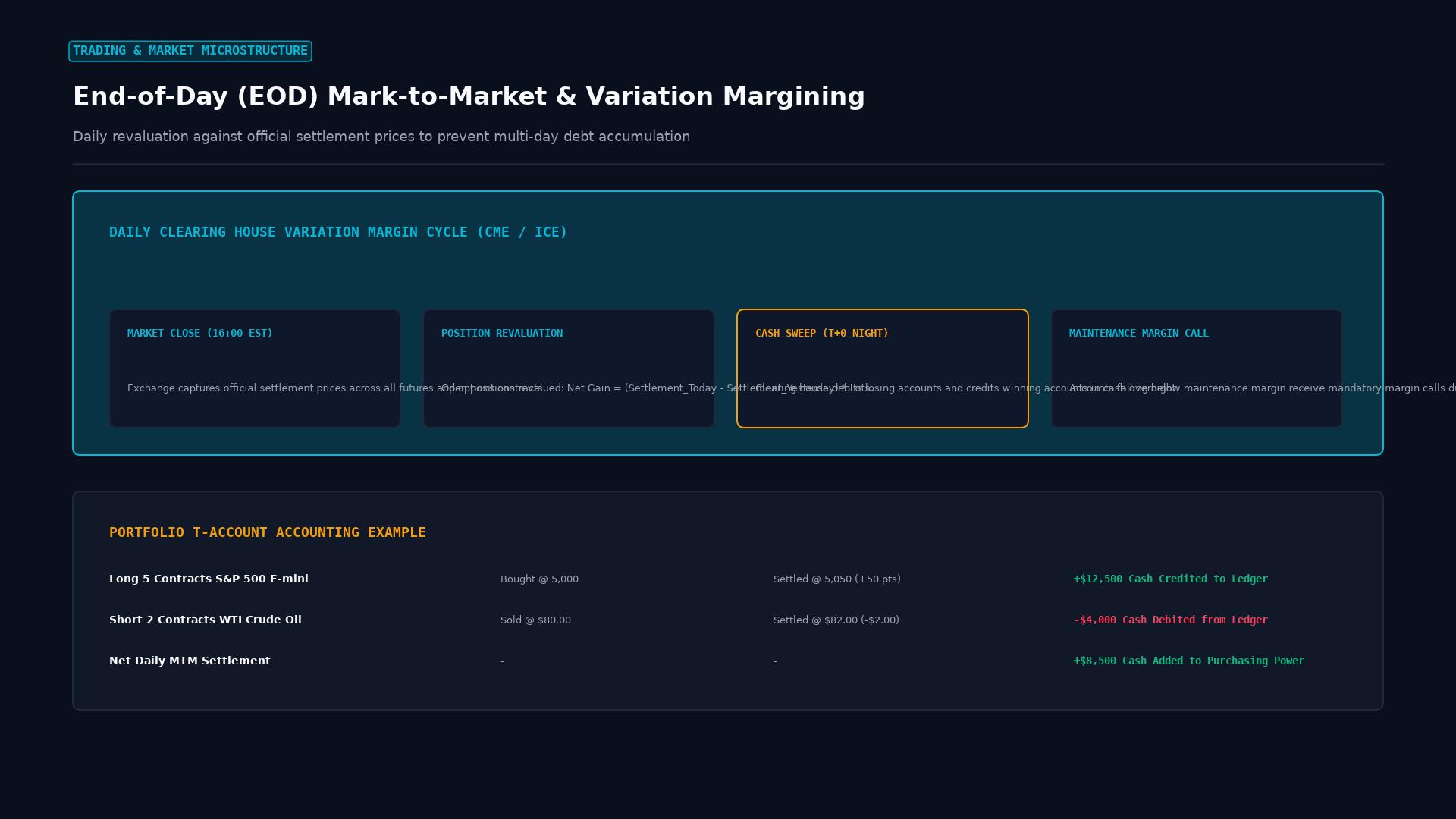 Figure: Daily clearing revaluation cycle: revaluing open derivatives against official closing settlement prices, cash-settling daily gains/losses, and issuing maintenance margin calls.
Key Takeaways
- Eliminates Cumulative Counterparty Risk: Daily MTM prevents losses from compounding over weeks or months, ensuring that losing counterparties settle their financial debt every 24 hours.
- Variation Margin Transfer: In exchange-traded currency futures (such as CME FX futures) and cleared OTC forwards, daily MTM results in actual physical cash debits and credits between clearing members.
- Distinction Between Balance and Equity: In retail forex trading platforms (e.g., MetaTrader), daily MTM reflects continuously in Account Equity ($\text{Balance} + \text{Floating MTM P&L}$), determining free margin and margin call thresholds.
- ISDA Master Agreement CSA: Institutional OTC bilateral currency transactions utilize an ISDA Credit Support Annex (CSA) where daily MTM revaluations dictate collateral pledged between prime brokers.
The Mathematical Mechanics of Daily MTM
For an open currency position, the daily mark-to-market profit or loss is calculated relative to either the initial trade entry price (on Day 1) or the previous day’s official settlement fix (on Day $t$):
$$\text{Daily MTM P&L}t = Q \times \left( S_t - S{t-1} \right)$$
Where:
- $Q$ is the open position size (positive for long positions, negative for short positions).
- $S_t$ is the official closing settlement rate on Day $t$.
- $S_{t-1}$ is the settlement rate established at the close of Day $t-1$ (or entry price if opened today).
Step-by-Step Futures Example
Assume a trader holds 2 long EUR/USD futures contracts on the Chicago Mercantile Exchange (CME), where each contract controls €125,000 (total position: €250,000):
- Day 1 Entry: Bought at 1.0820. Closing settlement fix prints at 1.0850. $$\text{Day 1 MTM} = 250,000 \times (1.0850 - 1.0820) = +$750$$ The trader’s clearing account is immediately credited with $750 in cash that evening.
- Day 2 Close: EUR/USD drops; settlement fix prints at 1.0790. $$\text{Day 2 MTM} = 250,000 \times (1.0790 - 1.0850) = -$1,500$$ The clearing house debits $1,500 in cash from the trader’s account that evening. If account equity drops below the Maintenance Margin, a margin call is issued.
OTC Foreign Exchange vs. Cleared Futures Comparison
| Dimension | Exchange-Traded FX Futures (CME) | Bilateral Over-the-Counter (OTC) FX | Retail Spot Forex |
|---|---|---|---|
| Clearing Body | Central Counterparty Clearinghouse (CCP) | Bilateral bank counterparty | Retail Broker / Market Maker |
| Cash Settlement | Daily cash sweep (Variation margin) | Daily collateral transfer under ISDA CSA | Floating equity update + financing swap adjustment |
| Settlement Benchmark | Official 3:00 PM EST exchange fix | WMR / Refinitiv 4:00 PM London fix or 5:00 PM NY | Broker proprietary aggregator price at 5:00 PM EST |
| Credit Risk Exposure | Virtually zero (backed by CCP default fund) | Bilateral counterparty credit risk | Broker insolvency / segregation risk |
The Systemic Importance of Mark-to-Market
Before the widespread adoption of mandatory daily mark-to-market accounting, financial institutions maintained long-term forward and swap positions at historical book value until final maturity. During market crises, institutions concealed billions in unrealized paper losses until bankruptcy struck without warning.
Daily MTM enforces radical financial transparency:
- Early Distress Warning: If a bank or fund experiences consecutive days of large MTM losses, risk managers observe margin depletion instantly.
- Defensive De-risking: It forces trading desks to trim losing trades before positions jeopardize the solvency of the institution.
- Contagion Prevention: By settling variation margin every evening, the failure of one firm does not trigger a domino-effect default across the interbank system.
Frequently Asked Questions
What is the difference between Mark to Market and Realized P&L?
Mark to Market (MTM) P&L is the theoretical, unrealized valuation of an open position based on current market closing prices; it fluctuates continuously until the position is closed. Realized P&L represents the permanent, locked-in financial profit or loss crystallized the moment an open position is officially executed and closed.
Does daily MTM close my open forex trade?
No. In spot forex and rolling forward contracts, daily MTM does not close or terminate your open trade. The position remains active, but your account balance and equity are recalculated, and overnight financing charges (swap rates/rollover interest) are debited or credited.
What is a “Margin Call” triggered by MTM?
A margin call occurs when cumulative negative MTM revaluations reduce your account equity below the broker’s or exchange’s mandated Maintenance Margin requirement. The trader must either immediately deposit additional funds or the broker will automatically liquidate open positions to prevent negative balance exposure.
Ready to trade forex?
Open a free demo account with a regulated broker. Practice with virtual funds before risking real money.