Eurocurrency
A Eurocurrency is any sovereign currency held on deposit in a commercial banking institution situated outside the regulatory borders and jurisdiction of the home nation that issued the currency.
What Is Eurocurrency?
A Eurocurrency is any national currency deposited in a commercial bank located outside the borders of the country of origin. Despite the presence of the word “Euro” in the prefix, the term has no direct relationship with the Euro currency or the European continent. Instead, “Euro-” is a financial legacy prefix denoting offshore status.
The most prominent example is the Eurodollar—a U.S. Dollar deposited in a bank outside the United States (whether in London, Frankfurt, Tokyo, Singapore, or the Cayman Islands). Similarly, Japanese Yen held in a London commercial bank is classified as Euroyen, and British Pounds held on deposit in Zurich are termed Eurosterling.
The Eurocurrency market constitutes a multi-trillion-dollar offshore wholesale banking network that powers global corporate trade finance, international syndications, and cross-currency liquidity in foreign exchange.
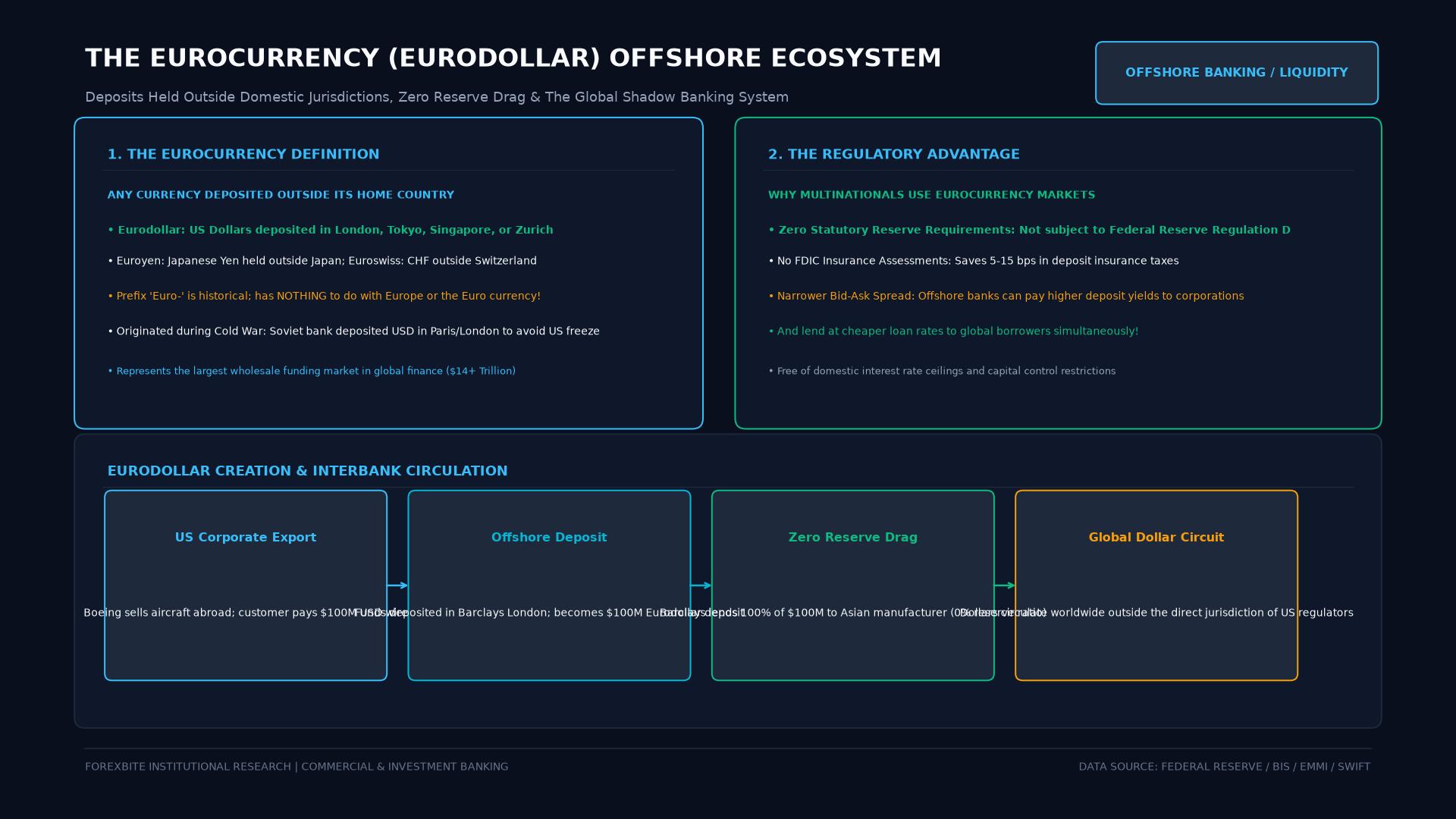 Figure: Offshore deposit intermediation: domestic currency held in foreign banking jurisdictions outside the originating country’s statutory reserve requirements.
Key Takeaways
- Offshore Definition: Eurocurrency is created whenever a currency is deposited in any financial institution outside its home country’s legal regulatory purview.
- Eurodollars Dominate: U.S. Dollar-denominated deposits (Eurodollars) account for over 70% of the entire global Eurocurrency wholesale market.
- Freedom from Domestic Reserve Ratios: Because offshore banks are not subject to domestic central bank reserve requirements (such as Federal Reserve statutory ratios), they operate with lower administrative overhead and can offer narrower lending spreads.
- The Shadow Dollar Engine: The Eurocurrency market operates as the “offshore dollar engine,” creating international credit and driving global trade flows independently of domestic policy mandates.
The Cold War Origins of the Eurocurrency Market
The Eurocurrency market emerged in the 1950s during the height of the Cold War due to geopolitical tensions and U.S. financial regulations:
- Soviet Fear of Asset Seizure: The Soviet Union held large U.S. Dollar balances earned from oil and gold exports. Fearing that the U.S. government would freeze Soviet assets deposited inside American banks in New York, the Soviets transferred their dollars to the Banque Commerciale pour l’Europe du Nord (whose telegraphic telex code was EUROBANK) in Paris and the Moscow Narodny Bank in London.
- Regulation Q Arbitrage: During the 1960s, the Federal Reserve’s Regulation Q imposed a statutory legal ceiling on the interest rates U.S. domestic banks could pay on deposits. British and European banks, unbound by Regulation Q, offered higher deposit yields to international savers, drawing hundreds of billions in U.S. Dollars into London.
Domestic Banking vs. Offshore Eurocurrency Banking
| Feature | Domestic Currency Deposits | Offshore Eurocurrency Deposits |
|---|---|---|
| Location of Bank | Inside issuing country (e.g., Chase Bank, NY) | Outside issuing country (e.g., Barclays, London) |
| Central Bank Oversight | Home central bank (e.g., Federal Reserve) | Host jurisdiction regulator (e.g., UK PRA / FCA) |
| Statutory Reserve Ratios | Mandated by home central bank | Exempt from home reserve requirements |
| Deposit Insurance | Covered by domestic insurance (e.g., FDIC) | Generally uninsured by domestic government |
| Transaction Scale | Retail, commercial, and wholesale | Almost exclusively wholesale interbank ($1M+ blocks) |
| Interest Rate Spreads | Wider spreads to cover regulatory taxes | Tighter bid-ask lending spreads |
Major Eurocurrency Categories
- Eurodollar (USD): The backbone of international finance; used for global commodity trade (petrodollars), international syndicated credit, and FX swap financing.
- Euroyen (JPY): Japanese Yen held outside Japan, traditionally utilized by multinational corporations to fund low-interest carry trades.
- Euroeuro (EUR): Euro balances deposited in financial centers outside the Eurozone (e.g., London, Hong Kong, or New York).
- Eurosterling (GBP): British Pounds deposited in continental European or Asian commercial banks.
Role in Foreign Exchange and Swap Markets
The Eurocurrency deposit market is directly linked to foreign exchange through the Foreign Exchange Swap and Cross-Currency Basis Swap markets:
- Covered Interest Arbitrage: Banks continuously calculate the cost of borrowing a currency offshore (Eurocurrency rate) versus borrowing domestic currency and swapping it synthetically through spot and forward FX contracts.
- Offshore Liquidity Squeezes: During financial crises (such as March 2020), foreign banks often face severe shortages of offshore Eurodollars. This causes cross-currency basis spreads to blow out, requiring the Federal Reserve to open emergency Central Bank Liquidity Swap Lines to supply USD directly to foreign central banks.
Frequently Asked Questions
Is Eurocurrency illegal or unmonitored?
No. Eurocurrency banking is completely legal, highly institutional, and recognized by the Bank for International Settlements (BIS) and the International Monetary Fund (IMF). Participating banks are fully regulated by the banking authorities of the host country where they operate (e.g., the Prudential Regulation Authority in the UK).
Does depositing currency offshore increase the global money supply?
Yes. Through offshore interbank lending and fractional-reserve credit creation, Eurocurrency banks can create multiple credit claims backed by the same initial base deposit, effectively expanding global dollar liquidity outside the direct control of the Federal Reserve.
Can an individual retail trader open a Eurocurrency account?
While retail individuals can open foreign currency bank accounts abroad (e.g., a U.S. resident opening a USD account in London or Switzerland), the term “Eurocurrency market” primarily refers to the multi-million-dollar wholesale interbank money market where major dealer banks lend and borrow on short-term deposits.
Ready to trade forex?
Open a free demo account with a regulated broker. Practice with virtual funds before risking real money.